Quiz · Hard
Identify valid categorical syllogisms, apply the square of opposition and name the informal fallacy in short arguments.
'A feather is light. What is light cannot be dark. So a feather cannot be dark.' This is...
Composition
Equivocation
Division
Begging the question
'Light' is used for both weight and brightness. Composition and division move between parts and wholes.
'Everybody is buying this phone, so it must be the best.' Which fallacy?
Ad hominem
Appeal to popularity (bandwagon)
Begging the question
Slippery slope
Popularity is not evidence of quality. No person is attacked, nothing is assumed in the conclusion, and no chain of consequences is claimed.
'You can't trust his view on tax; he's rich.' Which fallacy?
Straw man
Ad hominem (circumstantial)
Red herring
Appeal to authority
It dismisses a claim by pointing to the arguer's situation rather than the evidence.
In traditional logic, which standard form is 'Some S are not P'?
A
E
I
O
A: all S are P; E: no S is P; I: some S are P; O: some S are not P.
Which terms does an O statement distribute?
Only the predicate
Only the subject
Both subject and predicate
Neither
'Some S are not P' says the S in question lie outside the whole of P, so P is distributed. A distributes the subject; E both; I neither.
All poets are dreamers; all lovers are dreamers; therefore all poets are lovers. What is wrong?
The conclusion is particular
There are two negative premises
The middle term is undistributed
The major term is illicitly distributed
'Dreamers' is the predicate of two A statements, so it is never distributed. Two classes can be inside a third without overlapping.
In the diagram, what is the relation between SaP (top left) and SoP (bottom right)?
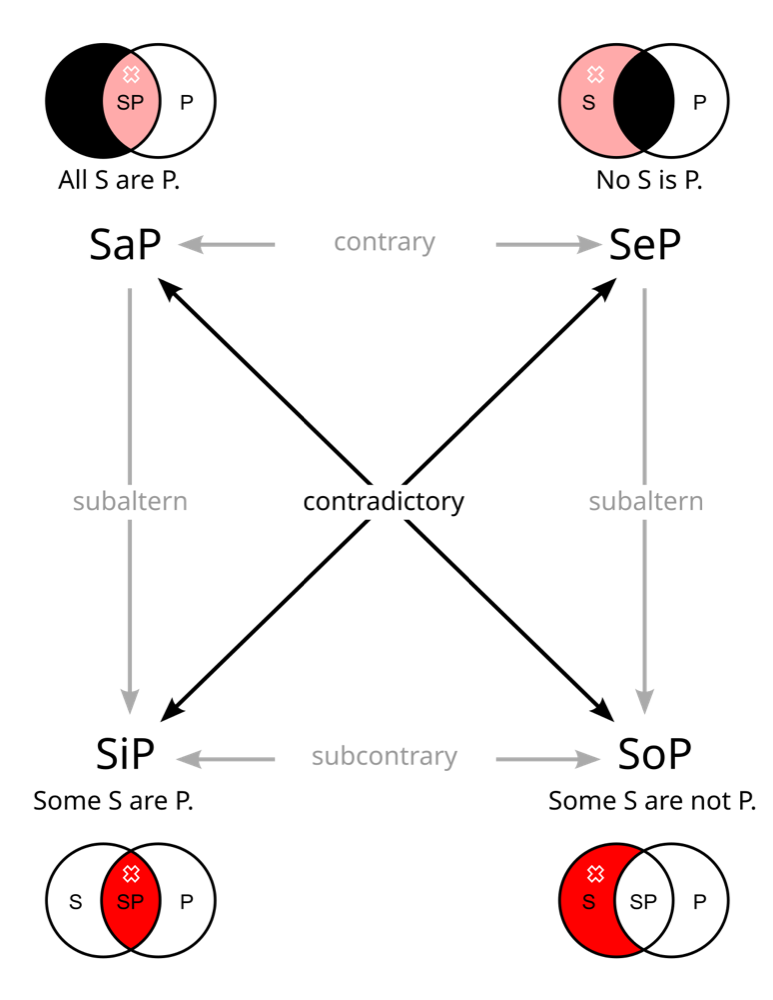
Contradictories
Contraries
Subcontraries
Subalterns
A and O are diagonal opposites and always have opposite truth values. Contraries are A and E; subcontraries are I and O; subalternation runs from A to I and E to O. Image: Tilman Piesk (Watchduck), public domain, via Wikimedia Commons.
On the traditional square of opposition, which statement is true of subcontraries (I and O)?
They cannot both be true
They always have opposite truth values
The truth of one implies the truth of the other
They cannot both be false
If 'Some S are P' is false, then no S is P, so 'Some S are not P' is true (given S exists). Both can be true: some birds fly and some do not.
Which conversion is valid?
'No S is P' to 'No P is S'
'All S are P' to 'All P are S'
'Some S are not P' to 'Some P are not S'
'All S are P' to 'No P is S'
E and I statements convert simply. A converts only to a particular (per accidens), and O cannot be converted. Converting A simply is a common mistake.
'Mr Jones wants a stricter drink-driving law, so he wants to ban alcohol.' Which fallacy?
Slippery slope
False dilemma
Straw man
Equivocation
His position is exaggerated into a more extreme one that is easier to attack. A slippery slope would claim a causal chain from the law to a ban.
'Either you support the new tax or you hate the poor.' Which fallacy?
False dilemma
Loaded question
Red herring
Appeal to nature
It ignores other options. A loaded question would be a question with hidden assumptions, such as 'Why do you hate the poor?'
'I took the pills and my cold went away, so the pills cured it.' The best name is...
Hasty generalization
Equivocation
Post hoc ergo propter hoc
Argument from ignorance
Colds often end by themselves; temporal order does not prove cause. Hasty generalization would be about a sample.
Which argument is valid?
All dogs are animals; some animals are fierce; so some dogs are fierce
No reptiles are mammals; all snakes are reptiles; therefore no snakes are mammals
No cats are dogs; some pets are not dogs; so some pets are cats
All A are B; all C are B; so all A are C
The correct one is Celarent (EAE-1). 'All dogs are animals; some animals are fierce' has an undistributed middle, 'No cats are dogs; some pets are not dogs' has two negative premises, and 'All A are B; all C are B' has an undistributed middle.
Which of these is NOT a fallacy?
Citing a celebrity chef on the safety of vaccines
Dismissing a study because the author is unpopular
Saying a drug is safe because nobody has proved it dangerous
Citing the consensus of climate scientists on a question of climate science
Appealing to genuine expertise in the relevant field is a legitimate inductive argument. The other options are illegitimate authority, ad hominem and argument from ignorance.
'My uncle smoked his whole life and lived to 95, so smoking is not dangerous.' Which fallacies apply?
Composition only
Begging the question
Anecdotal reasoning and hasty generalization
Equivocation
One case is not a representative sample, and risk is statistical, not guaranteed.
A test is 95% accurate for a disease that affects 1 in 1,000 people. A random person tests positive. Ignoring the base rate leads us to...
wrongly think the person is very likely ill
correctly conclude the person is very likely healthy
think the test is useless
conclude the disease is common
In 1,000 people about 1 has the disease and about 50 of the healthy 999 test positive, so a positive is still much more likely a false positive. Base rate neglect confuses test accuracy with the probability of disease.
'Each player on the team is excellent, so the team is excellent.' This is the fallacy of...
Division
Accident
Post hoc
Composition
Composition assumes what holds of the parts holds of the whole. A team of stars may play badly together; division goes the other way.
Under the Boolean (modern) interpretation of categorical statements, which traditional relation fails?
Contradictoriness of A and O
Contrariety (A and E can both be true if S is empty)
Contradictoriness of E and I
Nothing; all relations are kept
Boolean logic denies existential import, so 'All unicorns are white' and 'No unicorns are white' are both vacuously true. The contradictory pairs survive.
'A is true because the Bible says so, and the Bible is true because it is the word of God as stated in the Bible.' This is...
Equivocation
Circular reasoning
Hasty generalization
False cause
The conclusion is assumed in the premises. A circular argument can be valid but cannot convince anyone who does not already accept the conclusion.
