Quiz · Medium
Formulas for terms and sums, infinite geometric series, sigma notation and convergence from graphs.
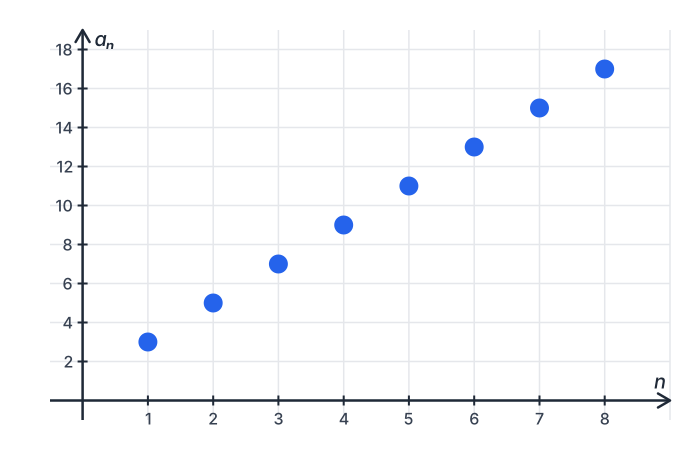
The dots show a sequence. Which explicit formula matches?
aₙ = n + 2
aₙ = 2n − 1
aₙ = 2n + 1
aₙ = 3·2ⁿ⁻¹
The terms are 3, 5, 7, … so d = 2 and a₁ = 3, giving aₙ = 2n + 1. 2n − 1 has the right slope but starts at 1.
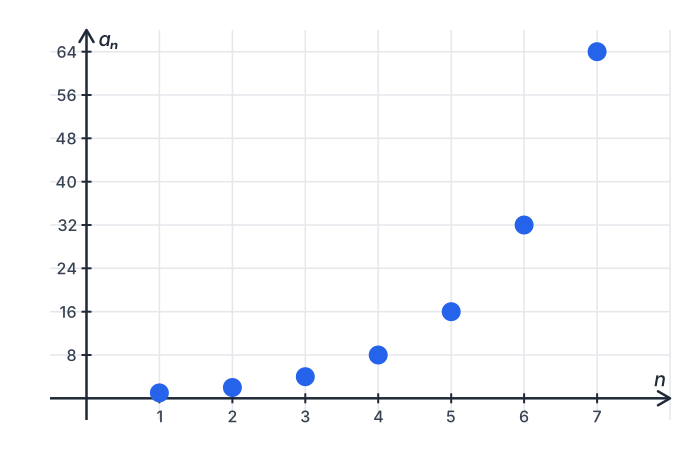
Which describes the plotted sequence 1, 2, 4, 8, …?
Arithmetic with d = 2
Geometric with r = 2
Geometric with r = 1/2
Neither arithmetic nor geometric
Each term is double the previous one, so it is geometric with r = 2. The differences 1, 2, 4 are not constant, which rules out arithmetic.
What is the common ratio of 12, −6, 3, −3/2, …?
1/2
−1/2
−2
−6
−6 ÷ 12 = −1/2. A positive 1/2 would keep all the terms positive.
Arithmetic sequence with a₁ = 7 and d = −3. What is a₁₅?
−35
−38
−45
−32
a₁₅ = 7 + 14(−3) = −35. −38 uses 15 steps instead of 14.
Geometric sequence with a₁ = 5 and r = 2. What is a₆?
320
32
160
25
a₆ = 5·2⁵ = 160. The exponent is n − 1 = 5, not 6 (which would give 320).
What is 1 + 2 + 3 + … + 50?
1250
1275
2550
1325
50·51/2 = 1275. 2550 forgets to divide by 2.
Arithmetic series with a₁ = 4 and d = 3. What is the sum of the first 12 terms?
492
222
252
246
a₁₂ = 4 + 11(3) = 37, so S₁₂ = 12(4 + 37)/2 = 246. 492 forgets the division by 2.
What is the sum of 6 + 2 + 2/3 + 2/9 + …?
9
8
18
The series has no sum
r = 1/3 and |r| < 1, so S = 6/(1 − 1/3) = 9.
True or false: 3 + 6 + 12 + 24 + … has the finite sum 3/(1 − 2) = −3.
True
False
False. The formula only works when |r| < 1. Here r = 2, the partial sums grow without bound and the series diverges.
Which fraction equals 0.777…?
7/10
7/9
77/100
8/9
0.777… = 0.7 + 0.07 + … with r = 0.1, so S = 0.7/0.9 = 7/9.
Evaluate .
24
26
30
36
2 + 5 + 8 + 11 = 26, or 3(1 + 2 + 3 + 4) − 4 = 30 − 4 = 26.
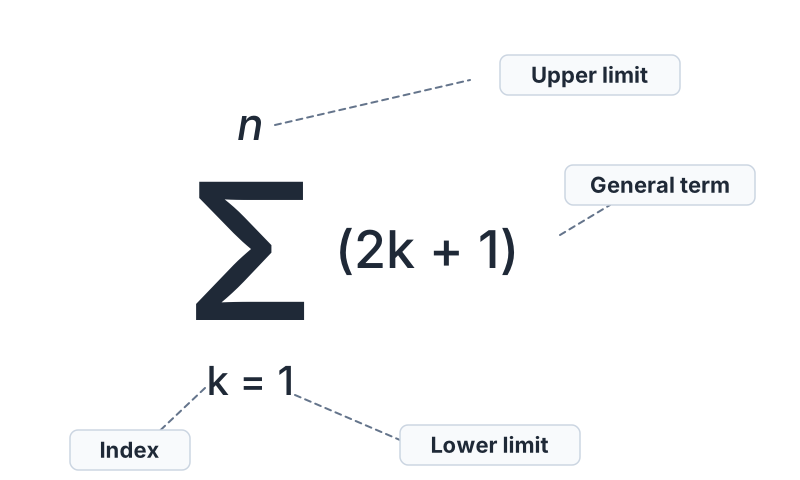
The picture shows . What is its value when n = 3?
12
9
15
21
3 + 5 + 7 = 15. Here k = 1, 2, 3 are substituted into 2k + 1.
Which term of the sequence 5, 9, 13, … equals 101?
24th
25th
26th
21st
5 + 4(n − 1) = 101 gives n − 1 = 24, so n = 25.
Geometric sequence with a₃ = 12 and a₆ = 96. What is a₁?
6
4
3
1.5
r³ = 96/12 = 8, so r = 2. Then a₁ = 12/r² = 3.
Which sequence is arithmetic?
2, 4, 8, 16, …
1, 4, 9, 16, …
10, 7, 4, 1, …
1, 1/2, 1/4, 1/8, …
10, 7, 4, 1 has a constant difference of −3. The first and last are geometric and 1, 4, 9, 16 is neither.
Simplify .
2
35
42
5040
7!/5! = 7·6 = 42.
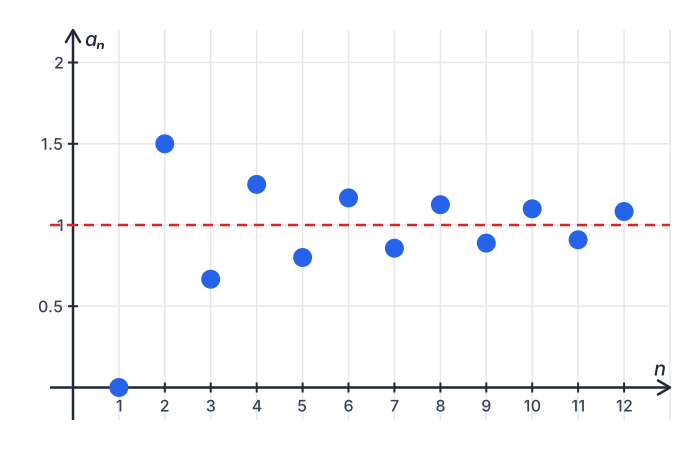
The plotted terms are 1 + (−1)ⁿ/n. What do they approach?
0
1
2
Nothing, because they alternate
The dots alternate around y = 1 but the distance 1/n shrinks to 0, so the sequence converges to 1.
The plotted terms are 8, −4, 2, −1, … What do they approach as n grows?
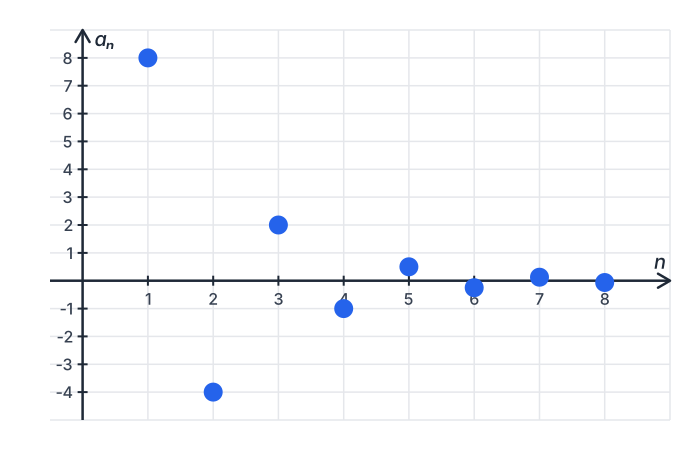
0
−1/2
8
They do not approach anything
r = −1/2 and |r| < 1, so the terms shrink toward 0 while alternating in sign.
a₁ = 2 and aₙ = 3aₙ₋₁ − 1. What is a₄?
27
38
14
41
a₂ = 3(2) − 1 = 5, a₃ = 3(5) − 1 = 14, a₄ = 3(14) − 1 = 41.
$500 earns 4% interest compounded annually. Which is the balance after 5 years?
$600.00
$608.33
$625.00
$2,500
Compound interest is geometric: 500(1.04)⁵ ≈ 608.33. $600 is what simple interest (arithmetic) would give.
