Quiz · Medium
Pick the correct sentence or spelling: gender and number agreement, ने, कि and की, the dot and chandrabindu, postposition spacing and the model letter.
A girl wants to write 'I went to school yesterday.' Which sentence is correct?
मैं कल स्कूल गई थी।
मैं कल स्कूल गया थी।
मैं कल स्कूल गई था।
मैं कल स्कूल गए थी।
जाना (to go) is intransitive, so the verb agrees with the subject, a girl: गई, and the helper थी is feminine too. गया is masculine; गया थी and गई था mix the genders.
Which sentence is correct for 'She ate an apple'?
वह सेब खाई।
उसने सेब खाया।
उसने सेब खाई।
वह सेब खाया।
खाना is transitive, so the simple past needs ने on the subject and the verb agrees with the object. सेब is masculine, so खाया. उसने सेब खाई agrees with the girl instead of the apple, the commonest slip.
True or false: the letters ड़ and ढ़ can begin a word.
True
False
False. They occur inside or at the end of words (बड़ा, पढ़ना, पेड़). A word-initial sound is written ड or ढ, as in डर and ढोल.
Which sentence is correct for 'The boy went home'?
लड़के ने घर गया।
लड़के ने घर गई।
लड़का घर गया।
लड़का घर गई।
जाना is intransitive, so there is no ने and the subject stays लड़का. ने belongs with the simple past of most transitive verbs such as खाना, देखना and पढ़ना.
How do you write 'Rahul's sister'?
राहुल का बहन
राहुल के बहन
राहुल कि बहन
राहुल की बहन
का, के, की agree with the thing possessed (बहन, feminine), not with the owner. कि means 'that' and is never used for 'of'.
Fill the gap: उसने कहा ___ वह कल आएगा।
कि
की
का
के
कि joins a reported clause ('that'). की, का, के are the three forms of 'of' and change with gender and number.
Which sentence correctly says 'I have a book'?
मैं के पास एक किताब है।
मेरे पास एक किताब है।
मेरा पास एक किताब है।
मुझे एक किताब है।
Having an object is expressed with X के पास. The pronoun takes its oblique form before पास: मेरे, not मेरा. मुझे is used for feelings and needs, such as मुझे भूख लगी है.
Which sentence correctly says 'I like tea'?
मैं चाय पसंद है।
मेरा चाय पसंद है।
मुझे चाय पसंद है।
मैं को चाय पसंद है।
पसंद है works like 'is pleasing to me': the person is in the dative (मुझे) and the verb is है. मैं cannot be the subject here.
Which spelling is correct for 'I do not know'?
मै नहीं जानता।
मैं नही जानता।
मैं नहीँ जानता।
मैं नहीं जानता।
Both मैं and नहीं need the dot (ं) because a vowel sign stands above the headline. The chandrabindu (ँ) is used only when nothing is above the headline, as in माँ or कहाँ.
What is the plural in 'two boys'?
दो लड़के
दो लड़का
दो लड़कें
दो लड़कों
Masculine nouns in -आ change to -ए in the plural: लड़का → लड़के. लड़कें (with a dot) is a spelling error and लड़कों is the oblique plural used before postpositions (लड़कों को).
How do you write 'three books'?
तीन किताबे
तीन किताबें
तीन किताबों
तीन किताबा
Feminine nouns ending in a consonant usually add -ें in the plural: किताब → किताबें. The dot is required. किताबों is the oblique plural (किताबों में).
Which is correct for 'in the rooms'?
कमरे में
कमरें में
कमरों में
कमरा में
Before a postposition a plural noun takes -ों: कमरा → कमरों में. कमरे में means 'in the room' (singular), and कमरा में is not grammatical because the noun must be oblique before में.
You are writing a polite request to your teacher: 'Please sit.' Which verb form is correct?
बैठ
बैठो
बैठा
बैठिए
बैठिए is the आप form. बैठ is the very familiar तू form, बैठो is the तुम form used with friends and younger people, and बैठा is a past form.
Which sentence is correct for 'She is reading'?
वह पढ़ रही है।
वह पढ़ रहा है।
वह पढ़ रही हूँ।
वह पढ़ रही हो।
Present continuous = stem + रहा/रही/रहे + है/हूँ/हो. रही is feminine; the helper must match the person: वह takes है, मैं takes हूँ, तुम takes हो.
Which sentence is correct for 'The children are playing'?
बच्चे खेल रहा है।
बच्चे खेल रहे हैं।
बच्चे खेल रहे है।
बच्चे खेल रही हैं।
बच्चे is masculine plural, so रहे and हैं. है without the dot is singular, and रही is feminine.
A man writes 'I will go to the temple tomorrow.' Which sentence is correct?
मैं कल मंदिर गया।
मैं कल मंदिर जाता था।
मैं कल मंदिर जाऊँगा।
मैं कल मंदिर जा रहा था।
कल can mean yesterday or tomorrow, so the verb must show which. -ऊँगा is future. गया, जाता था and जा रहा था are all past.
What is the traditional Hindi full stop called?
अल्प विराम (,)
प्रश्नवाचक चिह्न (?)
योजक चिह्न (-)
पूर्ण विराम (।)
The danda । ends a statement. अल्प विराम is the comma, प्रश्नवाचक चिह्न the question mark and योजक चिह्न the hyphen. Online texts often use '.' too.
Which sentence has the normal Hindi word order for 'I eat rice' (a man speaking)?
मैं चावल खाता हूँ।
मैं खाता हूँ चावल।
खाता हूँ मैं चावल।
चावल खाता मैं हूँ।
Hindi is subject, object, verb, with the verb and its helper last. Other orders appear for emphasis in speech, but they are not neutral written style.
Which is written correctly?
रामने खाना खाया।
राम ने खाना खाया।
राम-ने खाना खाया।
राम नें खाना खाया।
After a noun, postpositions are written as separate words: राम ने, घर में. Only pronouns join them: मैंने, उसने. ने never takes a dot.
Which is the correct way to write 'I ate' with ने?
मैं ने खाया।
मैं-ने खाया।
मैंने खाया।
मैनें खाया।
After a pronoun, ने is joined: मैंने, तुमने, उसने, हमने. Keep the dot on मैं and do not add one to ने.
Which sentence is correct for 'The girl is beautiful'?
लड़की सुंदरी है।
लड़की सुंदरा है।
लड़की सुंदर हूँ।
लड़की सुंदर है।
Adjectives that end in a consonant, like सुंदर, do not change for gender. Only -आ adjectives (बड़ा, बड़ी, बड़े) agree.
Which phrase is correct for 'a big house'?
एक बड़ा घर
एक बड़ी घर
एक बड़े घर
एक बड़ा घरी
बड़ा agrees with घर (masculine singular). बड़ी is feminine and बड़े is plural or oblique.
Which is the correct spelling of 'sick, ill'?
बिमार
बीमार
बीमर
बीमारि
बीमार has a long ी, from Persian bīmār. बिमार is one of the most frequent misspellings.
Which is the correct spelling of 'please'?
क्रपया
कर्पया
कृपया
कीपया
कृ is क with the vowel sign ृ (the vowel ऋ). It is not a conjunct of क and र.
Which is the correct spelling of 'exam'?
परिक्षा
परीछा
परिच्छा
परीक्षा
The second syllable has a long ी and the last part is the conjunct क्ष. परिक्षा with a short ि is a common slip.
Which sentence correctly says 'If it rains, I will stay at home' (a man speaking)?
अगर बारिश होगी, तो मैं घर पर रहूँगा।
अगर बारिश होगी, तब मैं घर पर रहता हूँ।
अगर बारिश हुआ, तो मैं घर पर रहूँगा।
अगर बारिश होगी, लेकिन मैं घर पर रहूँगा।
अगर...तो starts with a future होगी (feminine, like बारिश) and ends with a future रहूँगा. 'हुआ' is masculine and लेकिन ('but') changes the logic.
True or false: Hindi writes the first word of a sentence with a capital letter.
True
False
False. Devanagari has no capital letters. Names and sentence starts look like any other word.
In the model letter, which numbered part is the subject line (विषय)?
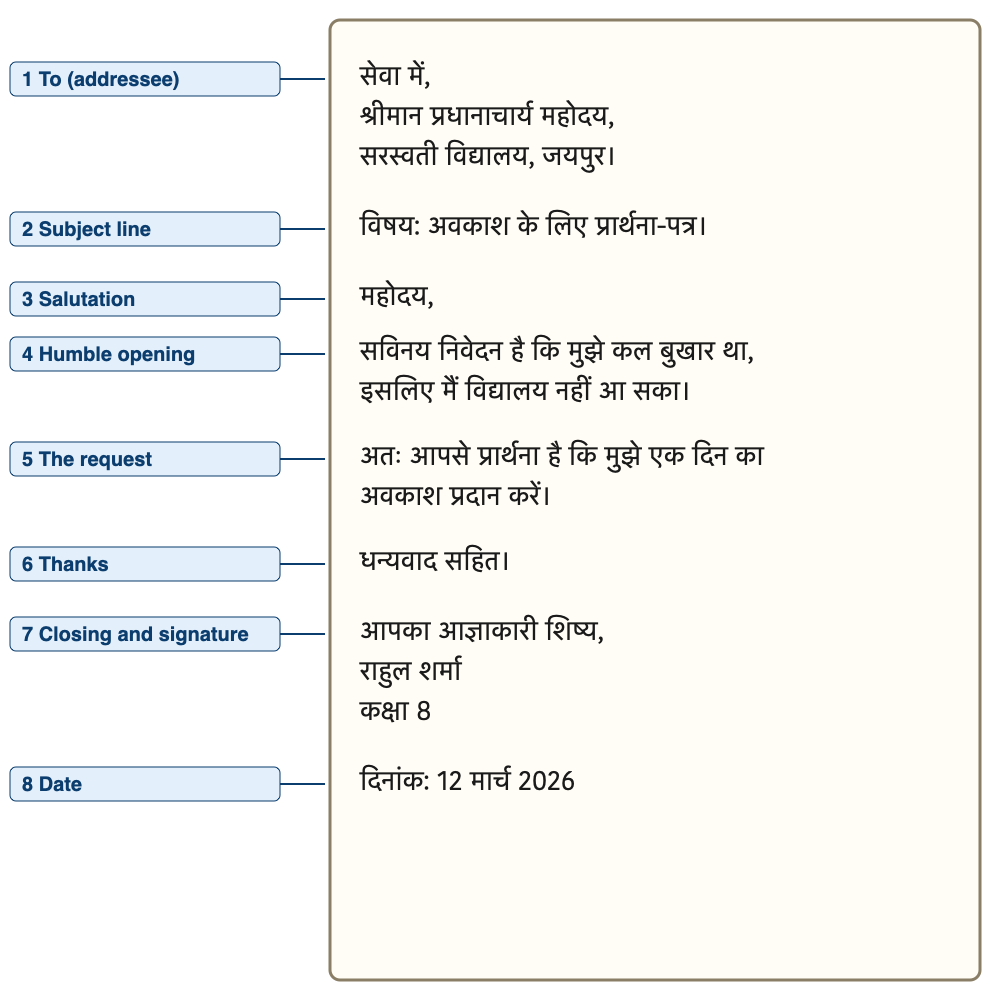
Part 2
Part 3
Part 5
Part 8
Part 2 begins with विषय: and names what the letter is about: अवकाश के लिए प्रार्थना-पत्र. Part 3 is the salutation महोदय.
In the model letter, what is part 6 (धन्यवाद सहित) used for?
Closing the request with thanks
Giving the date
Naming the school
Opening the letter
धन्यवाद सहित means 'with thanks'. It closes the request just before the closing and signature. Date and school appear elsewhere.
