Quiz · Hard
Karvonen, cardiac output, Fick, protein and fluid calculations plus applied training scenarios.
An athlete has HRmax 190 and resting HR 60. What is the Karvonen target heart rate at 70 percent intensity?
133 bpm
151 bpm
163 bpm
190 bpm
HRR = 190 - 60 = 130; 70 percent = 91; plus resting 60 = 151. Taking 70 percent of HRmax gives 133, the common mistake.
A person has a stroke volume of 80 mL and a heart rate of 150 bpm during exercise. Their cardiac output is:
230 mL/min
120 L/min
12 L/min
1.9 L/min
80 x 150 = 12,000 mL/min = 12 L/min.
An athlete with cardiac output 20 L/min and a-vO2 difference 150 mL/L: what is VO2?
3.0 L/min
0.13 L/min
30 L/min
7.5 L/min
VO2 = 20 x 150 mL = 3000 mL/min = 3.0 L/min.
A 75 kg lifter wants 1.6 g/kg protein per day. How many grams?
160 g
75 g
48 g
120 g
75 x 1.6 = 120 g.
A 60 kg runner loses 1.5 kg during a long run without drinking. About what fluid volume should be replaced (at 150 percent)?
0.5 L
1.5 L
2.25 L
3 L
1.5 kg is about 1.5 L; 150 percent is 2.25 L.
A runner's 400 m race lasts 50 seconds. Which statement best describes energy supply?
Mostly anaerobic with substantial phosphagen and glycolytic contribution
Entirely phosphagen
Entirely fat oxidation
Entirely aerobic
A 50 s all-out effort is predominantly anaerobic, with glycolysis dominant, but all systems contribute.
Why does a trained cyclist at the same absolute workload show a lower heart rate than before training?
Lower stroke volume
Higher stroke volume allows the same cardiac output at lower HR
Lower oxygen demand in tissues
Decreased blood volume
Training increases blood volume and stroke volume, so the same Q is met with fewer beats.
Which training choice best matches a goal of improving 1RM squat?
Static stretching only
15 reps at 40 percent 1RM
3 to 5 sets of 1 to 5 reps at about 85 percent+ 1RM with long rests
Slow steady cycling
Heavy loads, low reps and long rests suit maximal strength (specificity and overload).
An athlete's performance fell, resting heart rate is up, mood is low, and she feels persistently fatigued after increasing training volume sharply. The best interpretation is:
Lack of protein only
Normal adaptation, continue
Possible overreaching or overtraining; reduce load and monitor recovery
Dehydration only
Persistent decline with symptoms and rising load points to overreaching or overtraining, requiring rest.
Why do plyometrics aim for a short amortization phase?
To avoid muscle spindles
To increase fatigue
To preserve elastic energy and use the stretch reflex for greater power
To lengthen the eccentric phase
A long delay dissipates stored elastic energy as heat.
A marathoner develops confusion, headache and nausea after drinking large amounts of plain water. The most likely problem is:
Hypoglycemia only
Hyperthermia only
Hypernatremia
Exercise-associated hyponatremia
Overdrinking dilutes blood sodium.
A runner at 21 mL/kg/min uses how many METs?
21 METs
1 MET
3.5 METs
6 METs
21 / 3.5 = 6 METs.
On the energy chart, at 3 minutes of maximal effort, the most accurate description is:
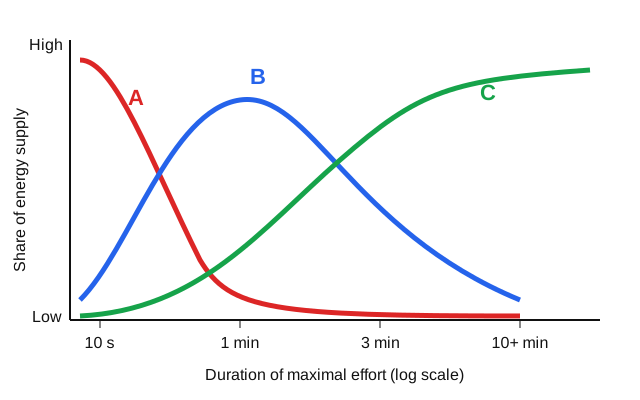
Phosphagen dominates
Aerobic and anaerobic glycolysis both contribute, with aerobic rising
Only glycolysis
No energy is produced
Around 2 to 3 minutes the systems cross: the oxidative share is about half and growing.
A coach increases weekly load by 40 percent for four weeks in a row. Which principle is violated?
Individuality
Reversibility
Progression
Specificity
Load should rise gradually, about 10 percent, to avoid overuse injury.
A person sits and holds a heavy weight against a wall without moving. Mechanically, work done is:
Equal to weight x time
Equal to ATP used
Maximum
Zero, because no displacement, though energy is used
Work = force x displacement; static holding is isometric with zero mechanical work but a metabolic cost.
