Quiz · Medium
Foundational questions on energy pathways, fuel use in different tissues and hormonal control.
Ketone bodies are produced mainly in which organ?
Brain
Red blood cells
Pancreas
Liver
Hepatic mitochondria make ketones from acetyl-CoA when oxaloacetate is scarce. The liver itself cannot use them.
Which has the highest thermic effect of food?
Protein
Carbohydrate
Fat
Alcohol
Protein is 20 to 30% of its energy; carbohydrate 5 to 10%; fat 0 to 3%.
Which organ's glycogen can supply glucose to the blood?
Skeletal muscle
Heart
Liver
Brain
Muscle lacks glucose-6-phosphatase, so its glycogen stays in muscle.
In which part of the cell does glycolysis take place?
Cytosol
Mitochondrial matrix
Inner mitochondrial membrane
Nucleus
Glycolysis occurs in the cytosol and needs no oxygen. The TCA cycle is in the matrix and the electron transport chain is on the inner membrane.
What is the net ATP yield of glycolysis per molecule of glucose?
4 ATP
2 ATP
30 ATP
36 ATP
Glycolysis uses 2 ATP and makes 4, so the net is 2. The 30 to 32 figure is for complete oxidation.
Which molecule is the final electron acceptor in the electron transport chain?
NAD⁺
Pyruvate
Oxygen
CO₂
Oxygen accepts electrons and protons to form water. NAD⁺ is regenerated by earlier steps but is not the final acceptor.
Which tissue cannot use fatty acids or ketones for fuel because it has no mitochondria?
Heart muscle
Liver
Skeletal muscle
Red blood cells
Red blood cells rely on anaerobic glycolysis.
Which of the following can be converted to glucose by gluconeogenesis?
Lactate
Even-chain fatty acids
Acetyl-CoA
Cholesterol
Lactate, glycerol and glucogenic amino acids can. Humans cannot convert acetyl-CoA from fatty acids to glucose.
Which of the following hormones is released when blood glucose falls?
Insulin
Glucagon
Leptin
Calcitonin
Glucagon stimulates glycogenolysis and gluconeogenesis. Insulin is released when blood glucose rises.
What proportion of total energy expenditure is typically basal metabolic rate in a sedentary adult?
About 10%
About 60 to 70%
About 30%
About 90%
BMR is the largest part, followed by activity and then TEF.
Which equation estimates BMR for adults with weight, height and age?
Atwater
Henderson-Hasselbalch
Mifflin-St Jeor
Michaelis-Menten
Atwater gives energy values of macronutrients; the other two are biochemistry equations.
A person has an RQ of 0.7. What is the main fuel being oxidized?
Carbohydrate
Protein
Alcohol
Fat
Fat gives an RQ of about 0.7, carbohydrate 1.0, protein 0.8.
Which enzyme is the rate-limiting step of glycolysis?
Phosphofructokinase-1
Hexokinase only
Pyruvate carboxylase
Glucose-6-phosphatase
PFK-1 is the main control point; pyruvate carboxylase and glucose-6-phosphatase belong to gluconeogenesis.
What is the role of carnitine?
Synthesizes fatty acids
Transports long-chain fatty acids into mitochondria
Makes ketones
Transports amino acids into cells
Without the carnitine shuttle, fatty acids cannot reach the beta-oxidation enzymes in the matrix.
Which vitamin deficiency would impair the pyruvate dehydrogenase complex?
Vitamin C
Vitamin K
Thiamin
Vitamin A
Thiamin pyrophosphate is a required coenzyme; deficiency causes lactic acidosis.
Which statement about the fed state is correct?
Glucagon is high
Ketone production is maximal
Gluconeogenesis is the main source of glucose
Insulin is high and promotes glycogen and fat storage
After a meal insulin rises and drives storage; glucagon, ketogenesis and gluconeogenesis are fasting responses.
During prolonged fasting (several days), the brain adapts by using more:
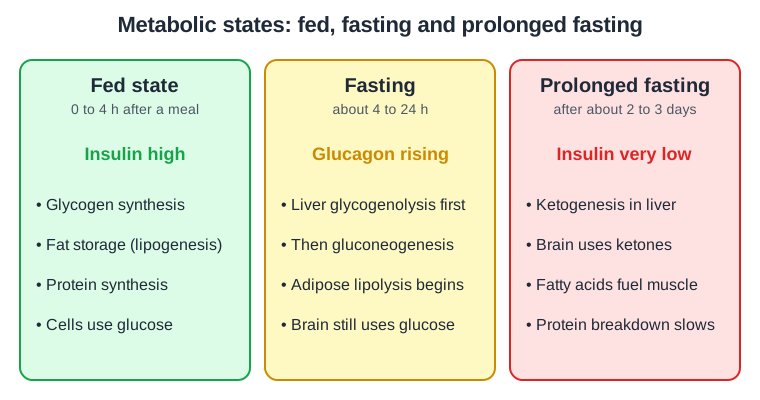
Ketone bodies
Fatty acids directly
Lactose
Urea
Fatty acids cannot cross the blood-brain barrier in useful amounts, but ketones can. This spares muscle protein.
Which of the following pathways occurs in the cytosol?
Beta-oxidation
Fatty acid synthesis
TCA cycle
Electron transport chain
Fatty acid synthesis is cytosolic; beta-oxidation is mitochondrial.
True or false: Alcohol metabolism raises NADH and can cause low blood glucose in fasting.
True
False
High NADH shifts pyruvate to lactate and blocks gluconeogenesis; this is why fasting drinkers can have hypoglycemia.
