Quiz · Medium
Twenty questions on leaf, root and stem anatomy, flower parts, double fertilization and alternation of generations, with diagrams and photos.
Which labeled layer of the leaf does most of the photosynthesis?
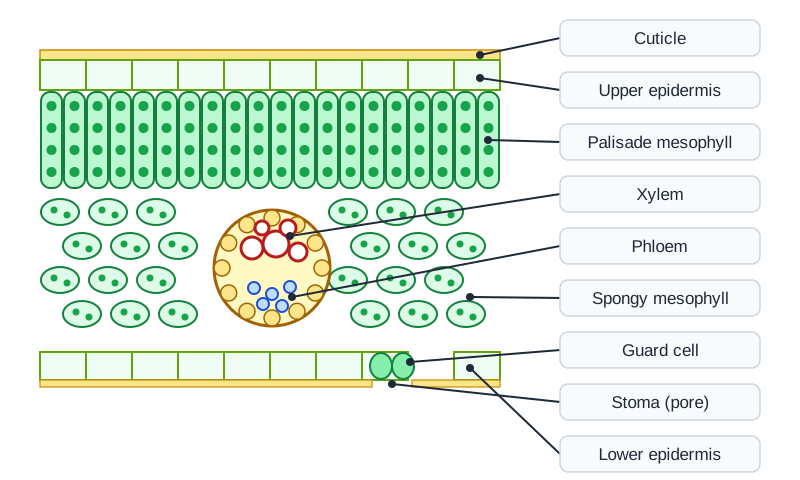
Upper epidermis
Palisade mesophyll
Spongy mesophyll
Lower epidermis
Palisade cells are tall, tightly packed and full of chloroplasts. The spongy mesophyll photosynthesizes too, but its main job is gas exchange through its air spaces. Epidermal cells (except guard cells) lack chloroplasts.
Which cross-section is from a monocot stem?
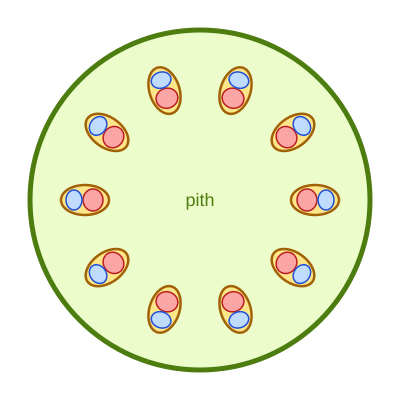
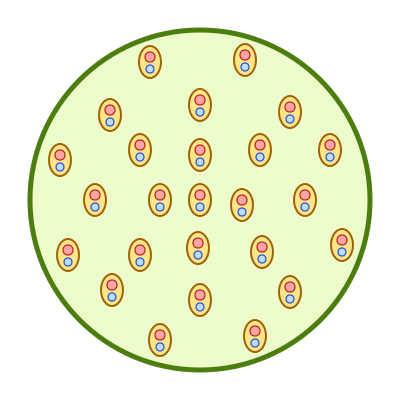
Monocot stems have vascular bundles scattered through the ground tissue. Eudicot stems arrange their bundles in a ring around the pith.
What is the main function of xylem?
Carry sugars from leaves to roots
Carry water and minerals from roots to shoots
Make new cells for growth in length
Protect the leaf from water loss
Xylem moves water and minerals upward. Phloem is the tissue that moves sugars, and in both directions.
In which root zone are new cells produced by mitosis?
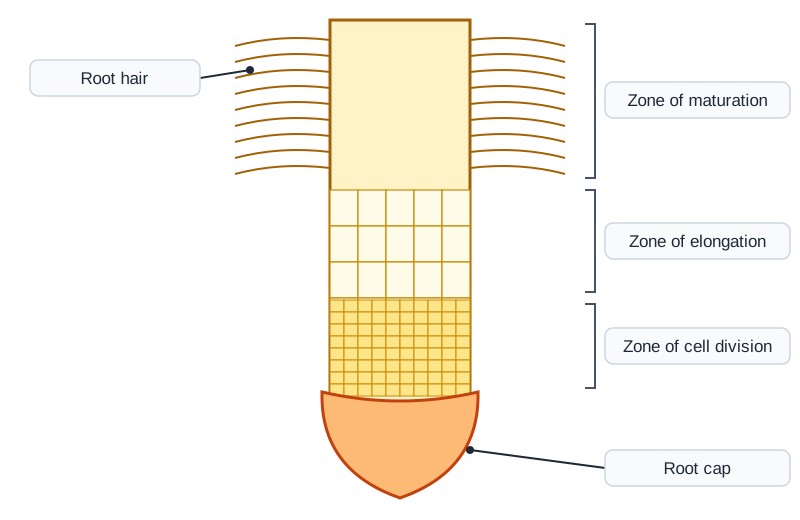
Root cap
Zone of cell division
Zone of elongation
Zone of maturation
The apical meristem in the zone of cell division makes new cells. The elongation zone is where they lengthen; root hairs form in the maturation zone.
Which feature identifies a eudicot rather than a monocot?
Parallel leaf veins
Flower parts in multiples of three
A taproot and net-veined leaves
One cotyledon
Eudicots typically have a taproot, net venation, two cotyledons and flower parts in fours or fives. The other options are monocot traits.
The Casparian strip in the root endodermis forces water and minerals to...
move only through cell walls
pass through a cell membrane before entering the xylem
move down to the root cap
leave the root through root hairs
The waxy suberin band blocks the apoplast (wall) pathway, so substances must enter the symplast by crossing a membrane. This lets the root control which minerals reach the xylem.
A potato is best described as a...
modified root
modified stem (tuber)
modified leaf
fruit
The eyes of a potato are axillary buds, which only stems have. Sweet potatoes, by contrast, are swollen roots.
Which tissue makes a tree trunk grow wider each year?
Apical meristem
Vascular cambium
Epidermis
Pericycle
The vascular cambium is a lateral meristem that adds secondary xylem (wood) inward and secondary phloem outward. Apical meristems make the plant longer, not wider.
Which part of the flower becomes the fruit?
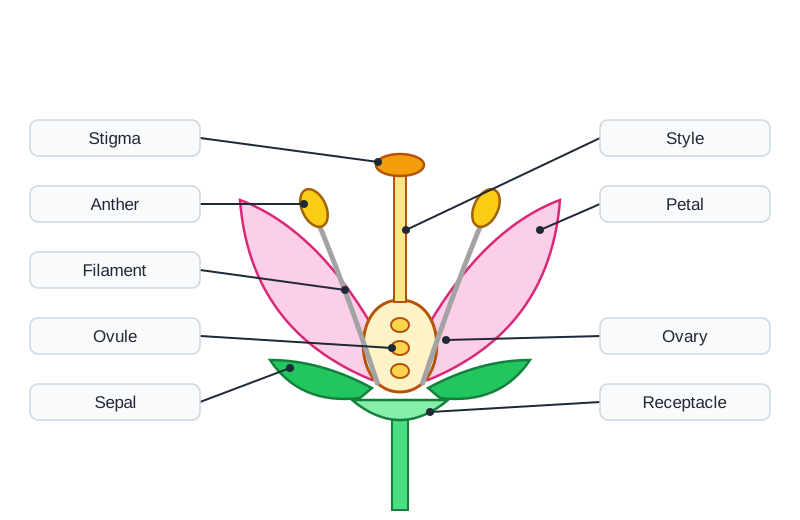
Ovule
Ovary
Anther
Stigma
The ovary develops into the fruit; the ovules inside become the seeds. Students often swap these two.
Pollen grains are produced in the...
stigma
ovary
anther
sepal
Meiosis in the anther makes microspores that develop into pollen grains. The stigma only receives pollen.
In double fertilization, the second sperm fuses with the two polar nuclei to form...
the zygote (2n)
the endosperm (3n)
the seed coat (2n)
the pollen tube (n)
One sperm + egg → diploid zygote; the other sperm + two polar nuclei → triploid endosperm, the seed's food store.
In plants, spores are produced by ____ and gametes are produced by ____.
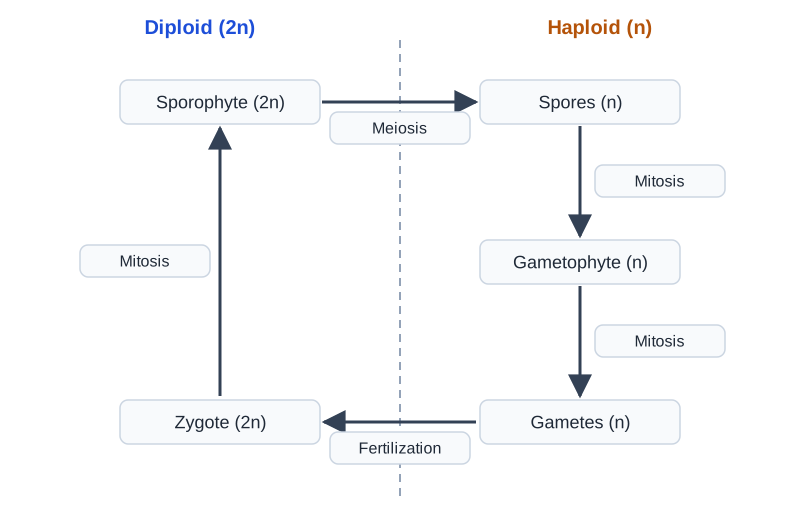
meiosis; mitosis
mitosis; meiosis
meiosis; meiosis
mitosis; mitosis
The diploid sporophyte makes haploid spores by meiosis. The gametophyte is already haploid, so it makes gametes by mitosis. In animals, by contrast, gametes come straight from meiosis.
The stalked capsules growing from this moss are the...
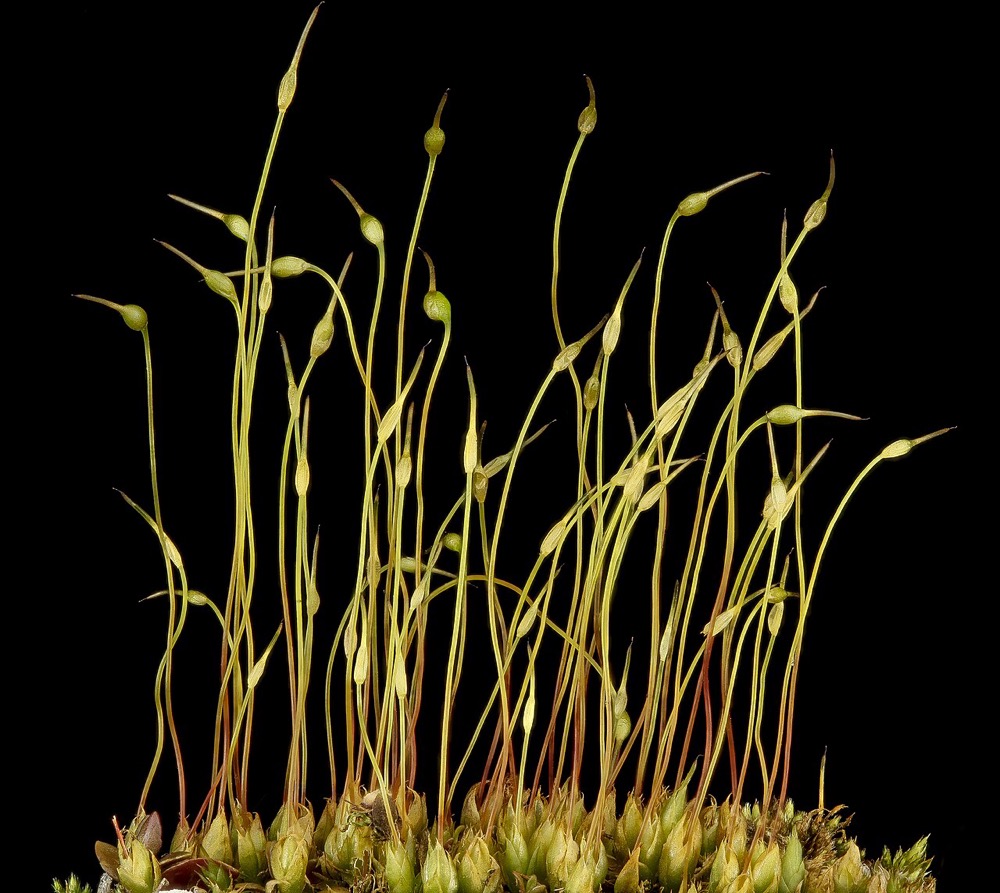
gametophyte (n)
sporophyte (2n)
rhizoids
male gametes
Moss sporophytes grow from the top of the female gametophyte and stay attached to it for food. The leafy green moss is the dominant gametophyte.
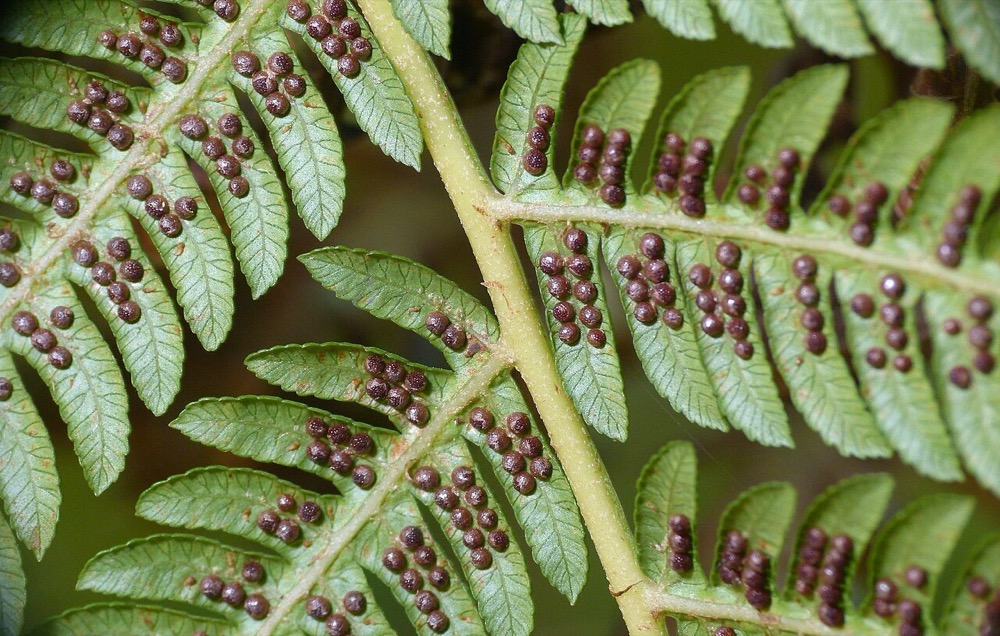
The brown clusters on the underside of this fern frond release...
pollen
seeds
haploid spores
gametes
Sori are clusters of sporangia where meiosis makes haploid spores. Ferns are seedless and make no pollen.
Image: L. Shyamal, CC BY-SA 3.0, via Wikimedia Commons.
Which plant group has vascular tissue but no seeds?
Mosses
Ferns
Conifers
Flowering plants
Ferns are seedless vascular plants. Mosses lack vascular tissue; conifers and flowering plants have seeds.
Why are mosses usually short and found in damp places?
They lack chlorophyll
They have no vascular tissue and their sperm must swim to the egg
They only reproduce asexually
Their roots are too deep
Without xylem they cannot move water far, and their flagellated sperm need a film of water. They have rhizoids, not true roots.
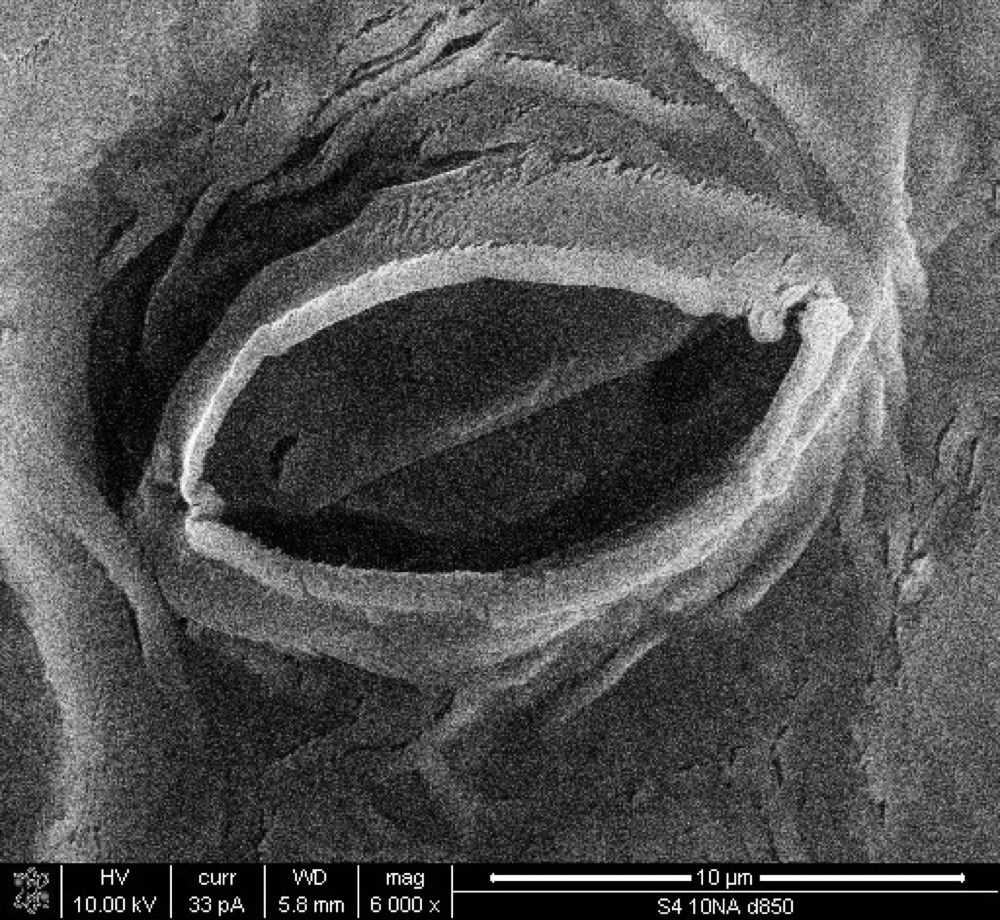
What structure is shown in this micrograph of a leaf surface?
A root hair
A stoma bordered by guard cells
A sieve plate
A pollen grain
The slit-like pore with two kidney-shaped cells on either side is a stoma with its guard cells.
Image: Charles Tschirhart, CC BY-SA 3.0, via Wikimedia Commons.
True or false: phloem can carry sugar both up and down the plant.
True
False
True. Phloem flows from source to sink, so sugar can move down to roots or up to fruits and young leaves. Xylem flows one way only.
Which cell type has thick lignified walls and is usually dead at maturity?
Parenchyma
Collenchyma
Sclerenchyma
Companion cell
Sclerenchyma (fibers and sclereids) gives rigid support. Parenchyma and collenchyma are alive at maturity; collenchyma has unevenly thickened primary walls.
Which part of the leaf mainly reduces water loss from the epidermis?
Cuticle
Spongy mesophyll
Xylem
Palisade mesophyll
The waxy cuticle waterproofs the leaf surface. Water still escapes through open stomata, which is why plants close them in drought.
