A mind map is a diagram with one topic in the middle and everything related branching outward. It's one of the few study techniques that works for both learning new material and revising old material, and it takes about 10 minutes to learn.
Here's how to make one that actually helps, when to use it, and when a list is honestly better.
What a mind map is for
Linear notes are good at recording. Mind maps are good at connecting. When you draw a branch from "photosynthesis" to "light-dependent reactions" to "thylakoid membrane," you're encoding a relationship, not just 3 facts.
That matters because facts with connections are easier to recall than facts floating alone. Ask yourself "where does the thylakoid membrane fit?" and the branch gives you the answer.
Mind maps also show you the shape of a topic at a glance. 4 fat branches and one thin one tells you what you understand and what you've been avoiding.
How to make one, step by step
1. Put the topic in the centre
2 to 4 words, in the middle of a blank page or a blank canvas. "The Cold War," "Cell division," "Contract law: offer and acceptance."
If your central topic needs a full sentence, it's too big. Split it into 2 maps.
2. Add the main branches
Draw 4 to 7 thick lines outward, one per major subtopic. For "The Cold War" that might be Origins, Key crises, Proxy wars, Arms race, Détente, Collapse.
Fewer than 3 branches means the topic is small enough for a list. More than 8 means you need a second level.
3. Branch again with details
Off each main branch, add thinner branches for the supporting points. Off "Key crises": Berlin blockade 1948, Cuban missile crisis 1962, Berlin Wall 1961.
Keep each label to a keyword or a short phrase. If you're writing sentences on branches, you're taking linear notes in a circle.
4. Draw connections across branches
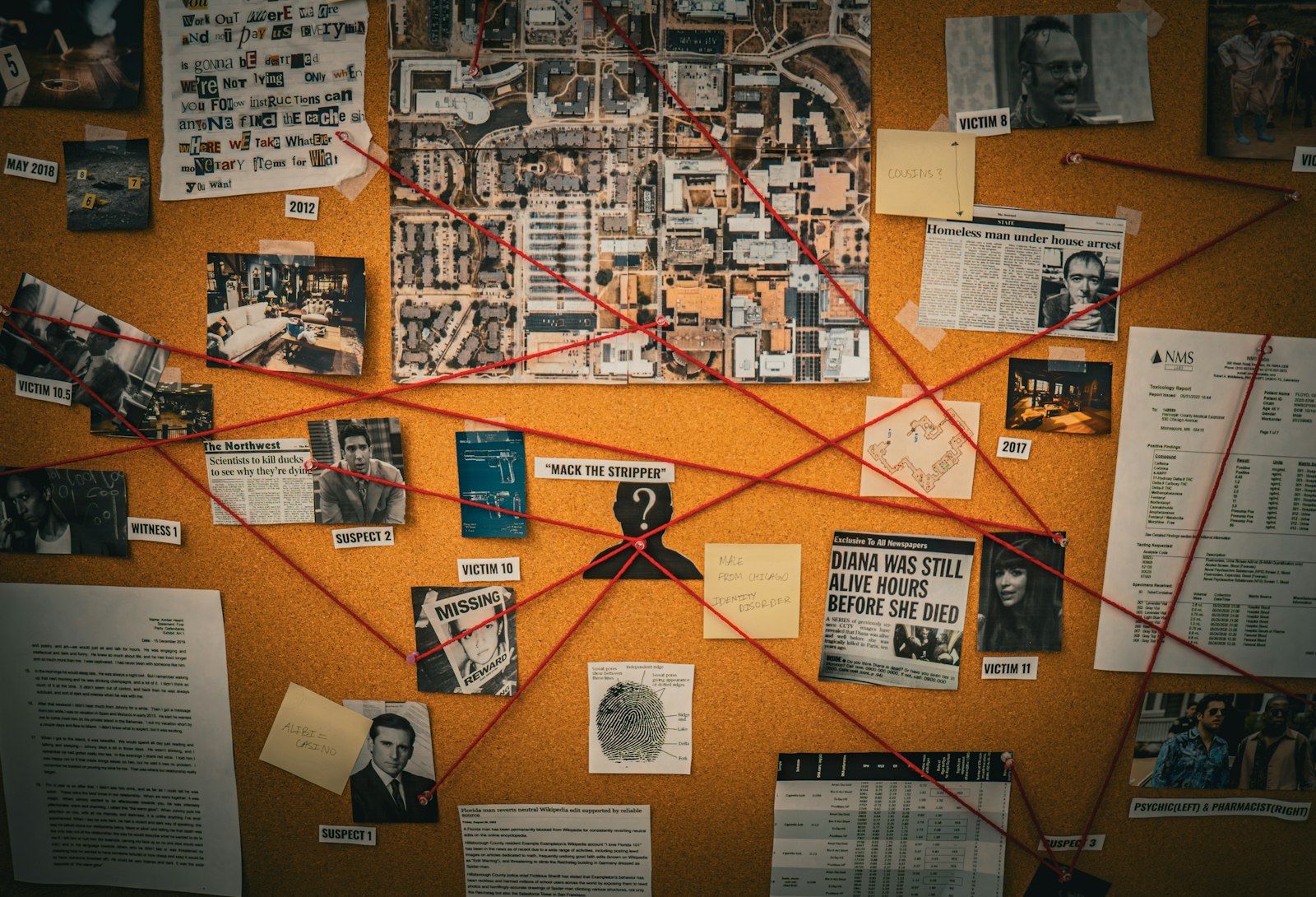
This is the step people skip and it's the most useful one. If "Cuban missile crisis" connects to "Arms race" (it does), draw a line between them and label it. Cross-links are where exam questions live.
5. Add colour and small images
One colour per main branch. A tiny sketch next to a keyword (a mushroom cloud, a wall, a handshake). This sounds childish and it works, because images and colours give your memory extra hooks.
Don't spend 40 minutes colouring, though. The map is a tool, not a poster.
3 examples
Revising a science chapter. Centre: "Enzymes." Branches: Structure, Function, Factors affecting rate, Inhibition, Examples. Under "Factors": temperature, pH, substrate concentration, enzyme concentration. Cross-link "Inhibition" to "Structure" via active site shape.
Planning an essay. Centre: the essay question. Branches: one per argument you'll make. Sub-branches: evidence, quotes, counter-arguments. Number the branches in the order you'll write them. You now have an essay plan you can see in one glance.
Learning a language topic. Centre: "At the restaurant." Branches: verbs, food nouns, phrases for ordering, phrases for paying, polite forms. Say each branch out loud as you draw it.
Using mind maps for active recall
Drawing a map from your notes is decent. Drawing it from memory is far better.
Read the chapter. Close it. Draw the map blank. Then open the chapter and add what you missed in a different colour. This is the blurting method in map form, and the second colour is your study list.
A week later, draw the map again from memory. It should be fuller. Whatever's still missing goes into flashcards.
Paper vs digital
Paper is faster to start and better for the memory-from-scratch exercise. Drawing by hand is slow enough that you think while you draw.
Digital is better for big topics, for editing, and for maps you'll come back to over a semester. You can collapse branches, move things, and you won't run out of page.
If you want a starting point instead of a blank canvas, an AI mind map maker can build the first draft from your notes or a PDF. Then you edit it, which forces you to check every branch, which is itself a form of studying. Just don't skip the from-memory redraw. A map you only ever look at is a pretty diagram, not a memory.
| Paper | Digital | |
|---|---|---|
| Speed to start | Instant | A minute to set up |
| Best for | Redrawing from memory | Big topics, editing over a semester |
| Space | Runs out | Unlimited, branches collapse |
| Memory benefit | Higher (slow, deliberate) | Lower unless you redraw by hand |
| Sharing | Photo it | Link or export |
When a mind map is the wrong tool
- Sequential processes. Steps that happen in order (a lab protocol, a legal procedure) are clearer as a numbered list or a flowchart.
- Pure memorisation. 200 vocabulary words don't have a structure to map. Use flashcards.
- Maths. Problem-solving methods map badly. Worked examples and practice questions do the job.
- Detailed notes. A map can't hold a paragraph of nuance. Use the map for the skeleton and Cornell-style notes for the meat.
Common mistakes
- Too many words per branch. Keywords only. The map is a prompt for your memory, not a replacement for it.
- No cross-links. Without them you've drawn a tree, and trees miss the relationships that exams ask about.
- Making it once and filing it. Redraw from memory. That's where the benefit is.
- Perfectionism. A messy map you drew in 8 minutes beats a beautiful one you never finished.
Start with one topic
Pick something you're revising this week. Blank page, topic in the centre, 5 branches. Give yourself 10 minutes and don't look at your notes until the timer ends.
Then look, and see what's missing.