Quiz · Hard
Multi-step strategy questions on HHI, EVA, value created, relative share, Ansoff cases, entry modes, VRIO and game theory.
Market shares in an industry are 40%, 30%, 20% and 10%. What is the HHI, and how is the market classified under the 2023 US Merger Guidelines (above 1,800 = highly concentrated)?
3,000, highly concentrated
3,000, unconcentrated
1,000, moderately concentrated
100, unconcentrated
HHI = 40^2 + 30^2 + 20^2 + 10^2 = 3,000, which is above 1,800. Summing the shares gives 100, which is not the HHI.
Two firms with shares of 25% and 15% in a market with HHI of 2,200 propose to merge. By how much does the HHI change?
400 points
750 points
375 points
1,500 points
Change = 2 x 25 x 15 = 750 (the combined share squared, 40^2 = 1,600, minus 25^2 + 15^2 = 850, which is 750). A rise of more than 100 points in a highly concentrated market raises the presumption of harm.
A firm earns NOPAT of $18 million on invested capital of $150 million and has a WACC of 10%. What is its economic value added?
$12 million
$6 million
$3 million
$15 million
ROIC = 18/150 = 12%. EVA = NOPAT minus WACC x capital = 18 - 15 = $3 million. The 2-point spread between ROIC and WACC is a percentage, not a dollar amount, and $12 million is simply 12% of the wrong base.
Customers are willing to pay $120 for a product, the firm charges $90 and its cost is $60. What is the total value created, and how is it shared?
$30 created, all captured by the firm
$60 created, all captured by the firm
$90 created, $30 to the customer
$60 created: $30 customer surplus and $30 firm profit
Value created = WTP minus cost = $60. Customer surplus = 120 - 90 = $30. Firm profit = 90 - 60 = $30.
In the BCG matrix shown, a unit has 12% market share while the leader has 48%. The market grows 15% a year. Which description fits?
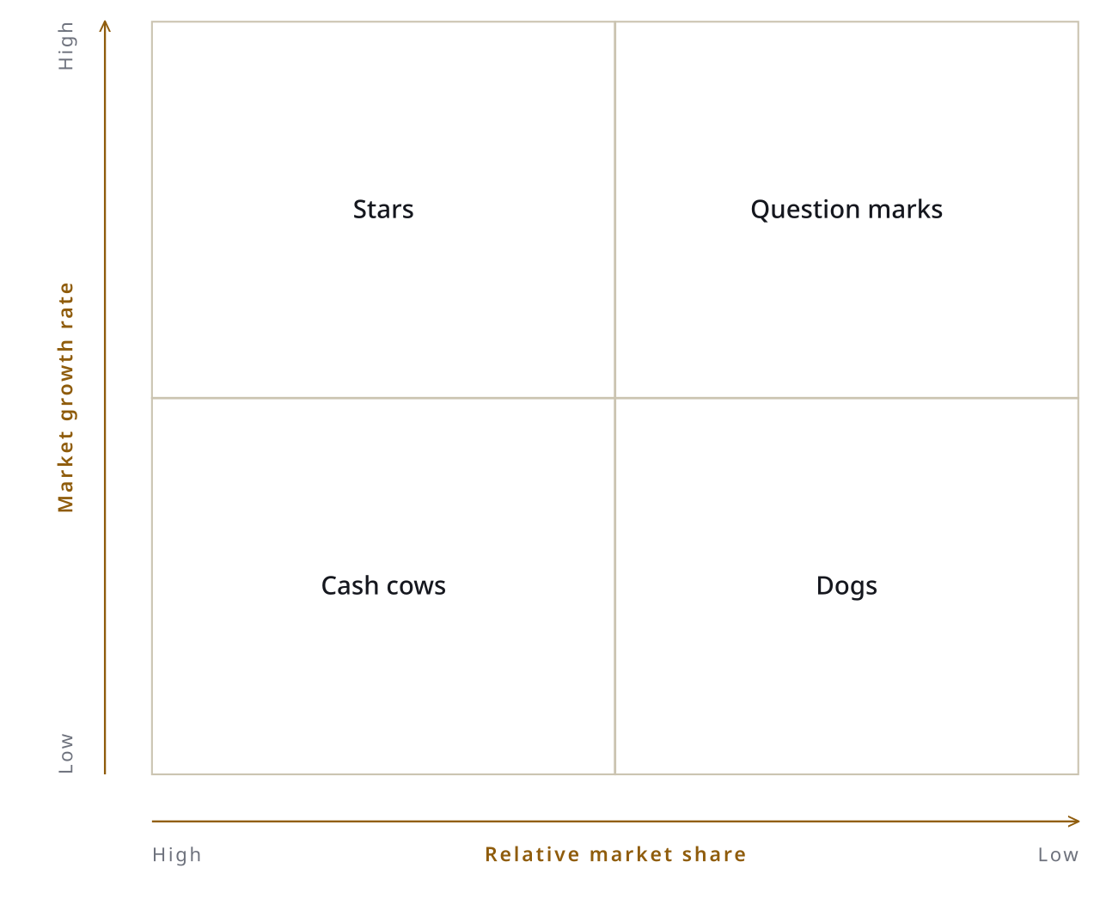
A question mark with relative share of 0.25
A star with relative share of 4.0
A dog with relative share of 0.25
A cash cow with relative share of 12
Relative share = 12/48 = 0.25 (low), and high growth makes it a question mark. A dog would have low growth. Image: Peter Gladdish, CC BY 4.0, via Wikimedia Commons.
Which scenario best fits the 'market development' cell of the Ansoff matrix shown?
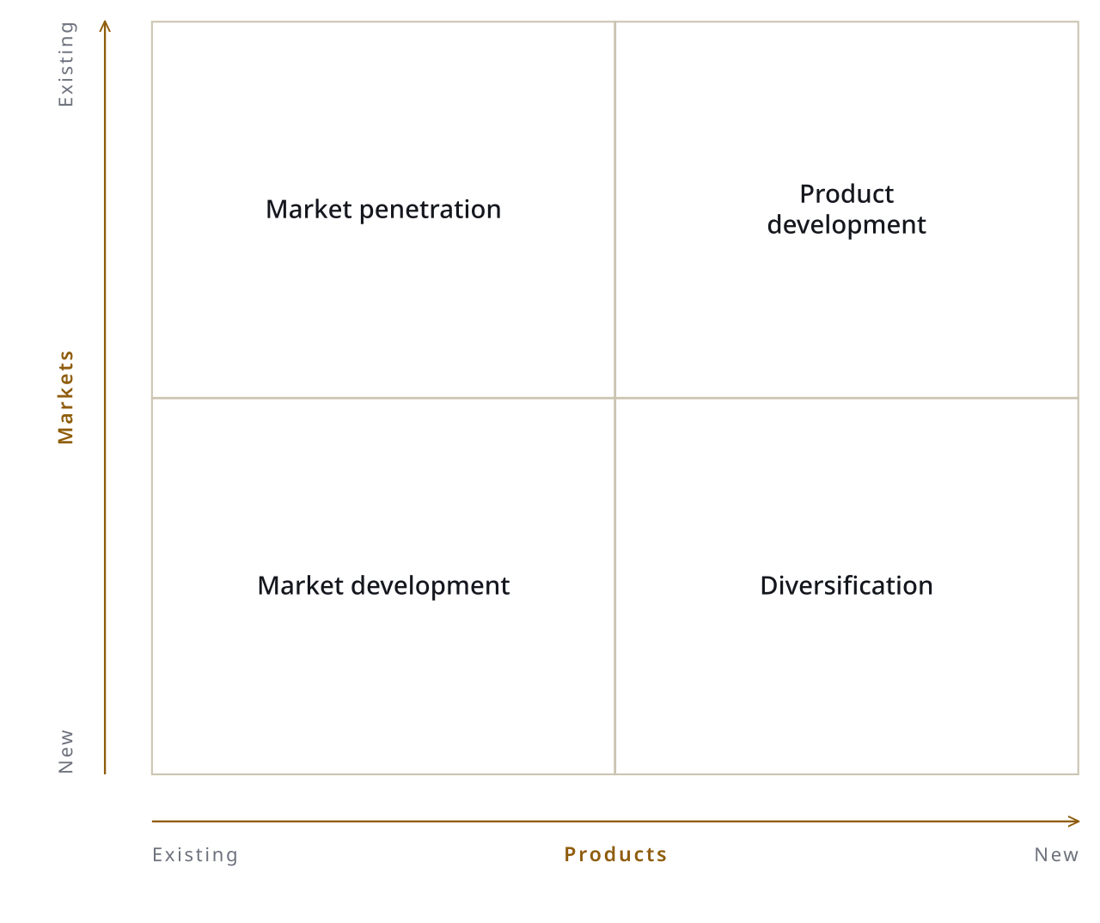
A coffee chain launches a new tea range for current customers
A UK coffee chain opens its existing shops in Japan
A coffee chain runs a loyalty program to sell more coffee to current customers
A coffee chain buys a software company
Existing product, new market. The tea range is product development, the loyalty scheme is penetration, and buying a software company is diversification. Image: Peter Gladdish, CC BY 4.0, via Wikimedia Commons.
A mid-sized manufacturer wants to enter a new foreign market quickly while sharing risk and gaining local knowledge. Which entry mode best fits?
Greenfield wholly owned subsidiary
Exporting through its own sales staff only
A joint venture with a local partner
Selling the home business and relocating
Joint ventures share risk and bring local knowledge, though control is shared. Greenfield investments are slower and riskier. Exporting is low commitment but limited.
A once-dominant photographic film company failed to adapt to digital imaging, although its own engineers invented the digital camera. Which concept explains the failure best?
Blue ocean value innovation
Backward integration
Horizontal integration
Core rigidity (capabilities become obstacles)
Existing capabilities, structures and the incentive to protect the film business blocked adaptation. Value innovation and integration are not explanations of the failure.
Porter argues that 'operational effectiveness is not strategy' because:
Best practices are easily imitated, while strategy requires a distinctive, trade-off-based set of activities
Operations never affects profitability
Strategy only concerns the top managers
Efficiency always conflicts with quality
Competitors can copy best practices, producing convergence. Strategic positioning comes from choosing different activities and creating fit.
A cement producer buys a chain of building-supply stores. Which description is the most accurate?
Backward vertical integration
Forward vertical integration into distribution
Related horizontal merger
Conglomerate diversification
Moving downstream toward customers (distribution) is forward integration. Cement and building supply stores are related in the value chain, so this is not conglomerate diversification.
Which statement about the BCG matrix is a valid critique?
It cannot be used for companies with more than one product
It assumes markets never change
High market share does not guarantee high profit and the axes ignore synergies between units
It ignores the concept of cash flow
BCG's simplifications (two dimensions, share-profit link, no synergies) are the usual critique. It was explicitly designed around cash flows.
A firm follows a strategy of building brand loyalty and premium design, but its prices are not higher than rivals' and its costs are high. What problem does this signal?
Failure to capture the value created by differentiation
Successful cost leadership
Perfect strategic fit
A blue ocean
Differentiation should raise willingness to pay and allow a premium or share gains that exceed the cost of differentiating. High cost without a premium destroys value.
A firm owns a resource that is valuable, rare and costly to imitate, but has no systems, culture or incentives to use it well. According to VRIO, the firm will:
Achieve a fully sustained advantage anyway
Leave part of the potential advantage unexploited
Fall into competitive disadvantage
Have only competitive parity
The O in VRIO requires organization (processes, culture, incentives) to capture value. Without it the advantage is not fully realized. Disadvantage arises when a resource is not valuable at all.
In a one-time prisoner's dilemma between two competing firms deciding whether to cut prices, the Nash equilibrium is typically:
Both hold prices
One cuts and the other holds
Both cut prices, even though both would be better off holding prices
No equilibrium exists
Cutting is the dominant strategy for each, so both end up worse off. Repeated interaction can make cooperation sustainable.
A strategy map links objectives across balanced scorecard perspectives. Which causal chain is typical?
Financial, then customer, then internal processes, then learning
Customer, then financial, then learning and growth, then processes
Internal processes only
Learning and growth, then internal processes, then customer, then financial
Investments in people and systems improve processes, which improve customer outcomes and finally financial results.
