Quiz · Hard
Sixteen questions using the money market graph, transmission channels, exchange rates, lags, QE and the long-run neutrality of money.
In the money market diagram, what causes the interest rate to fall from i1 to i2?
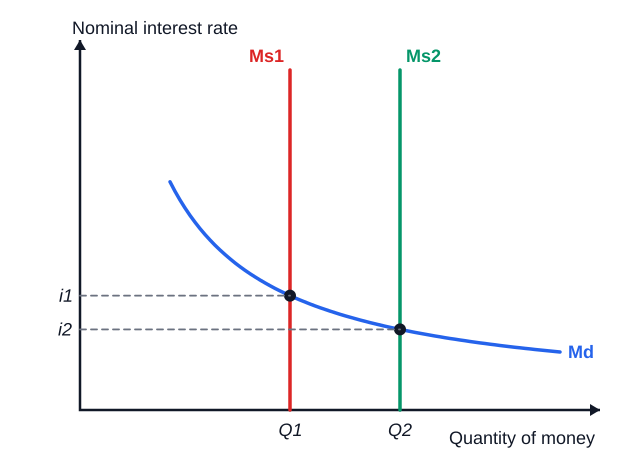
An increase in the money supply from Ms1 to Ms2
An increase in money demand
A decrease in the money supply
A rise in the price level
A larger money supply creates excess supply of money at i1, so the interest rate must fall until people willingly hold the extra money. Demand shifts or a smaller supply would raise rates.
Which sequence correctly describes expansionary monetary policy?
Money supply ↑ → interest rate ↑ → investment ↓ → AD ↓
Money supply ↑ → interest rate ↓ → investment ↑ → AD ↑ → real GDP ↑
Money supply ↓ → interest rate ↑ → AD ↓
Interest rate ↓ → money supply ↓ → AD ↑
This is the standard transmission mechanism: lower rates raise interest-sensitive spending, shifting AD right. The other sequences reverse a link or the direction.
The Fed raises the federal funds rate. Which is the most likely effect on the dollar and net exports?
The dollar depreciates and net exports fall
The dollar appreciates and net exports rise
The dollar appreciates and net exports fall
The dollar depreciates and net exports rise
Higher US rates attract foreign capital, raising demand for dollars. A stronger dollar makes US exports more expensive and imports cheaper, reducing net exports.
In the long run, an increase in the money supply causes:
Permanently higher real GDP
Permanently lower unemployment
Higher nominal variables (prices, wages) but no change in real GDP
Permanently lower interest rates
Money is neutral in the long run: real variables are determined by real factors. In the short run, sticky prices let output rise temporarily.
The economy is at potential output and the Fed unexpectedly increases the money supply. In the diagram, what do points A, B and C show?
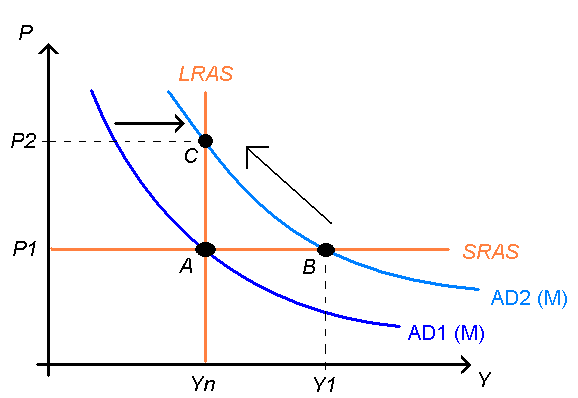
A: start; B: short-run effect with higher output; C: long run with higher prices at original output
A: start; B: long-run price level; C: short-run output
A: recession; B: potential output; C: inflationary gap
A: long run; B: AD1; C: LRAS shift
At A the economy is at Yn. The AD shift raises output to Y1 in the short run (B), but with no change in potential, prices eventually rise and output returns to Yn at P2 (C). Image: M.M. Schneider, CC0.
Which condition best describes a liquidity trap?
Nominal rates near zero and extra money does not stimulate spending
Rates above 10% and falling money demand
Banks are unable to find any deposits
The government has a large budget surplus
At the zero lower bound, extra money is simply held as cash, so further increases in the money supply do not lower rates or raise spending.
Which of the following is the main reason monetary policy has 'long and variable lags'?
The Fed only meets once a year
Changes in interest rates take time to affect investment, consumption and prices
Congress must vote on each rate change
Interest rates are fixed by contracts
Firms and households adjust spending slowly, and the effect on inflation takes even longer, so the impact lag is long and uncertain.
A bond with a fixed payment becomes less valuable when:
Market interest rates fall
The central bank buys bonds
Inflation falls
Market interest rates rise
Bond prices move inversely with market rates. A rate rise lowers existing bond prices. Fed purchases raise bond prices.
The Fed sells bonds in an open market operation. This tends to:
Reduce reserves, raise the federal funds rate and reduce AD
Increase reserves and reduce interest rates
Increase AD and prices
Lower the discount rate automatically
Selling bonds drains reserves from banks, tightening credit. It is a contractionary policy.
Which statement about a $1,000 deposit with a 10% reserve ratio is most accurate?
Banks can create only $900
Banks can eventually create up to $10,000 in total deposits if there are no leakages
Banks can create an unlimited amount of money
Deposits expand by exactly $1,100 per round forever
1 ÷ 0.10 = 10, so up to $10,000. Leakages (cash held, excess reserves) reduce this.
Why might the Fed prefer forward guidance to larger rate changes in some situations?
It requires Congressional approval
It automatically increases tax revenue
It can influence long-term rates through expectations without changing the current policy rate
It sets the exchange rate
Markets price long-term rates on the expected path of short-term rates, so credible guidance moves long rates even at the zero lower bound.
Which of the following is the best evidence that the Fed responded strongly to COVID-19 in March 2020?
It cut the target range to 0-0.25% and set reserve requirements to zero
It raised the discount rate to 5%
It reduced the monetary base
It announced a tax cut
Emergency rate cuts, QE and the end of reserve requirements were part of the March 2020 response. Tax cuts are fiscal policy.
Quantitative tightening affects the economy by:
Raising the money multiplier
Shrinking the Fed's balance sheet and draining reserves
Increasing the number of Fed governors
Cutting taxes on bank profits
QT removes reserves and tightens financial conditions, putting upward pressure on long-term rates.
A central bank follows a credible rule and inflation expectations are anchored. A one-time oil shock raises prices. The best response is likely to be:
Raise rates sharply immediately
Cut rates to zero
Look through the temporary shock, since expectations remain anchored
Buy long-term bonds in unlimited amounts
If expectations are anchored, a one-off price level jump will not turn into persistent inflation, so strong tightening would needlessly raise unemployment.
Which of these combinations best describes the Fed's rate decision in 2022-23?
Rates kept at zero throughout
Rates cut to negative levels
Rates fixed at 2%
Rates raised from near zero to above 5% to fight high inflation
The target range rose from 0-0.25% in March 2022 to 5.25-5.50% by July 2023.
Which of these is a drawback of discretionary policy compared with rules?
Time inconsistency: policymakers may be tempted to create surprise inflation
It requires no central bank
It reduces flexibility
It guarantees low inflation
Without a binding commitment, policymakers may promise low inflation but then inflate to boost output. Rules help build credibility.
