Quiz · Medium
Twenty questions on the labor force, unemployment and participation rates, discouraged workers, frictional, structural and cyclical unemployment, with US charts.
An economy has 180 million employed, 20 million unemployed and 100 million not in the labor force. What is the unemployment rate?
10%
6.7%
20%
11.1%
Labor force = 180 + 20 = 200 million, so u = 20/200 = 10%. 20/100 = 20% mistakenly uses people not in the labor force; 20/180 = 11.1% leaves out the unemployed from the denominator.
In the same economy, the labor force participation rate is:
60%
66.7%
90%
55.6%
Working-age population = 300 million. LFPR = 200/300 = 66.7%. 60% is the employment-population ratio (180/300).
A worker who has given up searching because she believes no jobs are available is classified as:
Unemployed
Employed
Frictionally unemployed
Not in the labor force
Without active search in the last four weeks she is not counted as unemployed; she is a discouraged worker outside the labor force.
A discouraged worker leaving the labor force causes the unemployment rate to:
Rise
Stay the same
Fall
Rise and the employment-population ratio to rise
The numerator falls and so does the denominator (labor force), reducing the measured rate, though no jobs were added.
Which type of unemployment is caused by a mismatch between workers' skills and job requirements?
Structural
Frictional
Cyclical
Seasonal
Structural unemployment reflects changes in technology or industry. Frictional is normal search; cyclical comes from weak demand.
A recent graduate is searching for her first full-time job. She is:
Cyclically unemployed
Frictionally unemployed
Structurally unemployed
Not in the labor force
Frictional unemployment covers new entrants and normal job search.
Cyclical unemployment equals zero when:
The unemployment rate is 0%
The economy is in a recession
The economy is at full employment (the natural rate)
Inflation is zero
At the natural rate, only frictional and structural unemployment remain.
The natural rate is 5% and the actual rate is 8.5%. Cyclical unemployment is:
3.5%
8.5%
13.5%
5%
Cyclical = actual − natural = 3.5 percentage points.
Which survey is used to calculate the unemployment rate?
The establishment (payroll) survey
The Current Population Survey (household survey)
The Consumer Price Index survey
JOLTS
The CPS of about 60,000 households measures employment status of people. The establishment survey counts jobs on payrolls.
Which of the following is counted as employed?
A person who worked 10 hours last week for pay
A person on temporary layoff expecting recall
A student not looking for work
A retiree volunteering unpaid at a charity
Any paid work in the survey week counts. People on layoff waiting to be recalled are unemployed; students and volunteers are outside the labor force.
U-6 is higher than U-3 because it includes:
Only people over 55
Only long-term unemployed
Discouraged workers, marginally attached workers and involuntary part-timers
People in prison
U-6 broadens the official definition to include underemployment and hidden slack.
The chart shows the unemployment rate rising to nearly 15% in 2020. Which event caused it?
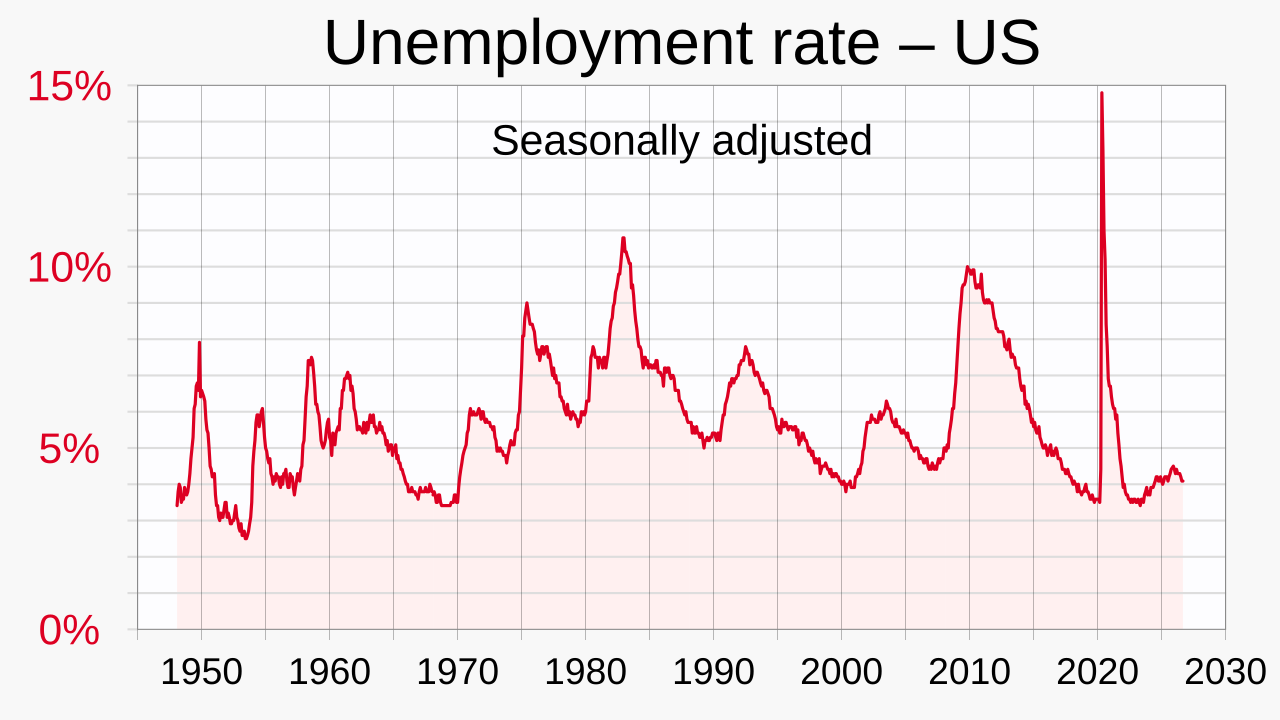
The 2008 financial crisis
The Volcker disinflation
The dot-com bubble
The COVID-19 pandemic and lockdowns
Lockdowns in March-April 2020 caused a sudden spike to 14.8%. In 2009 the peak was 10%, and in 1982 it was 10.8%. Image: RCraig09, CC BY-SA 4.0.
In the Great Depression chart, unemployment peaked at about:
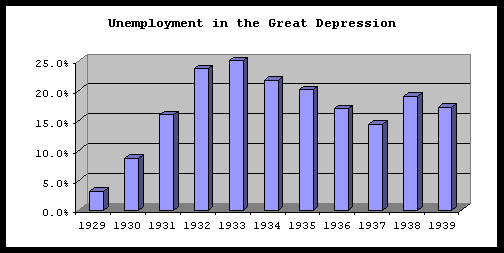
25% in 1933
10% in 1929
15% in 1939
5% in 1931
The unemployment rate rose from about 3% in 1929 to about 25% in 1933. Image: Mmakki, CC BY-SA 3.0.
Which of the following would reduce structural unemployment most directly?
Higher unemployment benefits
Job retraining programs
Lowering interest rates
An increase in the minimum wage
Retraining builds skills that match job openings. Expansionary policy addresses cyclical unemployment; higher benefits tend to lengthen search.
A steelworker is laid off because a recession reduced demand for steel. This is:
Cyclical unemployment
Frictional unemployment
Structural unemployment
Seasonal unemployment
The layoff is due to weak aggregate demand, so it is cyclical and should reverse when the economy recovers.
Which statement about the unemployment rate in recoveries is correct?
It always falls at the start of the recovery
It leads the business cycle
It never changes
It is a lagging indicator that may keep rising after the recession ends
Firms hire cautiously, and re-entering workers join the labor force, so the rate can peak after output starts growing.
Seasonal unemployment is shown by:
Auto workers laid off during a recession
A coal miner replaced by gas power
Lifeguards at an outdoor pool in winter
A new graduate searching for a first job
Seasonal unemployment follows predictable annual patterns of demand.
Why is full employment not equal to zero unemployment?
Frictional and structural unemployment always exist
Cyclical unemployment never goes away
Firms refuse to hire
The BLS undercounts jobs
At full employment the economy is at the natural rate, which includes frictional and structural unemployment.
True or False: A person on temporary layoff who expects to be recalled is counted as unemployed.
True
False
True. People waiting to be recalled from a temporary layoff count as unemployed even if they have not looked for work.
