Quiz · Hard
Sixteen harder questions on the Phillips curve, the Fisher effect, the quantity theory, the Taylor rule, sacrifice ratios and the 1970s.
The SRPC shifts upward when:
Expected inflation rises
Unemployment falls below the natural rate
The money supply is unchanged
Real GDP rises along a fixed SRAS
A higher expected inflation raises wage settlements, so actual inflation is higher at each unemployment rate. A fall in unemployment is a movement along the SRPC, not a shift.
According to the natural rate hypothesis, in the long run:
Permanent inflation can permanently lower unemployment
Unemployment returns to the natural rate regardless of the inflation rate
Inflation always returns to zero
Unemployment equals inflation
People adjust expectations, so the LRPC is vertical. Policy can temporarily push unemployment below the natural rate only by accelerating inflation.
The Fed announces a credible, permanent reduction in its inflation target and the public believes it. Under rational expectations, the likely effect is:
Inflation falls with a smaller loss of output than traditional estimates suggest
Inflation falls only after a deep recession
Unemployment rises permanently
Nothing happens
If expectations adjust immediately, wage and price setters lower their demands without a large unemployment cost. If the policy lacks credibility, the sacrifice ratio is larger.
The Fisher effect states that a permanent 2 percentage point rise in expected inflation will, in the long run, raise:
The real interest rate by 2 points
Both nominal and real rates by 2 points
The nominal interest rate by 2 percentage points
The nominal rate by 1 point
i = r + πe, and r is determined by real forces. So nominal rates rise one for one with expected inflation.
Using a Taylor rule with r* = 2%, π* = 2%, inflation at 4% and zero output gap, the implied policy rate is:
6%
5%
4%
7%
i = π + r* + 0.5(π − π*) + 0.5(gap) = 4 + 2 + 0.5(2) + 0 = 7%. The coefficient on inflation exceeds 1, so the real rate rises when inflation rises.
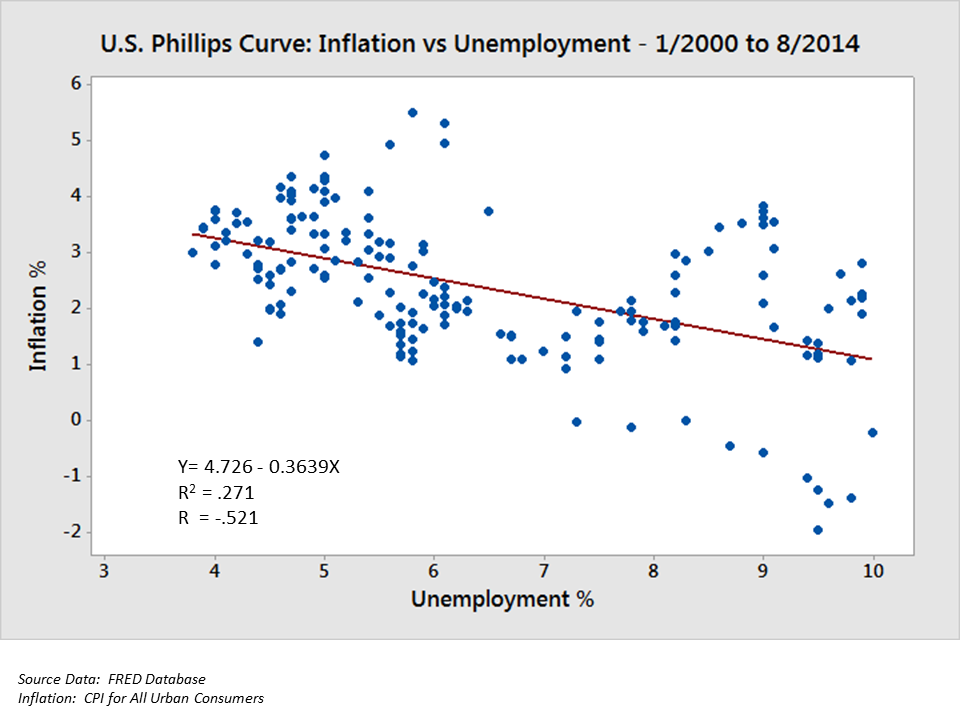
The scatter shows US unemployment against inflation (2000-2014). The fitted line slopes downward. What does this illustrate?
The long-run Phillips curve
A short-run Phillips curve trade-off, though with considerable scatter
The Laffer curve
Okun's law
A negative association between unemployment and inflation is the Phillips relationship. The scatter shows it is not a precise or stable trade-off. Image: Farcaster, CC BY-SA 3.0, via Wikimedia Commons.
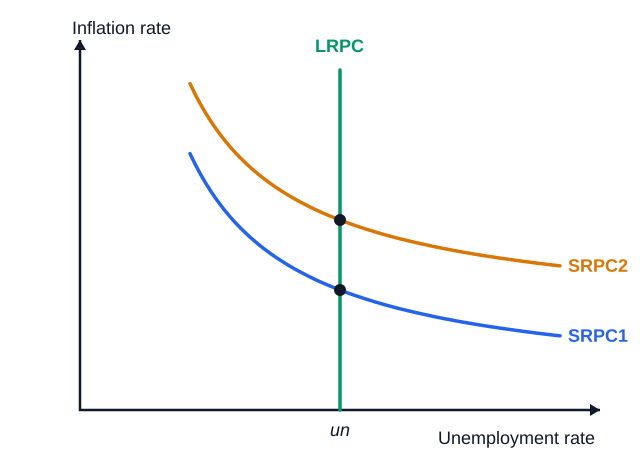
In the diagram, what does the move from SRPC1 to SRPC2 represent?
A rise in expected inflation (or a supply shock)
A movement along the same curve as unemployment falls
A fall in the natural rate of unemployment
A leftward shift of LRPC
Both curves intersect LRPC; SRPC2 lies above SRPC1 because inflation expectations are higher. At the natural rate, unemployment is unchanged.
An economy's sacrifice ratio is 5. The central bank wants to cut inflation from 8% to 3%. About how much cumulative real GDP (as a share of one year's GDP) will be lost?
5%
15%
25%
40%
A 5-point reduction × 5 = 25% of one year's GDP, spread over several years. A ratio of 5 means 5% of a year's output is lost per percentage point of disinflation.
Suppose nominal rates stay at 4% while expected inflation rises from 1% to 3%. The expected real rate:
Falls from 3% to 1%
Rises from 1% to 3%
Falls from 4% to 1%
Stays at 3%
r = i − πe: 4 − 1 = 3% before, 4 − 3 = 1% after. Borrowers gain, lenders lose, and spending tends to rise.
The 1970s experience of high inflation together with high unemployment is best explained by:
Negative supply shocks and rising inflation expectations shifting the SRPC upward
A leftward shift of the LRPC alone
Falling government spending
A rightward shift of aggregate demand only
Oil shocks raised costs, while rising expectations moved the SRPC up, so a given unemployment rate came with higher inflation: stagflation.
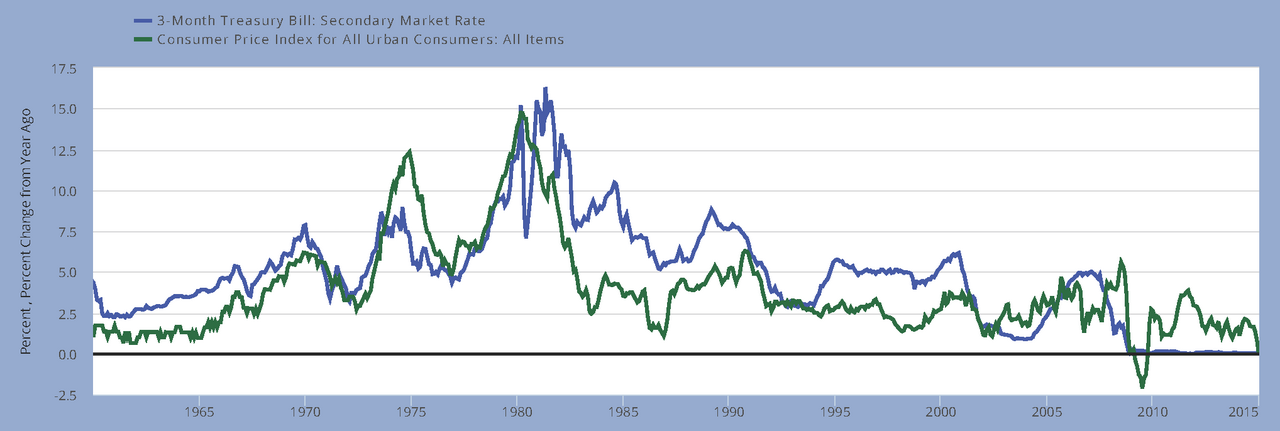
The chart plots the 3-month Treasury bill rate and CPI inflation. Which relationship does it best illustrate?
Real interest rates were always zero
Nominal interest rates tend to rise and fall with inflation
Inflation always lags interest rates by exactly one year
Nominal rates were unrelated to inflation after 1970
The two lines moved together in the 1970s and 1980s, consistent with the Fisher effect, but rates stayed above inflation after 1981, meaning real rates were high. Image: Lawrencekhoo/Patrug, public domain.
Which statement about hyperinflation is most accurate?
It is caused by too much saving
It always begins with a trade surplus
It is generated by high real interest rates
It usually results from rapid money creation to finance government deficits
Governments that cannot borrow or tax print money, which accelerates inflation. Velocity rises too, since people spend money before it loses value.
The economy has an inflation target of 2%. Inflation is 2% but unemployment is below the natural rate, which the central bank expects will push inflation up. A forward-looking central bank following the Taylor rule would:
Lower the policy rate
Raise the policy rate
Keep the rate unchanged
Increase the reserve requirement only
With positive output gap (below-natural unemployment) the Taylor rule says rates should rise, preventing inflation pressure from building.
True or False: According to the expectations-augmented Phillips curve, if unemployment equals the natural rate and there are no supply shocks, actual inflation equals expected inflation.
True
False
True. In π = πe − β(u − un) + ν, the gap and shock terms vanish, so π = πe.
Money growth is 10%, velocity is falling at 2% a year and real GDP grows 3%. The quantity theory predicts inflation of about:
15%
9%
7%
5%
%ΔM + %ΔV = %ΔP + %ΔY → 10 − 2 = %ΔP + 3 → %ΔP = 5%.
Why might a central bank prefer a 2% inflation target to a 0% target?
Because inflation is costless
Because it makes the Phillips curve vertical
It gives room to cut real interest rates during downturns and guards against deflation
Because it eliminates menu costs
With a positive target, nominal rates are on average higher, giving room to cut before hitting zero. Price index bias and sticky wages are also arguments.
