Quiz · Medium
Core concept check on conditioning, reinforcement, memory models, Bloom, Maslow, self-efficacy, attribution and basic test statistics.
A student learns to feel anxious when she hears the school bell because it was repeatedly paired with a fire drill. This is:
Operant conditioning
Classical conditioning
Observational learning
Shaping
A neutral stimulus (bell) became a conditioned stimulus through association with an unconditioned stimulus (the alarm).
A teacher gives a sticker for each completed assignment, and completion increases. This is:
Positive reinforcement
Negative reinforcement
Positive punishment
Negative punishment
Adding a pleasant stimulus increased the behavior.
Taking away recess because a student interrupted is:
Negative reinforcement
Positive punishment
Extinction
Negative punishment
A pleasant thing (recess) is removed to decrease the behavior.
Which schedule produces the highest, steadiest response rate and is the most resistant to extinction?
Fixed ratio
Fixed interval
Variable ratio
Variable interval
Because reinforcement is unpredictable, responding persists. Fixed interval gives scalloped, pause-then-burst responding.
Where does information go first in the Atkinson-Shiffrin model, before attention selects it?
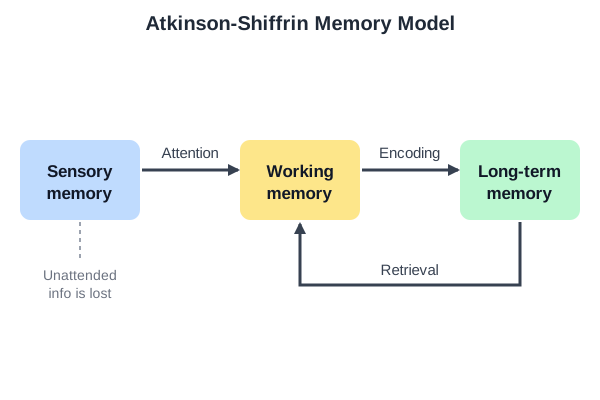
Working memory
Sensory memory
Long-term memory
Procedural memory
Attention moves selected information from sensory memory to working memory.
Which process moves information from working memory into long-term memory?
Encoding
Retrieval
Attention
Decay
Retrieval goes the other way, from long-term memory to working memory.
Approximately how many chunks can working memory hold according to modern estimates?
About 20
About 100
Unlimited
About 4
Miller said 7 plus or minus 2; later work (Cowan) suggests closer to 4 chunks.
Which study strategy has the strongest research support for long-term retention?
Highlighting
Re-reading
Practice testing spread over time
Summarizing the text word for word
Dunlosky et al. (2013) rated practice testing and distributed practice as high utility. Highlighting and re-reading are low utility.
A new teacher's phone number blocks a student from remembering the old number. This is:
Proactive interference
Retroactive interference
Decay
Retrieval failure due to lack of cues
New information (new number) disrupts older memory (old number). In proactive interference, the old interferes with the new.
Metacognition means:
Thinking about and regulating one's own thinking
Memorizing facts
Learning from observing others
Solving problems quickly
Planning, monitoring and evaluating one's own learning.
Which level of Bloom's Revised Taxonomy is at the base?
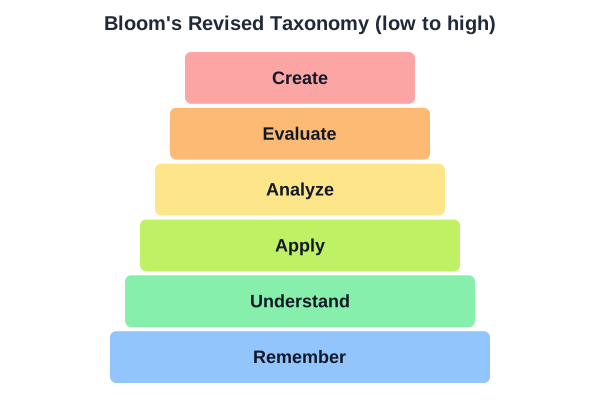
Understand
Apply
Create
Remember
Remember is the lowest level and Create is the highest.
Maslow's hierarchy says that which need must be reasonably met before a student can focus on belonging?
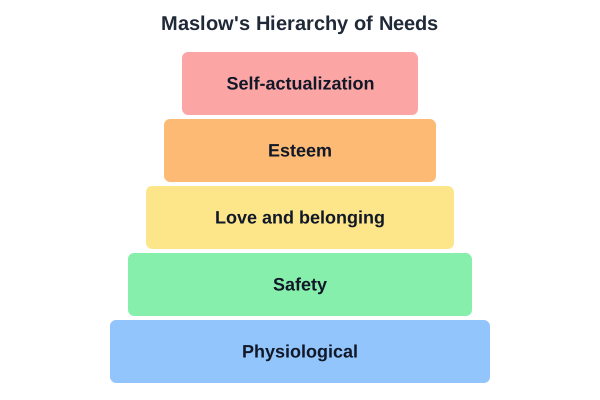
Esteem
Self-actualization
Safety
Cognitive growth
Physiological and safety needs come before belonging.
Self-determination theory identifies which three basic needs?
Safety, esteem and achievement
Autonomy, competence and relatedness
Power, affiliation and achievement
Effort, ability and luck
Supporting all three fosters intrinsic motivation.
Which is the strongest source of self-efficacy?
Mastery experiences
Verbal persuasion
Vicarious experiences
Physiological states
Success at a task builds belief better than other sources, per Bandura.
A teacher says, 'You must be really smart.' According to Dweck's research, this kind of praise tends to:
Raise persistence
Increase intrinsic motivation
Have no effect
Promote a fixed mindset and avoidance of challenge
Person praise implies ability is fixed. Praise effort and strategies instead.
A student believes she failed because she is not smart. In Weiner's terms, this attribution is:
Internal, unstable and controllable
External, stable and uncontrollable
Internal, stable and uncontrollable
External, unstable and controllable
Ability is seen as internal to the person, unchanging and outside one's control. Effort would be internal, unstable and controllable.
Offering pizza coupons to children for reading that they already enjoy may lead to:
Increased intrinsic motivation
The overjustification effect: lower interest when the rewards stop
No change in motivation
Better comprehension
External rewards can shift the perceived reason for reading from interest to reward.
What does a z-score of -1 mean?
One standard deviation below the mean
One percent below the mean
The 1st percentile
One point below average
z = (x - mean)/SD. A z of 0 is average.
Which pair is correct?
Reliability = fairness; validity = consistency
Reliability = difficulty; validity = length
Reliability = accuracy of scoring only
Reliability = consistency; validity = measures what it is supposed to measure
A test can be reliable without being valid, but not valid without being reliable.
