Quiz · Medium
Realism, liberalism, constructivism, security dilemma, deterrence, soft power and international law in short applied questions.
Which statement best reflects the realist view of international politics?
Institutions can eliminate conflict among states
States pursue power and security in an anarchic system
Identities and norms define national interests
Economic class drives all state behavior
Realism stresses self-help and power. Liberalism emphasizes institutions, constructivism ideas and Marxism class.
Two neighboring states each increase their military budgets to feel safer, which makes both feel less safe. This is an example of:
Collective security
Soft power
Complex interdependence
The security dilemma
Defensive moves look threatening to others and cause arms races. Collective security is a different concept: shared response to aggression.
A country attracts students, tourists and investment through its culture, universities and values. Joseph Nye would call this:
Soft power
Hard power
Coercive diplomacy
Hegemonic stability
Soft power is attraction without coercion. Hard power uses military or economic pressure.
Which thinker is most associated with the democratic peace theory?
Thomas Hobbes
Hans Morgenthau
Immanuel Kant
Karl Marx
Perpetual Peace (1795) argued that republics are less likely to go to war. Hobbes and Morgenthau are realists.
Alexander Wendt's phrase 'anarchy is what states make of it' best illustrates:
Neorealism
Dependency theory
Constructivism
Liberal institutionalism
Constructivists argue that the meaning of anarchy depends on shared ideas, not just material power.
During the Cold War, the doctrine that both superpowers could destroy each other in a nuclear exchange was called:
Mutual Assured Destruction
Containment
Détente
Appeasement
MAD depended on second-strike capability. Containment was US policy to stop the spread of communism.
Which of these is an example of an international non-governmental organization?
NATO
The World Bank
The European Commission
Amnesty International
NGOs are private groups. NATO, the World Bank and the Commission are intergovernmental or supranational bodies.
Which institution can prosecute individuals for genocide and war crimes?
The International Court of Justice
The International Criminal Court
The World Trade Organization
The UN General Assembly
The ICJ settles disputes between states. The ICC, created by the Rome Statute, tries individuals.
What does 'Responsibility to Protect' say?
States may never intervene in each other's affairs
States must protect their people from mass atrocity, and the international community may act if they fail
The UN must send peacekeepers to every conflict
Only NATO may authorize intervention
R2P (2005) qualifies sovereignty as responsibility. It does not create an automatic right to intervene; the Security Council must authorize force.
The Peace of Westphalia (1648) is usually cited as the origin of:
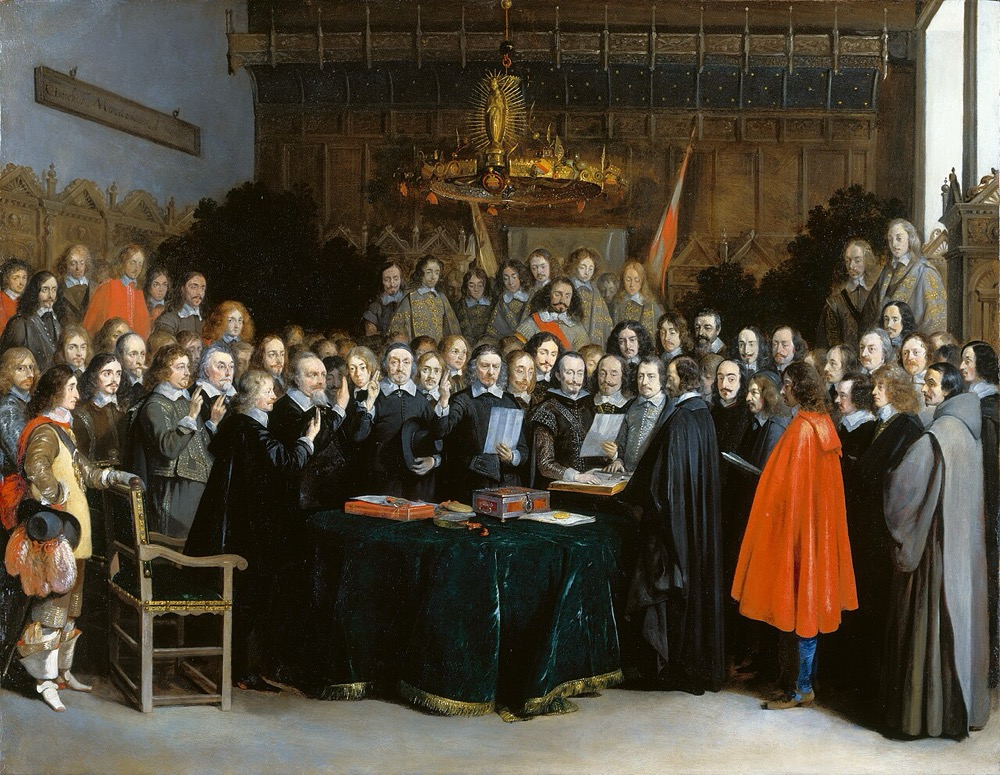
The United Nations
The balance of power in the Cold War
The modern system of sovereign states
The European Union
It ended the Thirty Years' War and is the traditional starting point of state sovereignty in IR theory.
A state avoids war by threatening unacceptable retaliation. This is:
Deterrence
Appeasement
Isolationism
Humanitarian intervention
Deterrence works through the credible threat of punishment.
Which sentence best describes complex interdependence?
States depend only on military alliances
The strongest state controls all other states
The world has no economic links
States are connected through trade, NGOs and institutions, so the use of military force becomes costly
Keohane and Nye used the idea to challenge purely realist views.
Which of these best fits the term 'hegemon'?
A state that has joined every alliance
A state without armed forces
A state with predominant military, economic and ideological influence over the system
A state under UN trusteeship
The US after 1945 is the classic example, and Britain in the 19th century is another.
According to Waltz, the 'system' level of analysis explains war by:
The personality of leaders
The anarchic structure of the international system
A country's domestic institutions
Public opinion in each state
The three images in Waltz's Man, the State, and War: individual, state, system. Neorealism focuses on the third.
What is the main difference between collective security and an alliance?
Collective security is voluntary while alliances are compulsory
Alliances have no military
Collective security excludes great powers
Collective security covers all members against any aggressor, while an alliance targets specific external threats
The League and UN are collective-security bodies; NATO is an alliance (though Article 5 is collective defense).
The 1970s effort to relax US-Soviet tensions through arms control agreements is known as:
Détente
Containment
Brinkmanship
Isolationism
SALT I and the Helsinki Accords belong to détente. Containment was the earlier, more confrontational strategy.
Which pair of terms correctly matches?
Jus in bello: rules for conducting war
Jus ad bellum: how prisoners must be treated
Customary law: written treaties only
Jus cogens: rules that states can freely ignore
Jus ad bellum is about the justification for war. Jus cogens are fundamental norms (e.g. against genocide) that cannot be derogated.
In which situation is 'proxy war' the best description?
Two states fight a direct border war
A state sanctions another state
Two superpowers supply arms to opposing sides in a third country's civil war
A state signs a trade treaty
The Cold War produced many: Korea, Angola, Afghanistan.
Which theory would say global poverty results from a structure that keeps poor countries dependent on rich ones?
Classical realism
Dependency (world-systems) theory
Democratic peace theory
Liberal internationalism
Wallerstein's world-systems theory describes core and periphery.
Which of these is a hard-power instrument?
Funding university exchanges
Promoting a country's films
Hosting a cultural festival
Imposing a naval blockade
Blockades and sanctions coerce; the other options are soft-power.
Which statement about sanctions is most accurate?
They always force regime change
They can pressure a government but often hurt civilians and may not change policy
They are military actions
They cannot be imposed without a UN vote
States and organizations can impose sanctions on their own; effectiveness varies.
