Quiz · Medium
Covers Hobbes, Locke and Rousseau, Montesquieu, Machiavelli, Marx, Rawls, Nozick, Mill and Berlin, plus legitimacy and political obligation.
Which phrase describes the state of nature according to Hobbes?
A state of perfect freedom governed by reason
A golden age of equality
'Solitary, poor, nasty, brutish, and short'
A just order enforced by natural law
Without a common power life is a war of all against all. A state of reasonable freedom under natural law is closer to Locke, and a golden age of equality to Rousseau's romantic view.
Why does Locke believe government is limited?
It is created by consent to protect natural rights, and may be dissolved if it violates them
Because all power should be divided among clans
Because God gave kings absolute authority
Because the state of nature is a war of all against all
Locke's Second Treatise argues for a fiduciary trust, and the right of revolution. Hobbes held that the sovereign must be absolute; the divine right of kings is what Locke attacked.
In Rousseau's Social Contract, the 'general will' is...
the sum of all individual preferences
the will of the monarch
the decision of the majority at any moment
the will of the citizens as a body directed at the common good
The general will aims at the common good and may differ from the 'will of all', which is merely the aggregate of private wills, or from a majority's passing preference.
The giant figure on the frontispiece shown, made up of many small people, symbolizes which political theory?
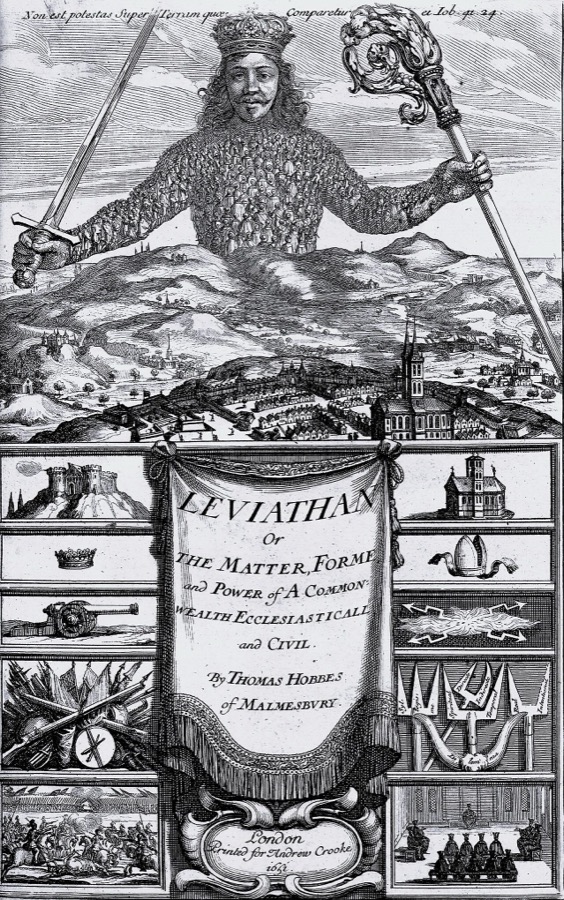
Hobbes's sovereign (the Leviathan) as an artificial person composed of its subjects
Locke's limited government
Marx's classless society
Plato's philosopher-kings
The frontispiece of Hobbes's Leviathan (1651), engraved by Abraham Bosse, shows the sovereign wielding sword and crozier, his body formed from the subjects who authorized him. The others are different theories entirely. Image: CC0, via Wikimedia Commons.
The idea of separating legislative, executive and judicial powers is most associated with...
Rousseau
Montesquieu
Hobbes
Marx
Montesquieu's Spirit of the Laws (1748) influenced the US constitutional framers. Rousseau favoured the sovereignty of the general will, and Hobbes a single sovereign.
Machiavelli's concept of 'virtù' refers to...
Christian moral virtue
a ruler's skill, energy and adaptability in mastering circumstances
personal wealth
loyalty of a people to a prince
Machiavelli's virtù is closer to prowess than to moral goodness. Fortuna is the unpredictable force a prince must contend with.
In Rawls's original position, the parties choose principles...
knowing their own talents so they can maximize them
by majority vote in an existing society
based on divine commands
without knowing their own social position, talents or conception of the good
The veil of ignorance forces impartiality. If parties knew their position they would favour themselves.
The difference principle permits inequalities only if they...
benefit the least advantaged
maximize total utility
result from voluntary exchange
reward the most talented
The difference principle is Rawls's distributive rule. Maximizing total utility is utilitarian; free exchange is Nozick's view.
Which statement best expresses Nozick's entitlement theory?
A distribution is just if it maximizes the minimum share
A distribution is just if it gives everyone equal resources
A distribution is just if it arises from just acquisition and just transfer
A distribution is just if it matches desert
Nozick argued that justice is historical and unpatterned. Maximin is Rawls's view; equality of resources is Dworkin's.
Berlin's 'negative liberty' means...
self-mastery according to reason
freedom to realize one's potential
freedom from the state only
freedom from interference by others
Negative liberty is the absence of obstacles. Positive liberty concerns self-direction or capacities, which Berlin feared could justify coercion.
Mill's harm principle says that society may coerce an individual against their will only to...
prevent harm to others
protect them from themselves
enforce majority morality
promote the greatest good
Mill rejected paternalism and moralism as grounds for coercion. 'Promoting the greatest good' is the utilitarian principle but not his restriction on interference.
Marx's thesis on Feuerbach says philosophers have only interpreted the world; the point is to...
abolish it
understand it
change it
accept it
Thesis 11 (1845) expresses Marx's emphasis on practice and revolution.
Hume criticizes social contract theory because...
people are too selfish to cooperate
no one has actually consented, and tacit consent is a fiction
contracts require writing
the state of nature never existed in Europe
In 'Of the Original Contract' (1748) Hume says allegiance rests on utility and custom. His ship analogy ridicules tacit consent.
Which sequence lists Aristotle's three good forms of government?
Monarchy, aristocracy, polity
Tyranny, oligarchy, democracy
Monarchy, oligarchy, democracy
Aristocracy, timocracy, tyranny
Their corrupt forms are tyranny, oligarchy and democracy (rule of the many in their own interest). Plato's Republic lists timocracy, oligarchy, democracy and tyranny as degenerate regimes.
Weber's three pure types of legitimate authority are...
monarchic, aristocratic and democratic
divine, natural and positive
traditional, charismatic and legal-rational
military, economic and ideological
Weber distinguished authority by the basis of its legitimacy: custom, a leader's personal qualities, or rules and procedures.
The 'fair play' argument for political obligation says...
we must obey because God ordains the state
those who accept the benefits of a cooperative scheme owe their share of the burdens
we gave express consent when we turned 18
we obey because we fear punishment
Hart and Rawls developed fair play as an argument based on reciprocity. Critics say benefits are unavoidable and not chosen.
Okin's critique of Rawls focuses on...
his support for private property
the difference principle's inefficiency
the use of maximin reasoning
the neglect of justice within the family
Okin argued that Rawls's theory treats the family as outside justice, though gender inequality there affects fair opportunity.
Gramsci's concept of 'hegemony' refers to...
rule by military force alone
a world government
rule maintained by consent, as the ruling class's values become common sense
the mere majority of votes
Hegemony explains why subordinate groups may accept the existing order without coercion.
Which of these is a standard utilitarian or consequentialist justification of punishment?
Deterrence
Retribution
Desert
Expressing moral outrage as an end in itself
Deterrence looks to future consequences (less crime). Retribution looks backward to desert.
Which view says justice requires neutralizing the effects of brute luck but not of choices?
Libertarianism
Communitarianism
Hobbesian contractarianism
Luck egalitarianism
Dworkin and Cohen distinguish option luck (results of gambles) from brute luck. Libertarians defend entitlement from just acquisition and transfer regardless of the origin of talents.
Which pair is correctly matched?
Hobbes: separation of powers
Locke: life, liberty and property
Rousseau: the minimal state
Nozick: the difference principle
Hobbes defended an indivisible sovereign, Rousseau popular sovereignty and the general will, and Nozick the minimal state; the difference principle is Rawls's.
