Quiz · Medium
Metals, ceramics, polymers, stress-strain basics and the foreign body response, for first-course biomedical engineering.
Which statement best defines biocompatibility?
The material does not corrode in saline
The material produces no immune response of any kind
The ability to perform its intended function with an appropriate host response in a specific application
The material is derived from natural tissue
Biocompatibility is application-specific and requires an appropriate response, not necessarily no response. Corrosion resistance is a separate property, and synthetic materials can be fully biocompatible.
Which implant material is bioinert?
Alumina
Bioglass 45S5
Beta-tricalcium phosphate
PLGA
Alumina interacts minimally with tissue. Bioglass bonds to bone (bioactive), while β-TCP and PLGA degrade (resorbable).
A stiff metal stem causes bone around it to resorb. This is called:
Osseointegration
Galvanic corrosion
Creep
Stress shielding
The stem carries load that bone would carry, and by Wolff's law under-loaded bone resorbs. Osseointegration is the opposite: bone bonding to the implant.
Which is the approximate elastic modulus of Ti-6Al-4V?
1 GPa
110 GPa
20 GPa
500 GPa
Ti-6Al-4V is about 110 GPa, higher than cortical bone (15-20 GPa) but lower than CoCr and stainless steel.
Why does titanium resist corrosion in the body?
It is a noble metal like gold
Its modulus is low
It contains nickel
A thin passive TiO₂ layer forms spontaneously and reforms if scratched
Titanium is actually reactive, but its oxide film protects it. Gold is noble; titanium is not.
In the diagram shown, the point where the curve first departs from a straight line is the:
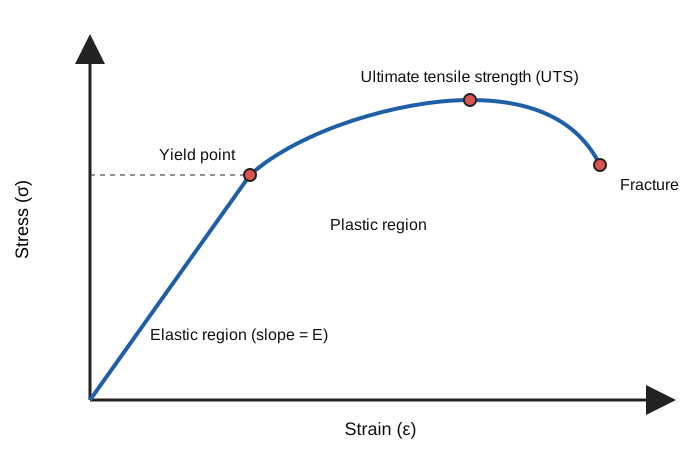
Yield point
Ultimate tensile strength
Fracture point
Toughness
The end of linear elastic behavior is the yield point. UTS is the maximum stress later on, and toughness is the area under the curve, not a point.
In the stress-strain curve shown, the slope of the initial straight segment gives:
Ultimate strength
Toughness
Elastic modulus
Poisson's ratio
Slope = stress/strain = E, the stiffness.
A 5 mm diameter wire carries 400 N in tension. The stress is about:
16 MPa
20 MPa
80 MPa
5 MPa
A = π(2.5 mm)² = 19.6 mm², so σ = 400/19.6 ≈ 20.4 MPa (N/mm² = MPa). Using diameter as the radius gives the tempting wrong 5 MPa.
Which polymer is the standard bearing liner in total joint replacements?
PMMA
PTFE
UHMWPE
PDMS
UHMWPE has low friction and good toughness. PMMA is bone cement, PTFE is used for grafts, PDMS (silicone) for soft implants.
In the order of the foreign body response, which comes immediately after protein adsorption?
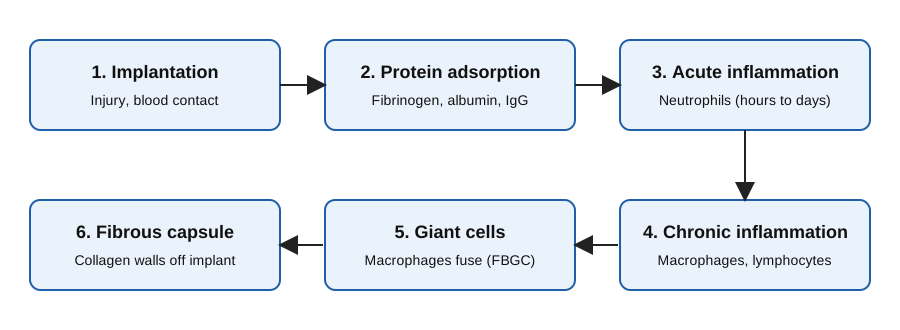
Acute inflammation with neutrophils
Fibrous capsule formation
Foreign body giant cell formation
Chronic inflammation
Order: protein adsorption, acute inflammation, chronic inflammation, giant cells, fibrous capsule.
Foreign body giant cells result from:
Neutrophil division
Fibroblast proliferation
Platelet aggregation
Fusion of macrophages
Macrophages that cannot engulf a large implant fuse into multinucleated giant cells.
Which of the following is a bioresorbable ceramic?
Zirconia
Beta-tricalcium phosphate
Alumina
Dense hydroxyapatite sintered at high temperature
β-TCP dissolves and is replaced by bone. Alumina and zirconia are inert and dense sintered HA resorbs very slowly.
Which statement about PLGA is correct?
It degrades by oxidation
It is non-degradable
It is a metal alloy
It degrades by hydrolysis of ester bonds
PLGA is a polyester degraded by hydrolysis into lactic and glycolic acid, which are metabolized.
Two metals in contact in body fluid corrode faster than either would alone. This is:
Galvanic corrosion
Pitting corrosion
Fretting
Fatigue
A galvanic couple makes the less noble metal anode. Pitting is localized attack on one metal.
A composite has 50% fibers (E = 100 GPa) and 50% matrix (E = 4 GPa). Loaded along the fibers its modulus is:
8 GPa
104 GPa
52 GPa
25 GPa
Rule of mixtures: 0.5(100)+0.5(4)=52 GPa. The 8 GPa result comes from the inverse (series) model, which applies to transverse loading.
Which test method standard family evaluates biological safety of medical devices?
ISO 13485
ISO 10993
ISO 9001
IEC 60601
ISO 10993 covers biological evaluation. ISO 13485 is the quality management standard for devices and IEC 60601 covers electrical safety.
True or false: A bioinert material produces no host response at all.
True
False
Even bioinert materials adsorb proteins and typically become encapsulated in a thin fibrous layer.
Which surface treatment best reduces non-specific protein adsorption?
Increasing roughness
Plasma etching to expose nonpolar groups
Grafting PEG
Coating with fibrinogen
Hydrated PEG chains form a steric barrier. Fibrinogen would promote platelet adhesion.
Why is autograft considered the gold standard for bone grafting?
It is osteoconductive, osteoinductive and osteogenic without immune rejection
It is cheap and unlimited
It never resorbs
It has no donor-site problems
Autograft supplies a scaffold, signals and living cells. Its limits are finite supply and donor-site pain, so option 'unlimited' and 'no donor problems' are wrong.
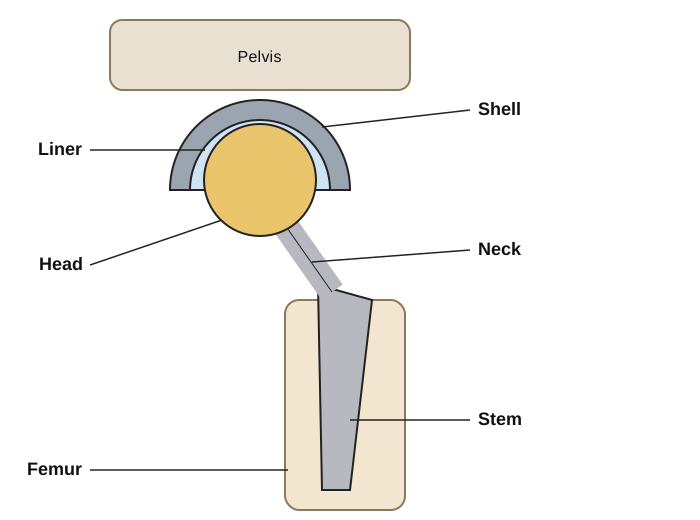
In the hip implant diagram, which component is usually made of UHMWPE?
Stem
Head
Neck
Liner
The liner sits between the shell and head and forms the soft bearing surface.
A scaffold of density 0.3 g/cm³ is made from a polymer of density 1.2 g/cm³. Its porosity is:
25%
75%
30%
90%
Porosity = 1 - 0.3/1.2 = 0.75. The 25% result is the solid fraction.
The Vroman effect describes:
Cells fusing at an implant
Metal ion release
Polymer chain scission
Protein exchange on a surface in which early abundant proteins are displaced by higher affinity ones
It explains why albumin adsorbs first and fibrinogen later displaces it on many surfaces.
Wear particles from UHMWPE cause implant failure mainly by:
Macrophage-driven osteolysis leading to loosening
Making the implant heavier
Raising body temperature
Increasing the stem's modulus
Particles are phagocytosed by macrophages that release cytokines that stimulate bone resorption around the implant.
Which is TRUE for nitinol?
It contains no nickel
It has a modulus higher than CoCr
It is superelastic and shape-memory
It is a polymer
Nitinol is a nickel-titanium alloy with shape memory and superelasticity, used in stents and guidewires.
