Quiz · Medium
Twenty-four questions on states of matter, density, phase changes, gas laws, atomic structure, the periodic table and mixtures.
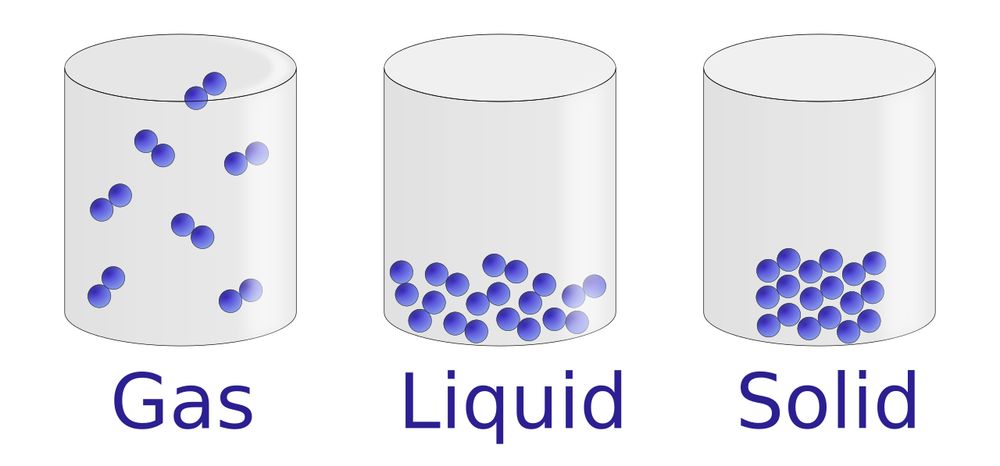
Which state of matter is shown in the left container?
Gas
Liquid
Solid
Plasma
The particles in the left container are far apart and spread through the whole container: that is a gas. In a liquid (middle) particles touch but flow, and in a solid (right) they sit in fixed positions.
Image: Yelod, CC BY-SA 3.0, via Wikimedia Commons.
A metal sample has a mass of 120 g and a volume of 40 cm³. What is its density?
0.33 g/cm³
30 g/cm³
80 g/cm³
3 g/cm³
Density = mass ÷ volume = 120 ÷ 40 = 3 g/cm³. Dividing the other way (40 ÷ 120) gives 0.33, a common mix-up.
An object has a density of 0.8 g/cm³. What will it do when placed in water (1.0 g/cm³)?
Sink to the bottom
Float, with most of it below the surface
Hover in the middle
Float only if its mass is small
Anything less dense than the fluid floats. Mass alone does not decide it; density does. A floating object displaces its own weight of water, so about 80% of this one is submerged.
Frost forms on a cold window on a winter night. Which change of state is this?
Condensation
Deposition
Freezing
Sublimation
Water vapor turns directly into ice crystals without becoming liquid first: gas to solid is deposition. Condensation (gas to liquid) would give droplets, and sublimation is the reverse process.
A pot of water is boiling steadily at 100 °C while you keep heating it. Why does its temperature stay constant?
The burner is not transferring any more heat
The water has reached absolute zero
Boiling water cannot absorb more energy
The added energy is used to separate particles (change state), not to raise their average kinetic energy
During a phase change, energy goes into overcoming attractions between particles (latent heat). Temperature, which measures average kinetic energy, stays constant until all the liquid has become gas.
Boiling water is a chemical change because bubbles of gas form.
True
False
Boiling is a physical change: water molecules (H₂O) are still H₂O in the steam. Bubbles can signal a chemical change only if a new substance forms.
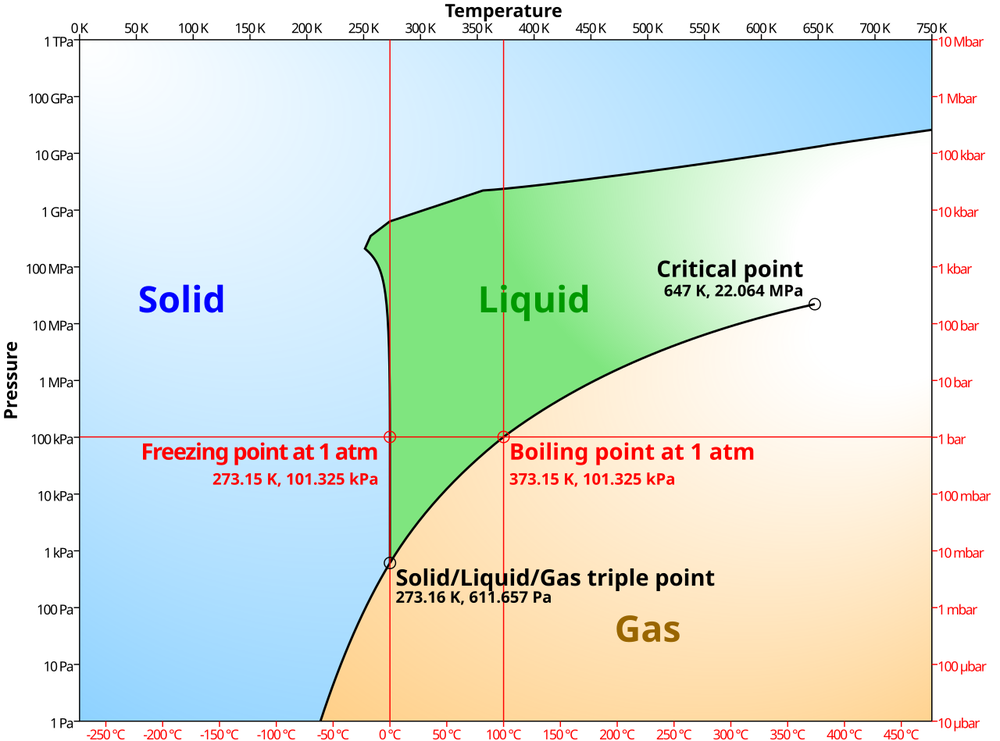
Using the phase diagram of water, what state is water at 1 atm (about 100 kPa) and 50 °C?
Liquid
Solid
Gas
A mix of solid and gas
At about 100 kPa the liquid region lies between the freezing point (0 °C) and the boiling point (100 °C), so water at 50 °C is liquid.
Image: Cmglee (simplified by Manlleus), CC BY-SA 3.0, via Wikimedia Commons.
According to the phase diagram, what happens to the boiling point of water as the pressure decreases (for example on a high mountain)?
It increases
It stays the same
It decreases
It becomes the same as the freezing point
The liquid-gas boundary slopes upward: lower pressure means boiling at a lower temperature. That is why food takes longer to cook at high altitude.
Image: Cmglee (simplified by Manlleus), CC BY-SA 3.0, via Wikimedia Commons.
An atom of iron-56 has atomic number 26. How many neutrons does it have?
26
56
30
82
Neutrons = mass number − atomic number = 56 − 26 = 30. 26 is the number of protons (and electrons in a neutral atom).
Carbon-12 and carbon-14 are best described as which of the following?
Isotopes
Ions
Allotropes
Compounds
They have the same number of protons (6) but different numbers of neutrons (6 and 8). Ions differ in electron number; allotropes are different structural forms like graphite and diamond.
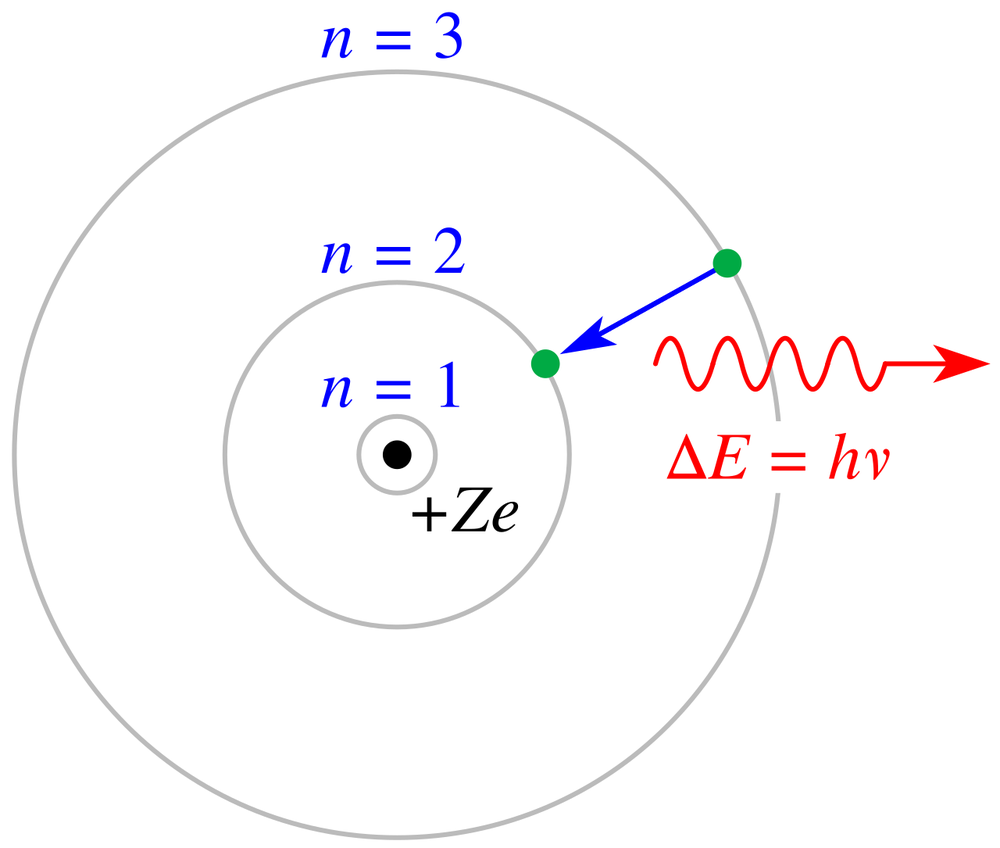
In the Bohr model, what happens when an electron falls from the n = 3 orbit to the n = 2 orbit?
A photon is absorbed
The electron leaves the atom
The nucleus gains a neutron
A photon is emitted
Dropping to a lower energy level releases the energy difference as light, ΔE = hν. Absorbing a photon moves an electron up, not down.
Image: JabberWok at English Wikipedia, CC BY-SA 3.0, via Wikimedia Commons.
Which of these elements is a noble gas?
Sodium (Na)
Neon (Ne)
Fluorine (F)
Magnesium (Mg)
Neon is in group 18 with a full outer shell. Fluorine is a halogen (group 17) and sodium and magnesium are metals.
Which atom has the largest atomic radius?
Lithium (Li)
Potassium (K)
Sodium (Na)
Beryllium (Be)
Radius increases down a group (more shells): Li < Na < K. Beryllium is in the same period as Li but smaller, since more protons pull the shell closer.
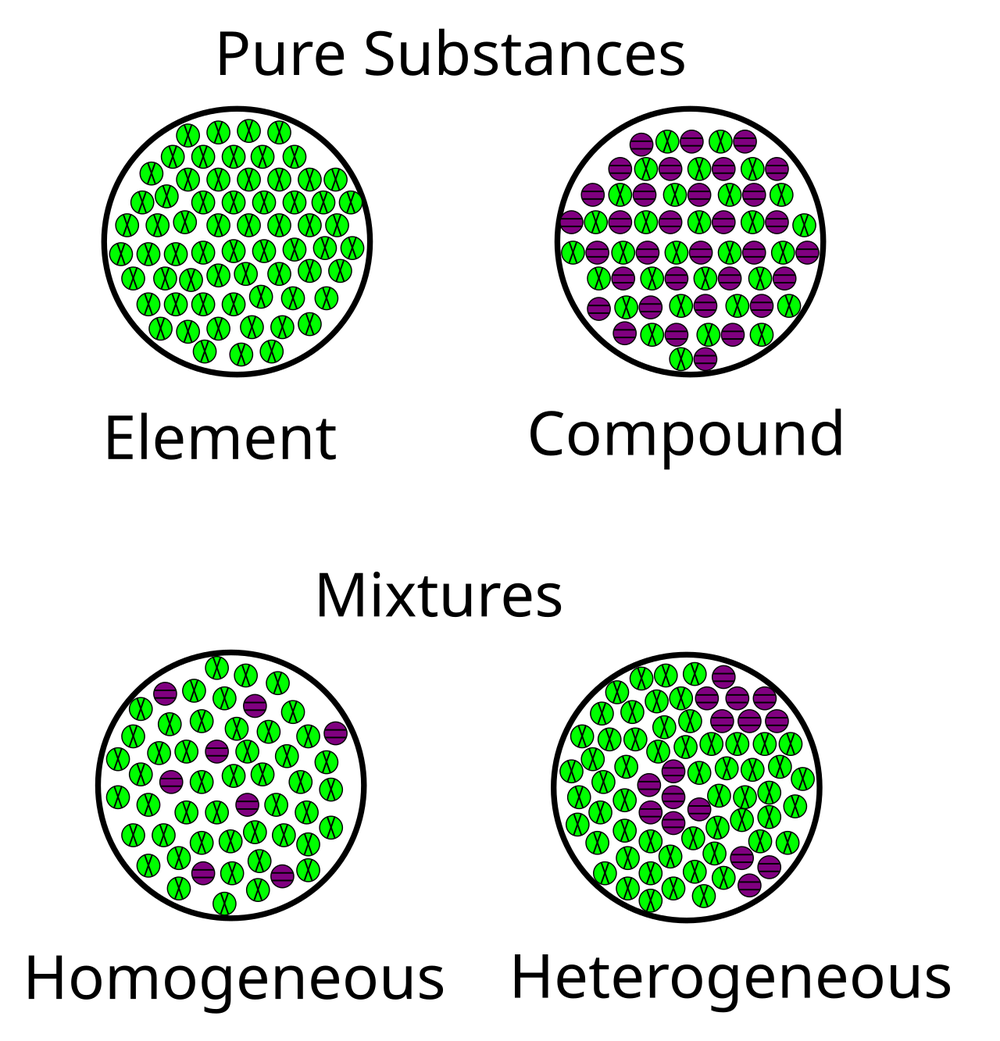
The bottom-left circle shows two kinds of atoms spread evenly with no visible pattern. What is it?
A compound
A heterogeneous mixture
An element
A homogeneous mixture
The two kinds of particles are not chemically bonded in a fixed pattern (so it is not a compound), and the mixing is uniform (so it is homogeneous).
Image: John Trombley, CC BY 4.0, via Wikimedia Commons.
The photo shows iron filings pulled from sulfur powder. Which property makes this separation possible?
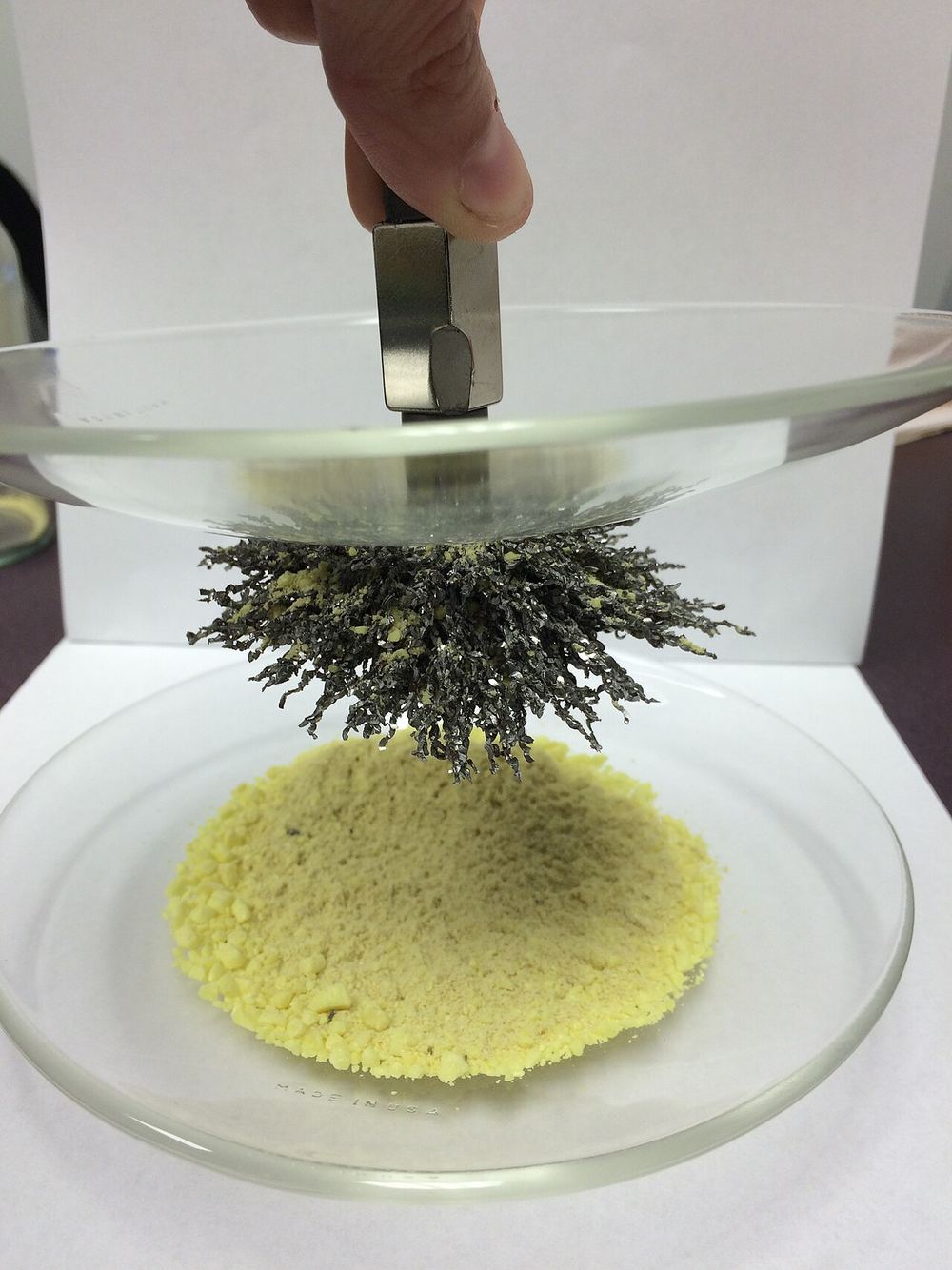
Iron is magnetic and sulfur is not
Iron is denser than sulfur
Iron dissolves in water
Iron has a lower boiling point
A magnet separates the mixture because only iron is attracted to it. The two elements are not chemically combined, so each keeps its own properties.
Image: Asoult, CC BY 4.0, via Wikimedia Commons.
Which of these is a chemical change?
Ice melting
Sugar dissolving in tea
A nail rusting
Crushing an aluminum can
Rusting makes a new substance (iron oxide). The others change only the form or arrangement of the same substance.
Which of these is a compound?
Air
Salt water
Sodium chloride
Brass
Sodium chloride (NaCl) is two elements chemically bonded in a fixed 1:1 ratio. Air, salt water and brass are mixtures.
A gas in a sealed syringe is compressed to half its volume at constant temperature. What happens to its pressure?
It doubles
It is halved
It stays the same
It quadruples
Boyle's law: P₁V₁ = P₂V₂. Halving V doubles P.
2.0 L of gas at 300 K is heated at constant pressure to 600 K. What is the new volume?
1.0 L
2.0 L
8.0 L
4.0 L
Charles's law: V₁/T₁ = V₂/T₂, so V₂ = 2.0 × 600/300 = 4.0 L. Doubling the kelvin temperature doubles the volume (Celsius would give a wrong answer).
10 g of substance A reacts completely with 4 g of substance B in a sealed container to form one product. What is the mass of the product?
6 g
14 g
10 g
40 g
Conservation of mass: total mass of products equals total mass of reactants, 10 + 4 = 14 g.
Ice is denser than liquid water.
True
False
Ice is about 0.92 g/cm³, less dense than liquid water, which is why it floats. Hydrogen bonds hold ice molecules in an open lattice.
What is 37 °C on the kelvin scale (approximately)?
236 K
310 K
37 K
273 K
K = °C + 273.15, so 37 °C ≈ 310 K. Subtracting 273 is the common error.
An alpha particle is made of which particles?
1 electron
2 electrons and 2 protons
A high-energy photon
2 protons and 2 neutrons
An alpha particle is a helium-4 nucleus. A beta particle is an electron and gamma radiation is a photon.
Why does a steel ship float even though steel is denser than water?
The ship's average density, including the air inside the hull, is less than water's
Steel is lighter when it is shaped into a ship
Salt water pushes harder on steel
The ship has less mass than the water it sits in
Buoyancy depends on average density. The hull encloses air so the ship displaces a weight of water equal to its own weight before sinking.
