Quiz · Medium
Foundational fingerprint questions: patterns, minutiae, impression types, development methods and history.
Ninhydrin reacts with which component of latent print residue?
Salt (chloride)
Lipids
Amino acids
Glucose
It gives Ruhemann's purple. Silver nitrate targets chloride.
What is the least common of the three basic fingerprint patterns?
Loop
Arch
Whorl
They are equally common
Arches are about 5 percent; loops 60 to 65 and whorls 30 to 35.
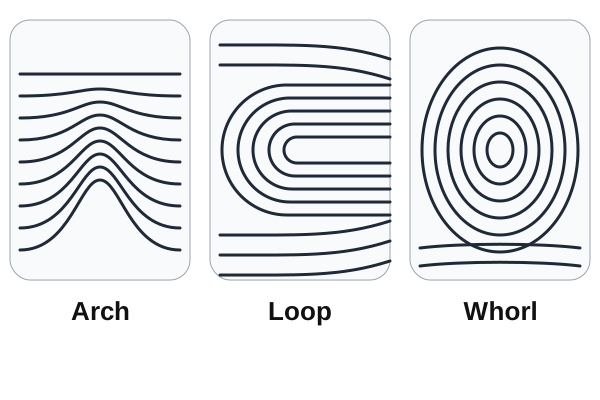
The left pattern in the picture has ridges that rise and fall without turning back. It is a(n):
Loop
Arch
Whorl
Delta
An arch has no recurving ridges and no delta.
Which pattern always has at least two deltas?
Whorl
Loop
Plain arch
Tented arch
Whorls have two or more deltas; loops have one.
A loop whose ridges open toward the thumb is called:
Accidental
Radial
Ulnar
Tented
Radial loops open toward the radius, on the thumb side. Ulnar loops open toward the little finger.
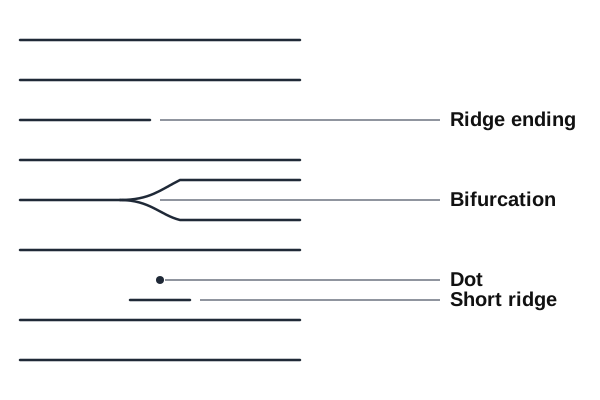
What is shown at the end of the line labeled 'Ridge ending' in the image?
A very short ridge
A ridge that splits into two
A pore
A ridge that stops
A ridge ending is where the ridge terminates. A split is a bifurcation.
A ridge that divides into two ridges is a:
Core
Bifurcation
Ridge ending
Dot
Bifurcation = fork. A dot is a tiny isolated ridge.
A bloody print on a wall is what type of impression?
Latent
Rolled
Patent
Plastic
Patent prints are visible. Latent prints are invisible. Plastic prints are 3-dimensional impressions.
A fingerprint pressed into soft putty is:
Latent
Plastic
A known print
Patent
A plastic print is a 3D impression in a soft material.
Which technique is best for developing prints on a sheet of paper?
Magnetic powder
Ninhydrin
Vacuum metal deposition
Cyanoacrylate fuming
Ninhydrin reacts with amino acids absorbed into porous paper. Cyanoacrylate is for nonporous surfaces.
What is the first step before lifting a latent print at a scene?
Cut out the surface
Spray ninhydrin
Brush more powder
Photograph it in place with a scale
Always photograph before any processing so that the original evidence is preserved.
Who is credited with publishing in 1892 a statistical study showing that fingerprints are unique and permanent?
Francis Galton
Edward Henry
Alphonse Bertillon
Edmond Locard
Galton published Finger Prints in 1892. Henry developed the classification system, Bertillon anthropometry.
The Will West case in 1903 showed a weakness of:
DNA
Handwriting analysis
Fingerprints
Bertillon's body measurement system
Two unrelated men had nearly the same measurements but different fingerprints.
Which case in Argentina in 1892 was the first murder solved with fingerprints?
Francisca Rojas
Brandon Mayfield
Will West
Thomas Jennings
Juan Vucetich's method matched a bloody thumbprint to Rojas. Jennings was the 1911 US case.
In the Henry primary classification, which finger pair has the value 16?
Right thumb and right index
Left thumb and index
Both little fingers
Right middle and ring
Fingers 1 and 2 (right thumb and index) are worth 16.
What does the 'E' in ACE-V stand for?
Evaluation
Examination
Exclusion
Enhancement
Analysis, Comparison, Evaluation, Verification.
What does AFIS do after a search?
Checks DNA
Gives a ranked list of candidates for an examiner to compare
Develops the print
States a final match
AFIS is a search tool. A human examiner makes the identification.
True or false: Identical twins have the same fingerprints.
False
True
Ridge detail depends on random conditions in the womb, so twins differ.
The 2004 mistaken identification of Brandon Mayfield involved a latent print recovered after:
The Madrid train bombings
The Oklahoma City bombing
The Lindbergh kidnapping
The Zodiac murders
The FBI matched Mayfield, but the Spanish police matched the print to another man.
Why are minutiae more useful than pattern type for identifying a person?
Minutiae are easier to see
Pattern type changes with age
Minutiae are the same for everyone
Many people share a pattern type, but the arrangement of minutiae differs
Pattern type is a class characteristic. Minutiae arrangement makes the print individual.
