Quiz · Medium
Mixed questions on relative and absolute dating, fossils, faults and folds, volcanoes, weathering and landforms.
In the Grand Canyon, the Tapeats Sandstone lies directly on top of the much older Vishnu Schist. What is this contact called?
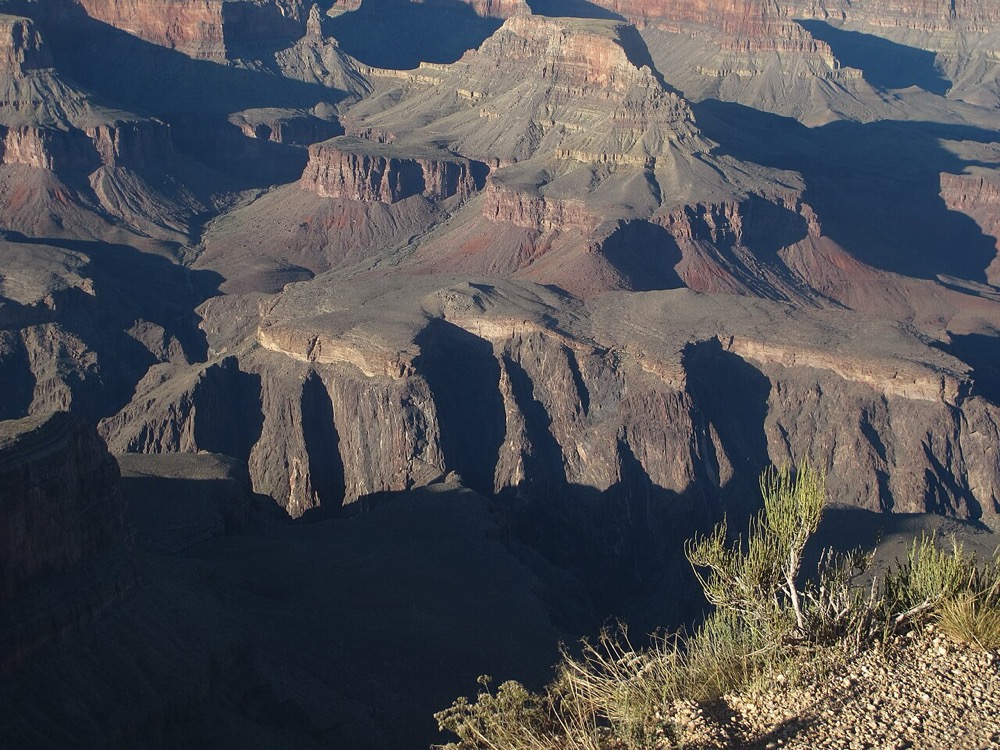
An angular unconformity
A nonconformity
A disconformity
A cross-cutting relationship
A nonconformity is sedimentary rock lying on eroded metamorphic or igneous rock. An angular unconformity needs tilted layers below flat layers, and a disconformity is between parallel sedimentary layers.
Image: Mikenorton, CC BY-SA 4.0, via Wikimedia Commons.
A granite body cuts across three tilted sandstone layers. Which statement is correct?
The granite is younger than the sandstone layers
The granite is older because granite is a harder rock
The granite is the same age as the sandstone
The age cannot be determined from the cutting relationship
By cross-cutting relationships, a feature that cuts other rocks must be younger than they are. Rock strength has nothing to do with relative age.
A rock sample contains 12.5% of its original potassium-40. The half-life of potassium-40 is 1.25 billion years. How old is the sample?
1.25 billion years
2.5 billion years
10 billion years
3.75 billion years
12.5% is 1/8, which is (1/2)^3, so three half-lives have passed: 3 × 1.25 = 3.75 billion years. Two half-lives would leave 25%.
Why can geologists not directly radiometrically date most sedimentary rocks?
Sedimentary rocks contain no radioactive isotopes
Sedimentary rocks are always younger than 50,000 years
The mineral grains come from older rocks, so the dates reflect the source rocks rather than deposition
Radioactive decay stops in rocks that have water in them
A radiometric clock starts when a mineral crystallizes. Sediment grains were crystallized long before they were deposited. Geologists bracket sedimentary layers between dated lava flows or ash beds.
Which feature makes a fossil an ideal index fossil?
Very large body size
Wide geographic distribution and a short range in time
Having lived for hundreds of millions of years
A hard shell that is found only in one basin
An index fossil should be widespread, abundant, easy to identify and limited to a short time range, so that it matches a precise time interval. Long-lived species are poor time markers.
In the diagram, which fault type is shown by B?
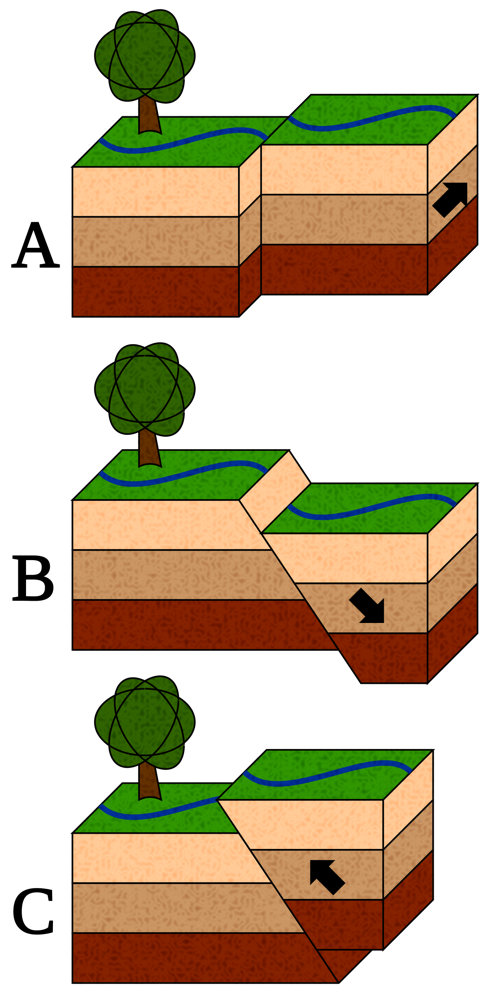
Normal fault
Reverse fault
Strike-slip fault
Thrust fault
In B, the hanging wall has moved down relative to the footwall. That is a normal fault formed by tension. A reverse fault (C) is the opposite and a strike-slip fault (A) slides horizontally.
Image: Karta24, Public domain, via Wikimedia Commons.
In an anticline that has been eroded flat, where are the oldest rocks found?
On the outside edges of the fold
They are evenly spread across the fold
They are always at the surface of the highest ground
In the center (core) of the fold
Anticlines arch upward, so erosion exposes the older, lower layers in the core with progressively younger layers on the flanks. In a syncline the youngest layers are in the core.
Which type of volcano has gentle slopes built from runny basaltic lava?
Stratovolcano
Cinder cone
Shield volcano
Lava dome
Shield volcanoes such as Mauna Loa are broad and gently sloped because low-viscosity basaltic lava flows far. Stratovolcanoes are steep and explosive; cinder cones are small and made of loose scoria.
Which of these best explains why a magma rich in silica tends to erupt explosively?
It is hotter than other magmas
It is viscous and traps gas bubbles until pressure builds
It contains less dissolved gas
It forms only on the ocean floor
Silica forms long chains that make the magma sticky. Gas cannot escape easily, so pressure builds and the eruption is violent. Silica-rich magmas are actually cooler than basaltic ones.
The photo shows a flow with a ropy, wrinkled surface next to a dark rubbly one. Which pair names them?
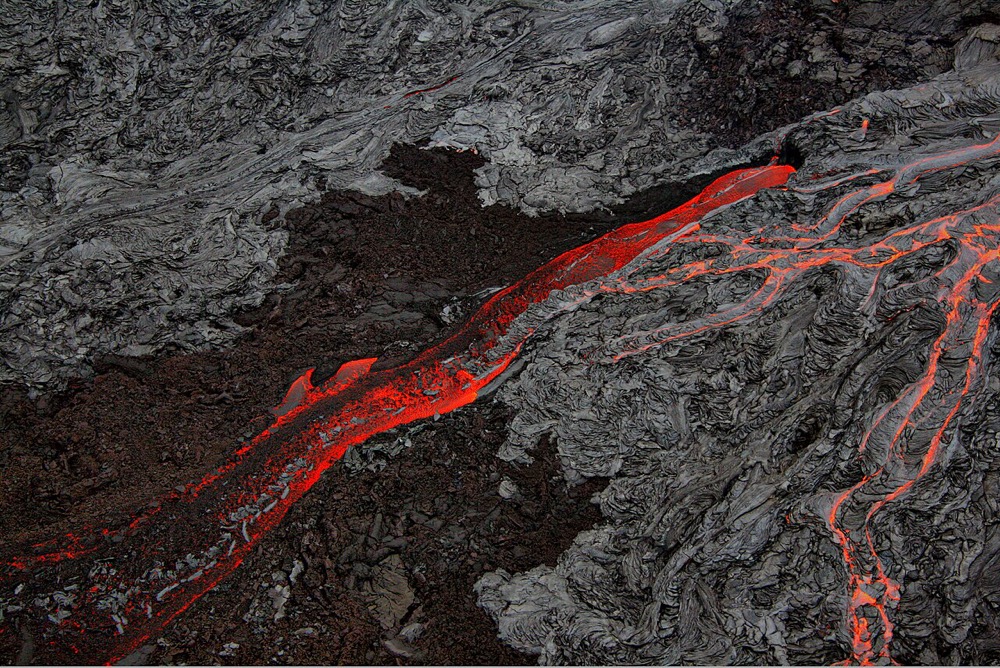
Pahoehoe (ropy) and aa (rubbly)
Aa (ropy) and pahoehoe (rubbly)
Tephra and pumice
Lahar and ash
Pahoehoe has a smooth, ropy skin; aa has a rough, clinkery surface. Tephra, pumice and ash are fragments, while a lahar is a volcanic mudflow.
Image: Brocken Inaglory, CC BY-SA 3.0, via Wikimedia Commons.
What is the deadliest volcanic hazard, a mixture of hot gas and ash racing down a volcano's slopes?
Lahar
Lava flow
Tephra fall
Pyroclastic flow
Pyroclastic flows move at highway speeds and are hundreds of degrees Celsius, so they leave almost no chance of escape. Lahars are mudflows, and lava flows usually move slowly enough for people to flee.
Which process breaks rock apart without changing its mineral composition?
Hydrolysis
Oxidation
Frost wedging
Dissolution of limestone
Frost wedging is physical (mechanical) weathering. Hydrolysis, oxidation and dissolution are chemical processes that change the minerals.
Limestone caves and sinkholes are most typical of which landscape type?
Glacial outwash plain
Karst
Volcanic shield
Alluvial fan
Karst forms where carbonic acid in groundwater dissolves soluble rock like limestone, creating caves, sinkholes and underground drainage.
Which statement about the photo is correct?
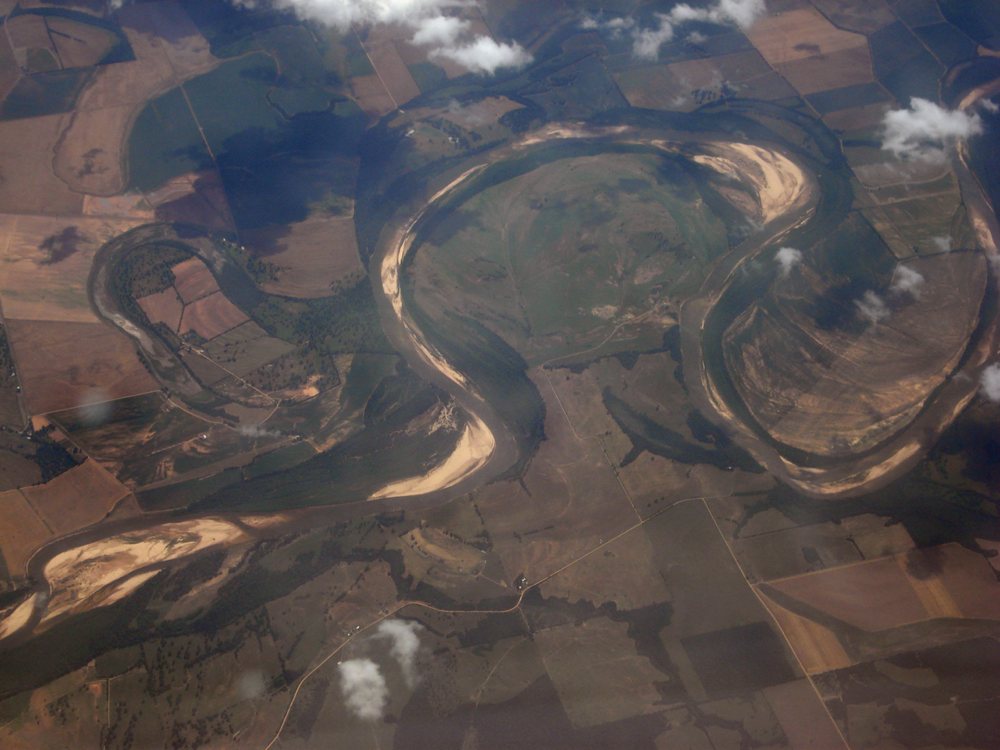
A river erodes the outside of its bends and deposits sediment on the inside, eventually cutting off loops to form oxbow lakes
The loops formed because a glacier carved the valley
The river deposits sediment on the outside of bends and erodes the inside
The loops are dried-up lava channels
Water flows fastest on the outside of a bend (cut bank) so erosion occurs there; it is slowest on the inside, where a point bar builds. Neck cutoffs leave oxbow lakes.
Image: Paul Morris, CC BY-SA 2.0, via Wikimedia Commons.
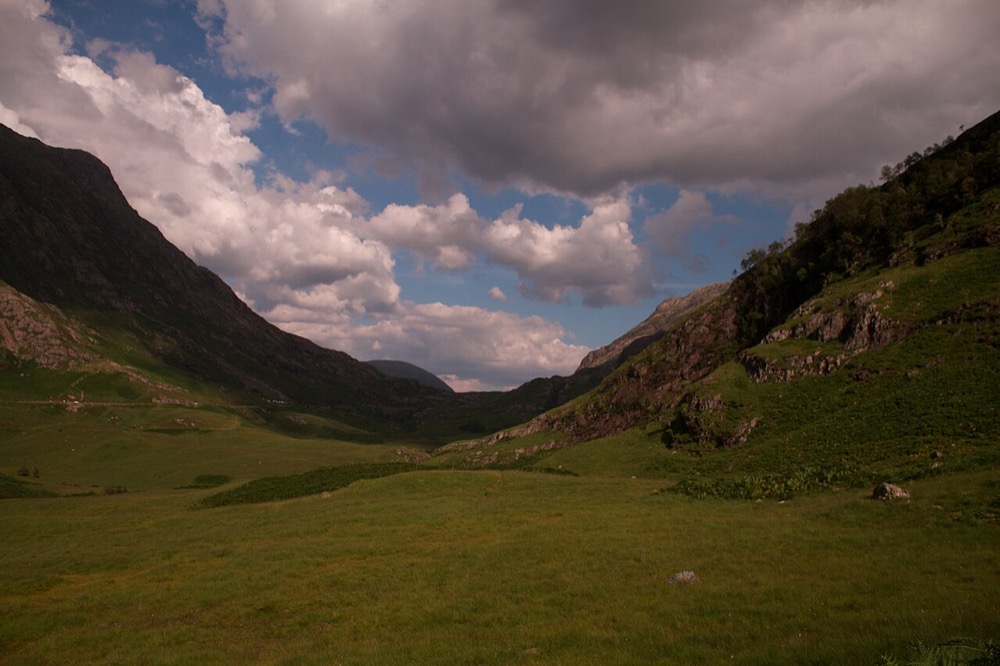
A valley with a broad, U-shaped cross section and a hanging valley on the side was most likely made by:
A fast mountain stream
Wind abrasion
A normal fault
A valley glacier
Rivers cut V-shaped valleys. Glaciers erode sideways as well as downward, leaving U-shaped valleys. Tributary glaciers leave hanging valleys that become waterfalls.
Image: Brian Gratwicke from DC, USA, CC BY 2.0, via Wikimedia Commons.
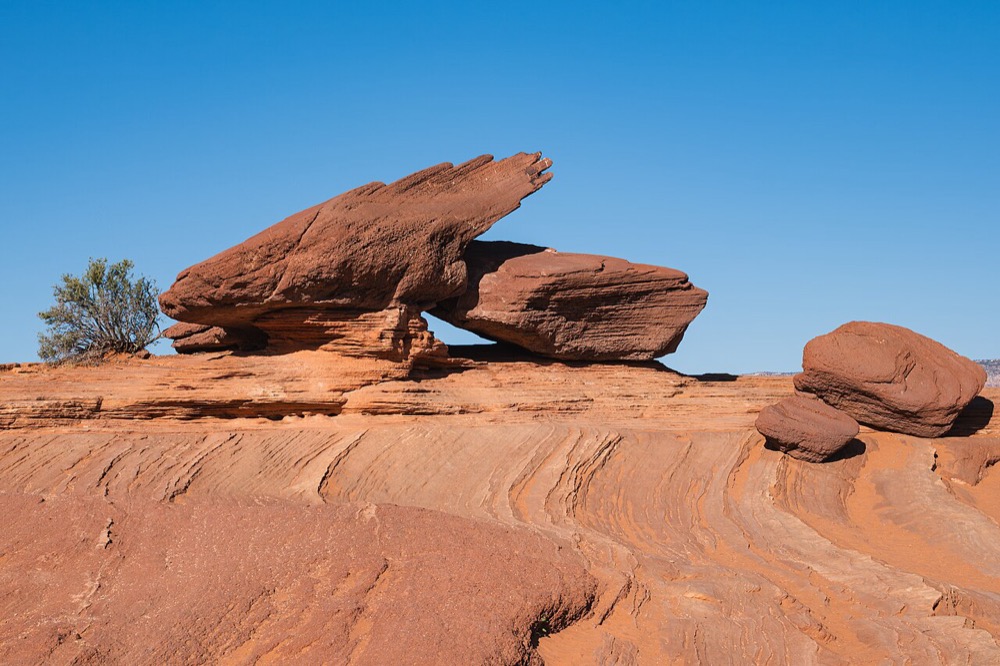
In the sandstone in the picture, inclined layers cut across each other at angles. What does cross-bedding record?
The time of an earthquake
Pressure from a nearby intrusion
The direction of the ancient wind or water currents
The age of the rock in years
Cross-beds are formed by migrating dunes or ripples; the beds dip in the downcurrent direction. They do not directly provide numerical ages.
Image: Christian David, CC BY-SA 4.0, via Wikimedia Commons.
On a topographic map, contour lines that are very close together indicate:
A flat plateau
A steep slope
A body of water
A river valley that flows downhill
Contour lines connect equal elevations; the closer they are, the more elevation change over a short distance, which means a steep slope.
Which event is NOT one of the 'Big Five' mass extinctions?
Cambrian explosion
End-Permian
End-Ordovician
End-Cretaceous
The Cambrian explosion was a burst of diversification of life, not an extinction. The end-Permian event (the Great Dying) was the worst.
What is the best evidence that an asteroid impact helped end the Cretaceous?
Fossils of dinosaurs found in Antarctica
Volcanic ash found in Greenland
A change in ocean salinity
A worldwide iridium-rich layer plus shocked quartz and the Chicxulub crater
Iridium is rare in Earth's crust but abundant in asteroids; shocked quartz forms only by very high pressure, and the Chicxulub crater is the right age.
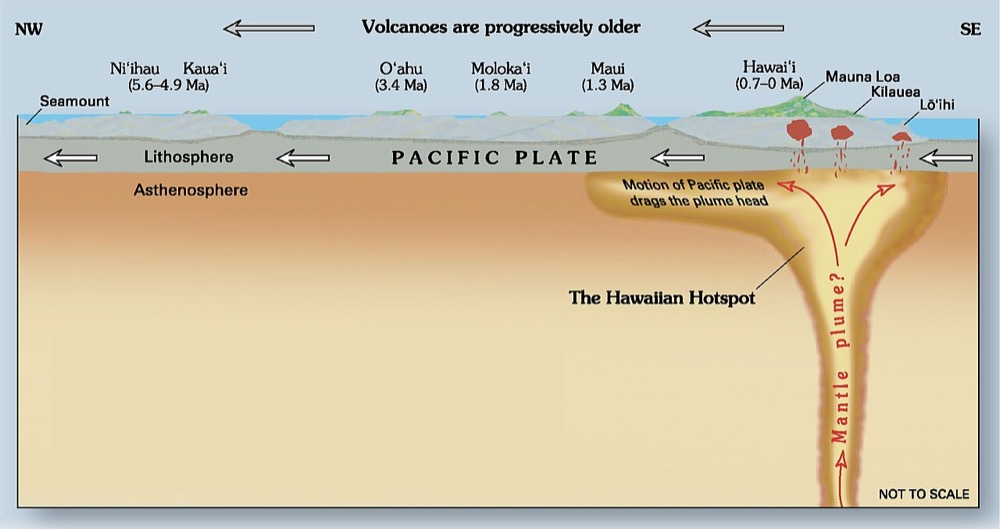
What does the Hawaiian-Emperor seamount chain show about the Pacific Plate?
Hawaii lies on a divergent boundary
The Pacific plate is not moving
It moves over a relatively fixed hotspot, with volcanoes getting older along its path
All the volcanoes formed at the same time
A mantle plume stays roughly fixed while the plate slides over it. New volcanoes form over the plume, and older ones are carried away to the northwest. The bend in the chain records a change in plate direction.
Image: Joel E. Robinson, USGS., Public domain, via Wikimedia Commons.
A geologist finds a layer of volcanic ash between two sedimentary layers and dates the ash at 66 million years. What can she conclude about the sediment layer below the ash?
It is younger than 66 million years
It is older than 66 million years
It is exactly 66 million years old
Nothing; sediment cannot be dated at all
By superposition, the layer below was deposited before the ash fell, so it is older. The layer above is younger. The ash bed gives a minimum age for the lower layer and a maximum for the upper.
Which sequence shows the correct order of geologic eras from oldest to youngest?
Paleozoic, Mesozoic, Cenozoic
Mesozoic, Paleozoic, Cenozoic
Cenozoic, Mesozoic, Paleozoic
Paleozoic, Cenozoic, Mesozoic
'Paleo' means ancient, 'Meso' middle and 'Ceno' recent. Remember that dinosaurs were in the middle (Mesozoic) era.
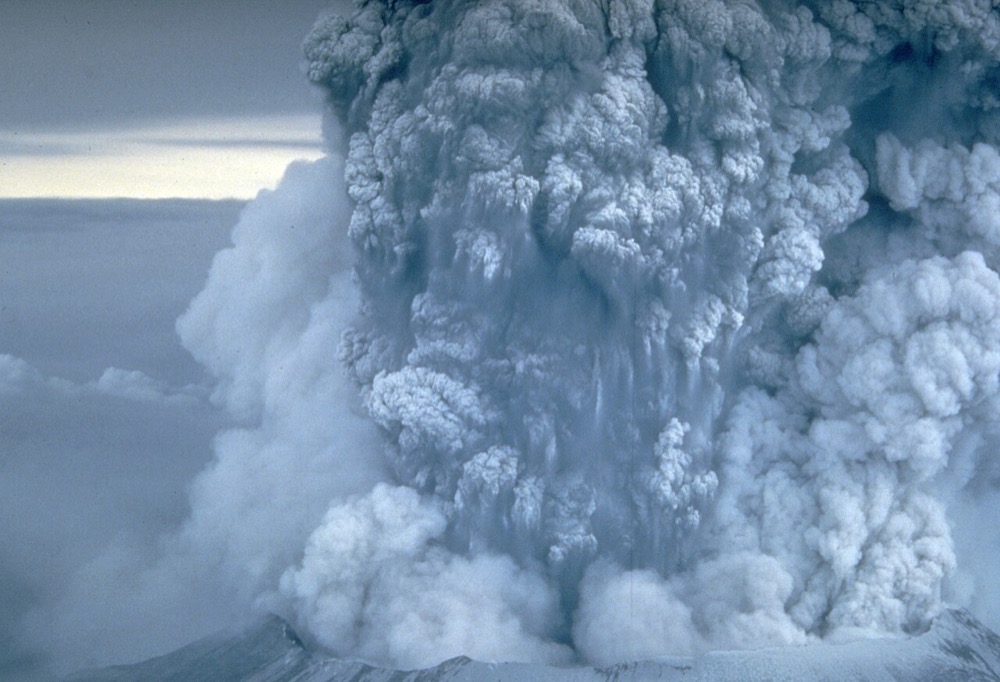
True or false: Mount St. Helens is a shield volcano.
True
False
Mount St. Helens is a steep-sided stratovolcano (composite volcano) built from layers of lava and ash above the Cascadia subduction zone. Shield volcanoes are broad and gently sloped, such as Mauna Loa.
Image: Donald A. Swanson, Public domain, via Wikimedia Commons.
