Quiz · Medium
Foundational questions on vitamin and mineral roles, deficiency diseases and absorption.
Which vitamin is needed for the synthesis of clotting factors II, VII, IX and X?
Vitamin K
Vitamin E
Vitamin C
Vitamin A
Vitamin K carboxylates these factors so they can bind calcium. Vitamin E is an antioxidant, and vitamin C is needed for collagen, not clotting factors.
A patient has bleeding gums, poor wound healing and small hemorrhages around hair follicles. Which deficiency is most likely?
Vitamin K
Vitamin C
Vitamin A
Niacin
Scurvy is due to weak collagen. Vitamin K deficiency also causes bleeding, but it does not cause perifollicular hemorrhages or gum swelling with poor wound healing.
Which vitamin deficiency is associated with the "four Ds": dermatitis, diarrhea, dementia and death?
Thiamin
Riboflavin
Niacin
Vitamin B6
This is pellagra. Thiamin deficiency causes beriberi and Wernicke-Korsakoff syndrome.
Which water-soluble vitamin is stored in the liver for several years?
Vitamin C
Thiamin
Biotin
Vitamin B12
B12 is the exception among water-soluble vitamins. That is why deficiency takes years to appear after a strict vegan diet begins.
Excess folic acid from supplements can be dangerous mainly because it can:
Mask vitamin B12 deficiency anemia while neurological damage continues
Cause rickets
Block iron absorption completely
Cause scurvy
Folic acid corrects the megaloblastic anemia of B12 deficiency and so hides it. The other effects listed are not caused by folic acid.
Which person is most at risk of vitamin D deficiency?
A young adult who runs outdoors daily
A homebound older adult who avoids sun and does not drink fortified milk
A person who eats salmon twice a week
A pregnant woman taking a prenatal vitamin
Older age, little UVB exposure, dark skin, and low intake all raise the risk. Salmon and supplements both supply vitamin D.
Which mineral is the most abundant in the human body?
Iron
Sodium
Calcium
Magnesium
About 1 to 1.5 kg of calcium is in the body, 99% in bones and teeth. Iron is a trace mineral.
Which of the following improves nonheme iron absorption?
Drinking tea with the meal
Taking a calcium supplement with the meal
Eating whole grains high in phytates
Vitamin C taken with the meal
Vitamin C reduces ferric iron to the more absorbable ferrous form. Tea polyphenols, calcium and phytates inhibit absorption.
A woman has fatigue, pallor and microcytic red cells with low ferritin. Which is the best dietary advice?
Eat lean red meat or fortified cereal with vitamin C-rich foods
Add more milk to meals
Take calcium with iron tablets
Avoid citrus fruits
Heme iron plus vitamin C boosts absorption. Calcium competes with iron, and citrus helps iron absorption.
Which mineral deficiency causes goiter?
Selenium
Iodine
Zinc
Fluoride
Low iodine means low thyroid hormone, TSH rises and the thyroid enlarges. Selenium deficiency is linked to Keshan disease.
Which statement about the RDA is correct?
It meets the needs of exactly 50% of people
It is the highest safe intake
It meets the needs of about 97 to 98% of healthy people in a group
It is used when there is not enough evidence to set a requirement
50% is the EAR; the highest safe intake is the UL; the AI is used when evidence is insufficient.
What does the Tolerable Upper Intake Level (UL) represent?
The amount everyone should aim for
The average requirement
The minimum to prevent deficiency
The highest daily intake unlikely to cause adverse effects in almost all people
The UL is a limit, not a goal. Intake above it increases risk of harm.
Which nutrient is essential for preventing neural tube defects?
Folate
Vitamin K
Zinc
Vitamin E
Folate is needed for DNA synthesis in rapidly dividing neural tube cells in the first weeks of pregnancy.
Why is thiamin given before glucose in a patient with alcohol use disorder?
Thiamin lowers blood glucose
Glucose metabolism uses thiamin and can precipitate Wernicke encephalopathy
Glucose blocks thiamin absorption
Thiamin prevents refeeding hypokalemia
Thiamin is a coenzyme for pyruvate dehydrogenase, so a glucose load in a thiamin-depleted patient can worsen the deficiency.
Which of the following is a heme iron source?
Spinach
Lentils
Beef
Fortified cereal
Heme iron is found in animal flesh. Spinach, lentils and fortified cereal contain nonheme iron.
Spinach contains lots of calcium, but little is absorbed because of:
Vitamin C
Lactose
Protein
Oxalate
Oxalate binds calcium in the gut. Lactose and protein modestly improve absorption.
True or false: Water-soluble vitamins cannot cause toxicity.
False
True
Excess B6 causes neuropathy, niacin causes flushing and liver injury, and very large doses of vitamin C can cause GI upset and kidney stones. Water-soluble vitamins are simply less likely to build up.
Which vitamin can the body make from cholesterol in skin exposed to sunlight?
Vitamin K
Vitamin D
Vitamin A
Vitamin C
UVB converts 7-dehydrocholesterol to previtamin D3. Gut bacteria make some vitamin K, but skin does not make K, A or C.
Which mineral is a component of thyroid hormones?
Calcium
Copper
Iodine
Manganese
Thyroxine (T4) has 4 iodine atoms and T3 has 3. Selenium helps convert T4 to T3.
Which pair of nutrients is most closely linked to bone mineralization?
Iron and vitamin C
Sodium and vitamin E
Zinc and vitamin B12
Calcium and vitamin D
Vitamin D improves calcium absorption. Without it, bone forms poorly even when calcium intake is adequate.
On the graph, which reference value is marked where the risk of inadequacy is 50%?
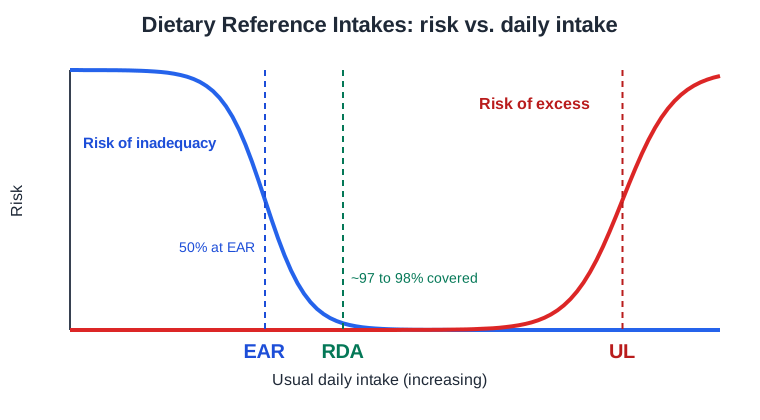
RDA
Estimated Average Requirement (EAR)
UL
Adequate Intake
At the EAR half of the group has inadequate intake. The RDA is set about 2 SD higher.
Which group of vitamins is shown in the left box of the diagram, and what is one of its features?
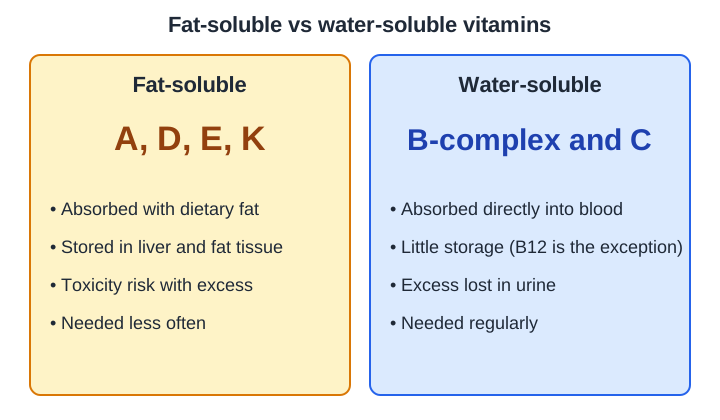
Water-soluble: absorbed directly into blood
Fat-soluble: absorbed with dietary fat and stored in liver and fat tissue
Water-soluble: stored for months
Fat-soluble: excess is lost in urine
The left box is fat-soluble vitamins A, D, E and K. Excess is stored, not lost in urine, so toxicity is more likely.
