Quiz · Medium
Fifteen-plus questions on absorption, distribution, metabolism, excretion and basic half-life concepts.
Which term describes what the body does to a drug?
Pharmacodynamics
Pharmacokinetics
Pharmacogenomics
Pharmacotherapeutics
Pharmacokinetics (ADME) is the body acting on the drug. Pharmacodynamics is the drug acting on the body.
Which route of administration has a bioavailability of 100% by definition?
Sublingual
Intravenous
Intramuscular
Oral
IV drug enters the circulation directly. IM and sublingual are usually high but not defined as 100%, and oral doses face first-pass metabolism.
A drug has extensive first-pass metabolism. Which statement is true?
Its volume of distribution is small
It must be highly protein bound
It is cleared mostly by the kidney unchanged
Oral bioavailability is reduced because the liver metabolizes part of the dose before it reaches the systemic circulation
First-pass is hepatic and gut-wall metabolism of orally absorbed drug. It has nothing to do with Vd or renal clearance.
Which route avoids first-pass hepatic metabolism?
Oral tablet
Sublingual
Oral solution
Gastric tube feeding
Sublingual veins drain to the superior vena cava. Every swallowed or tube-fed drug goes through the portal vein to the liver first.
Aspirin (a weak acid) overdose is treated with sodium bicarbonate. What is the purpose?
Increase aspirin's absorption in the stomach
Raise aspirin's protein binding
Alkalinize urine so aspirin becomes ionized and trapped in urine
Convert aspirin to its prodrug form
Ionized drug cannot cross tubule membranes back into blood, so excretion rises (ion trapping). Absorption and binding are not the goal.
A drug has a volume of distribution of 400 L in a 70 kg adult. What does this most likely mean?
The drug stays in plasma
The drug is excreted rapidly
The drug is entirely protein bound in plasma
The drug is widely distributed into tissues
Vd is apparent. Values far above total body water (about 42 L) mean tissue binding or lipophilicity. Plasma-confined drugs have Vd of about 3 to 5 L.
Which statement about plasma protein binding is correct?
Only the unbound drug is pharmacologically active and available for metabolism and filtration
Albumin binds mostly basic drugs
Bound drug is filtered by the glomerulus
High protein binding always increases Vd
Albumin binds mostly acidic drugs (alpha-1 acid glycoprotein binds basic ones). High binding generally keeps drug in plasma, lowering Vd.
Which pair describes Phase I and Phase II metabolism correctly?
Phase I: oxidation, reduction, hydrolysis; Phase II: conjugation
Phase I: conjugation; Phase II: oxidation
Both are conjugation reactions
Phase I occurs in the kidney; Phase II in the liver
Phase I (mostly CYP450) functionalizes. Phase II conjugates with glucuronide, sulfate, acetyl etc. making the product more polar.
Which drug is a CYP450 inducer that can reduce the effectiveness of oral contraceptives?
Rifampin
Ketoconazole
Cimetidine
Grapefruit juice
Rifampin (like carbamazepine, phenytoin, St. John's wort) speeds metabolism. The other options are inhibitors that would raise levels.
A patient on simvastatin is told to avoid grapefruit juice. Why?
Grapefruit induces CYP3A4 and lowers simvastatin levels
Grapefruit inhibits intestinal CYP3A4 and raises simvastatin levels
Grapefruit binds simvastatin in the gut
Grapefruit raises urinary excretion of simvastatin
Inhibition of intestinal CYP3A4 increases bioavailability, so the risk of myopathy rises.
After a single dose, approximately how many half-lives are needed to eliminate about 97% of the drug?
1
5
2
10
After 1 half-life 50% is gone; 2: 75%; 3: 87.5%; 4: 93.75%; 5: 96.9%.
A drug is given every 8 hours and has a half-life of 6 hours. About how long until it reaches steady state?
8 hours
24 to 30 hours
Immediately after the first dose
Several weeks
Steady state takes about 4 to 5 half-lives, so 24 to 30 hours. The dosing interval does not change the time to steady state.
Which statement about a loading dose is correct?
It depends mainly on clearance
It is used only for drugs with a short half-life
It rapidly achieves the target concentration and depends on volume of distribution
It changes the half-life of the drug
Loading dose = Ctarget x Vd / F. Maintenance dose depends on clearance. Half-life is a property of the drug in the patient, not of the dose.
Phenytoin shows disproportionate rises in plasma level after small dose increases. Why?
Metabolism enzymes become saturated (zero-order kinetics)
It has a very small Vd
It is eliminated unchanged by the kidney
It is not protein bound
Saturable (Michaelis-Menten) kinetics mean clearance falls as concentration rises. Ethanol and high-dose aspirin behave similarly.
Which is a typical feature of neonates compared with adults?
Higher albumin levels
Immature glucuronidation (e.g. chloramphenicol toxicity)
Faster renal clearance
Mature CYP450 function from birth
Neonates have immature liver enzymes and kidneys and lower protein binding. Gray baby syndrome occurs because chloramphenicol is not glucuronidated.
What does 'AUC' represent in pharmacokinetics?
Peak plasma concentration
Time to peak concentration
Rate of absorption only
Total drug exposure over time
Area under the concentration-time curve. Cmax is the peak and Tmax its time.
Which route of excretion is most important for most drugs and their metabolites?
Sweat
Exhaled air
Saliva
Renal (urine)
The kidney clears most drugs. Lungs matter for volatile anesthetics; sweat, saliva and milk are minor.
The diagram shows LADME. Which stage is the movement of drug from the site of administration into the bloodstream?
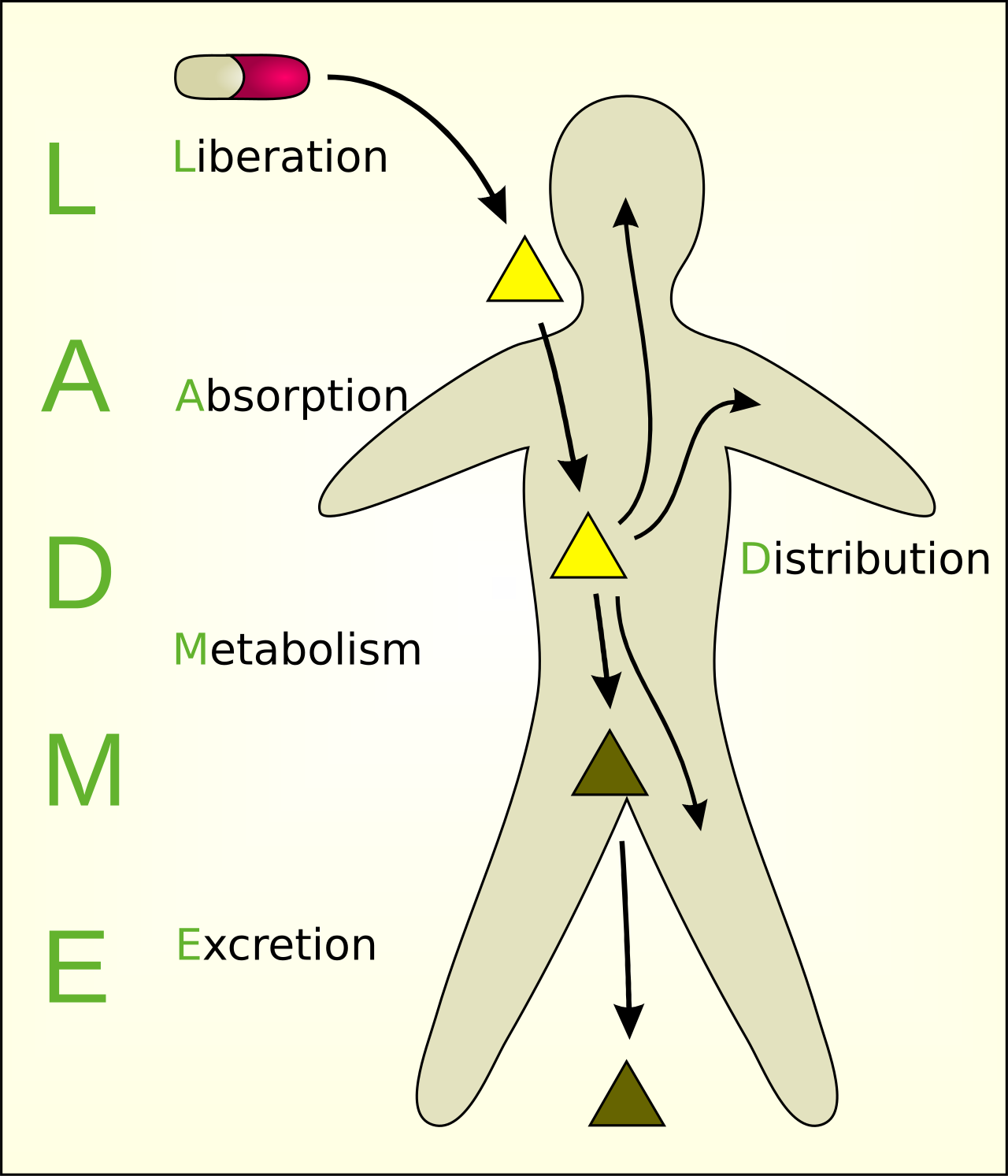
Absorption
Distribution
Metabolism
Excretion
Absorption: entry into the circulation. Distribution: spread to tissues. Metabolism: chemical change. Excretion: removal. Image: Scivit, CC BY 4.0, via Wikimedia Commons.
The graph compares an IV dose with oral doses of different bioavailability. How is bioavailability estimated from the curves?
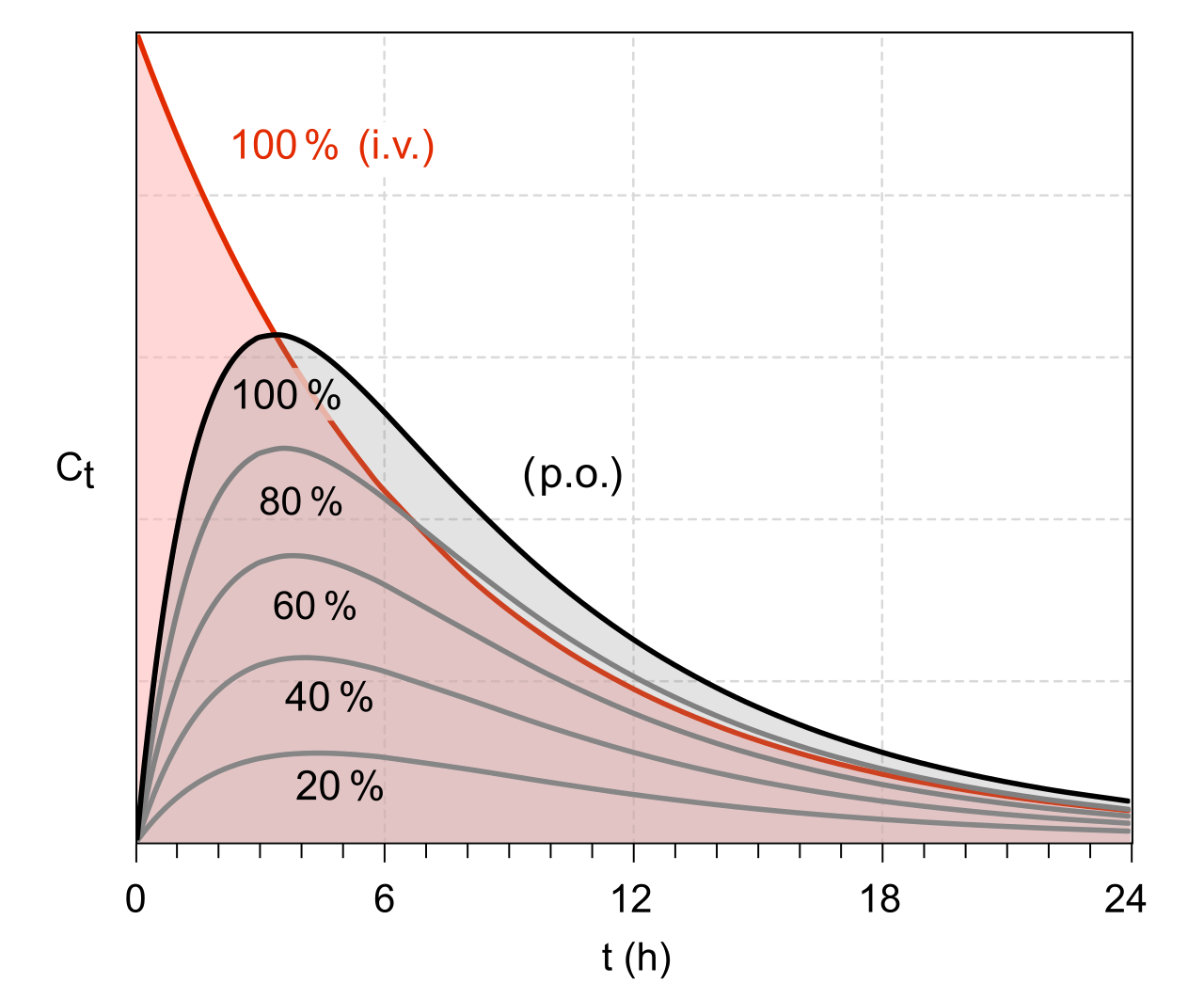
By comparing Tmax values
By the height of the IV curve alone
By the slope of the elimination phase
By comparing the AUC after oral dosing with the AUC after IV dosing (dose-corrected)
F = (AUCoral x DoseIV) / (AUCIV x Doseoral). Tmax and slope describe absorption rate and elimination, not extent. Image: Benff, CC BY-SA 4.0, via Wikimedia Commons.
