Quiz · Hard
Snell's law, critical angle, mirror and lens images, double slit, gratings, thin films, polarization and photon energy with numerical answers and photo questions.
Light in air strikes glass (n = 1.5) at an incidence angle of 40°. What is the angle of refraction?
60°
25°
27°
38°
, so . 60° would result from multiplying by 1.5 instead of dividing.
What is the critical angle for light going from glass (n = 1.5) into air?
42°
48°
56°
34°
, so . 48° is for water (n = 1.33); 56° is Brewster's angle for glass.
What is the speed of light in diamond (n = 2.42)?
7.3×10⁸ m/s
3.00×10⁸ m/s
2.0×10⁸ m/s
1.24×10⁸ m/s
m/s. Light is slower in any medium than in vacuum.
Orange light has a vacuum wavelength of 600 nm. What is its wavelength in water (n = 1.33)?
798 nm
600 nm
451 nm
1.33 nm
nm. The frequency, and therefore the colour, is unchanged.
An object is 30 cm in front of a concave mirror of focal length 10 cm. Where is the image, and what are its characteristics?
15 cm behind the mirror; virtual, upright, half-size
15 cm in front of the mirror; real, inverted and half-size
30 cm in front of the mirror; real, inverted, same size
7.5 cm in front of the mirror; real, upright
, so cm (positive = real). .
An object is placed 10 cm from a converging lens of focal length 20 cm. What kind of image is formed?
Virtual, upright, twice as large
Real, inverted, twice as large
Virtual, inverted, same size
No image is formed
→ cm (virtual); . Inside the focal length a converging lens works as a magnifying glass.
Light of wavelength 600 nm passes through two slits 0.20 mm apart and falls on a screen 1.5 m away. What is the spacing between adjacent bright fringes?
0.45 mm
45 mm
1.2 mm
4.5 mm
m.
A diffraction grating has 500 lines per mm. What is the highest order of maxima visible for 600 nm light?
2
5
3
4
m. → , so .
A soap film in air looks black where it is extremely thin (much thinner than the wavelength of light). Why?
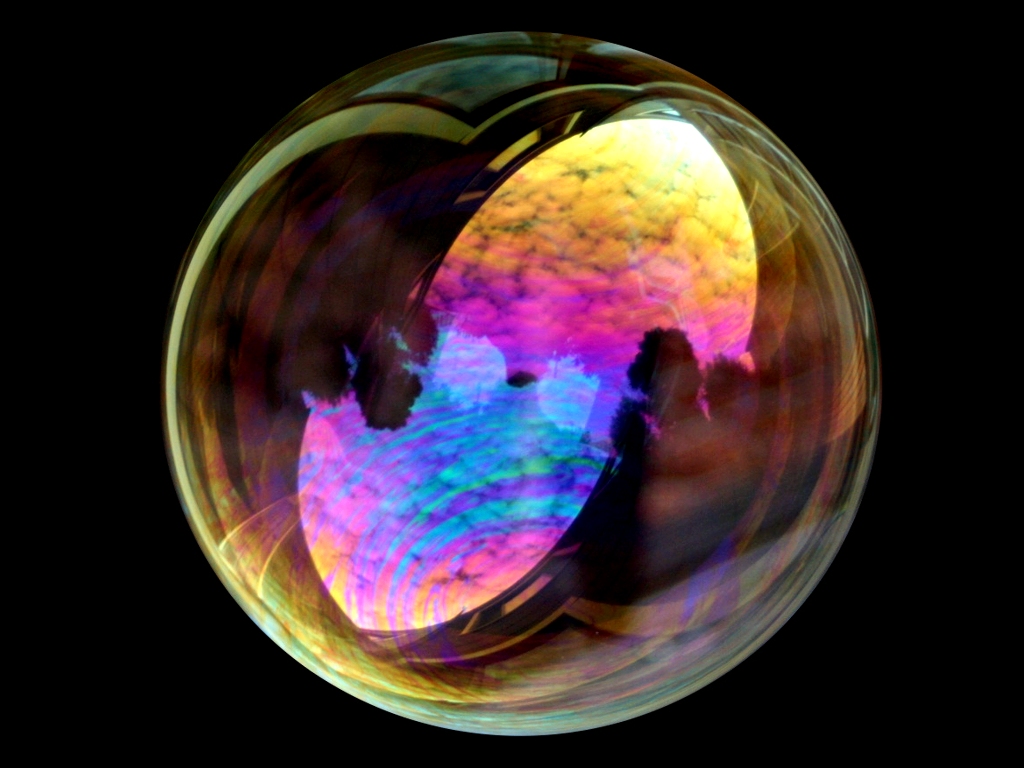
There is no light reflected from such a thin film
The reflection from the front surface has a 180° phase shift and the back reflection has none, so the two cancel
Both reflections have 180° phase shifts and cancel
Light is totally absorbed by the film
With one phase inversion, a path difference near zero gives destructive interference. The film at its thinnest therefore appears dark. Image: Brocken Inaglory, CC BY-SA 3.0, via Wikimedia Commons.
An anti-reflective coating on glass has n = 1.38. For green light of wavelength 550 nm in air, what is the minimum thickness of the coating?
About 100 nm
About 400 nm
About 200 nm
About 550 nm
nm: a quarter wavelength inside the coating.
Unpolarized light of intensity I₀ passes through two polarizers whose axes are 60° apart. What is the transmitted intensity?
I₀/4
I₀/2
I₀ cos²60° (= I₀/4)
I₀/8
The first polarizer passes . Malus's law for the second: .
What is Brewster's angle for light going from air to glass (n = 1.5)?
42°
34°
56°
90°
→ . At this angle the reflected light is fully polarized.
What is the energy of a photon of wavelength 500 nm? (hc = 1240 eV·nm)
248 eV
2.48 eV
0.40 eV
6.2 eV
eV.
The diameter of a telescope's circular aperture is doubled. What happens to its minimum resolvable angle (Rayleigh criterion)?
It is halved
It is doubled
It is quartered
It is unchanged
, inversely proportional to D.
In single-slit diffraction, the slit width is halved. What happens to the width of the central maximum?
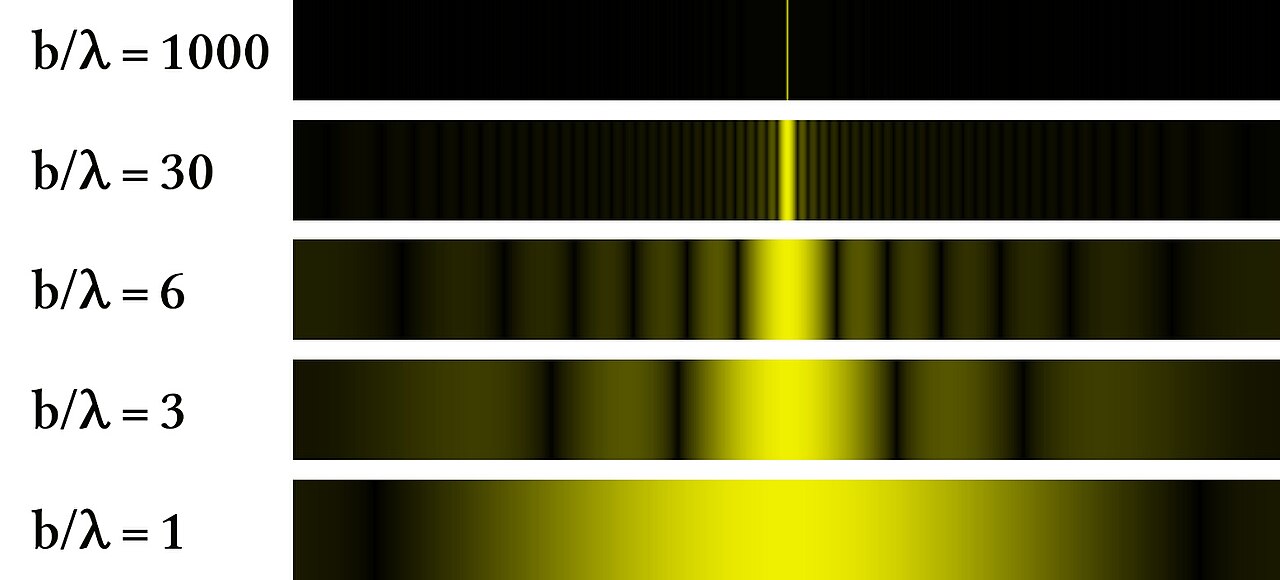
It halves
It is unchanged
It quadruples
It doubles
The first minimum is at : halving a roughly doubles the angular width. Image: MikeRun, CC BY-SA 4.0, via Wikimedia Commons.
A ray inside glass hits the glass–air boundary at 45° to the normal. What happens, given the critical angle of 42°?
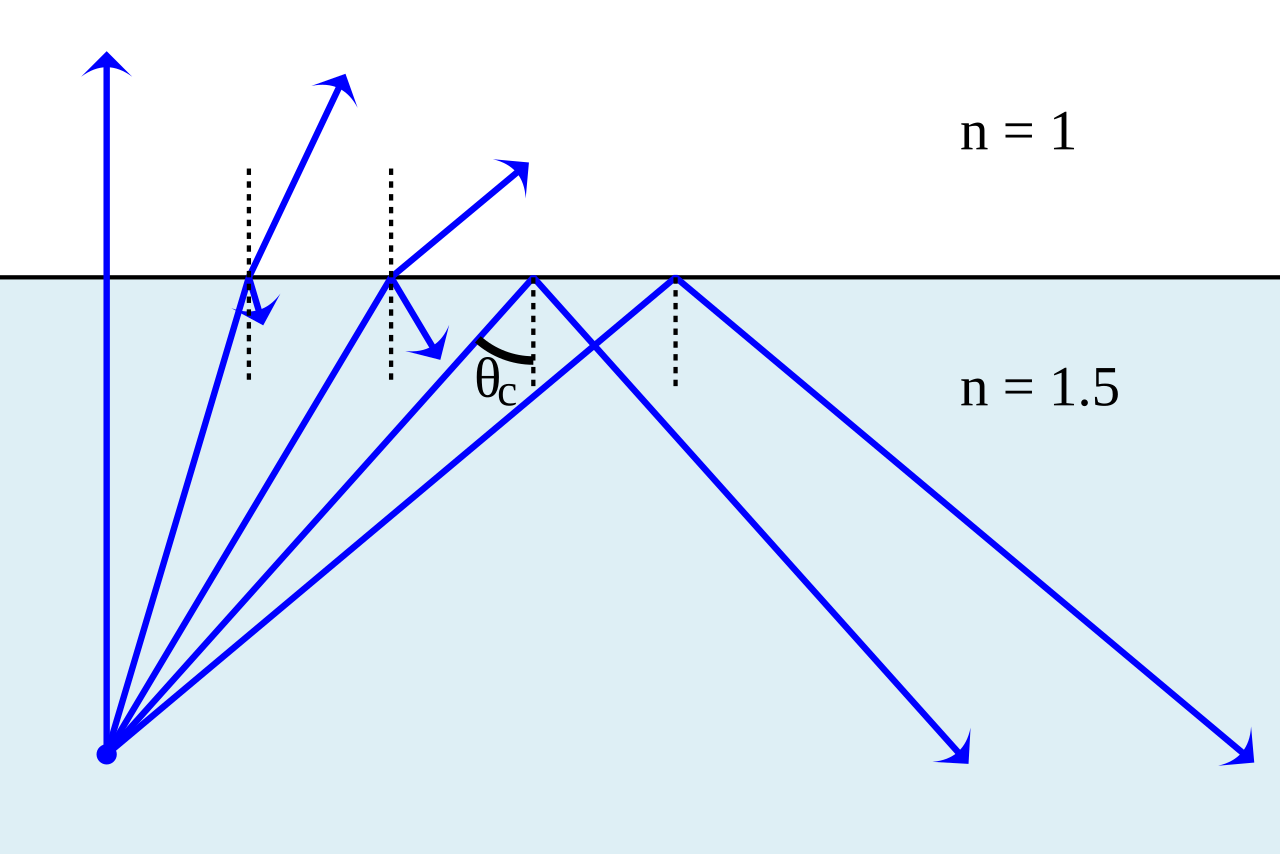
Part of the ray refracts out at a larger angle only
The ray refracts out at 45°
Total internal reflection occurs
The ray is absorbed
45° exceeds the critical angle (42°) and the ray goes from higher to lower n, so none escapes. Image: Lasse Havelund, CC BY-SA 3.0, via Wikimedia Commons.
In the prism photograph, which colour is deviated the most?
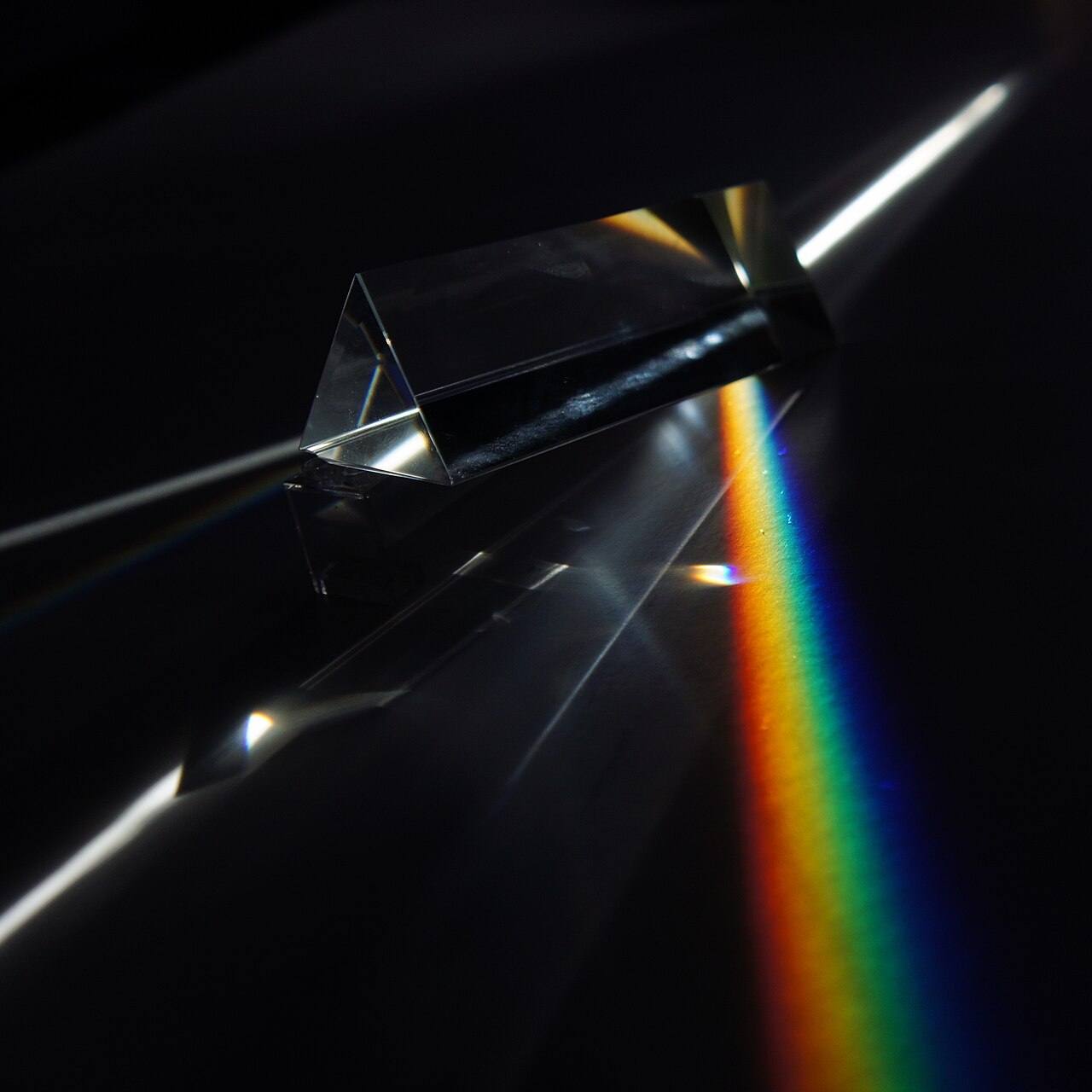
Red
Violet
Green
All colours are deviated equally
The refractive index of glass is larger for shorter wavelengths, so violet bends the most. Image: Kelvinsong, CC0, via Wikimedia Commons.
In a double rainbow like the one in the photograph, how does the colour order of the secondary (outer) bow compare with that of the primary bow?
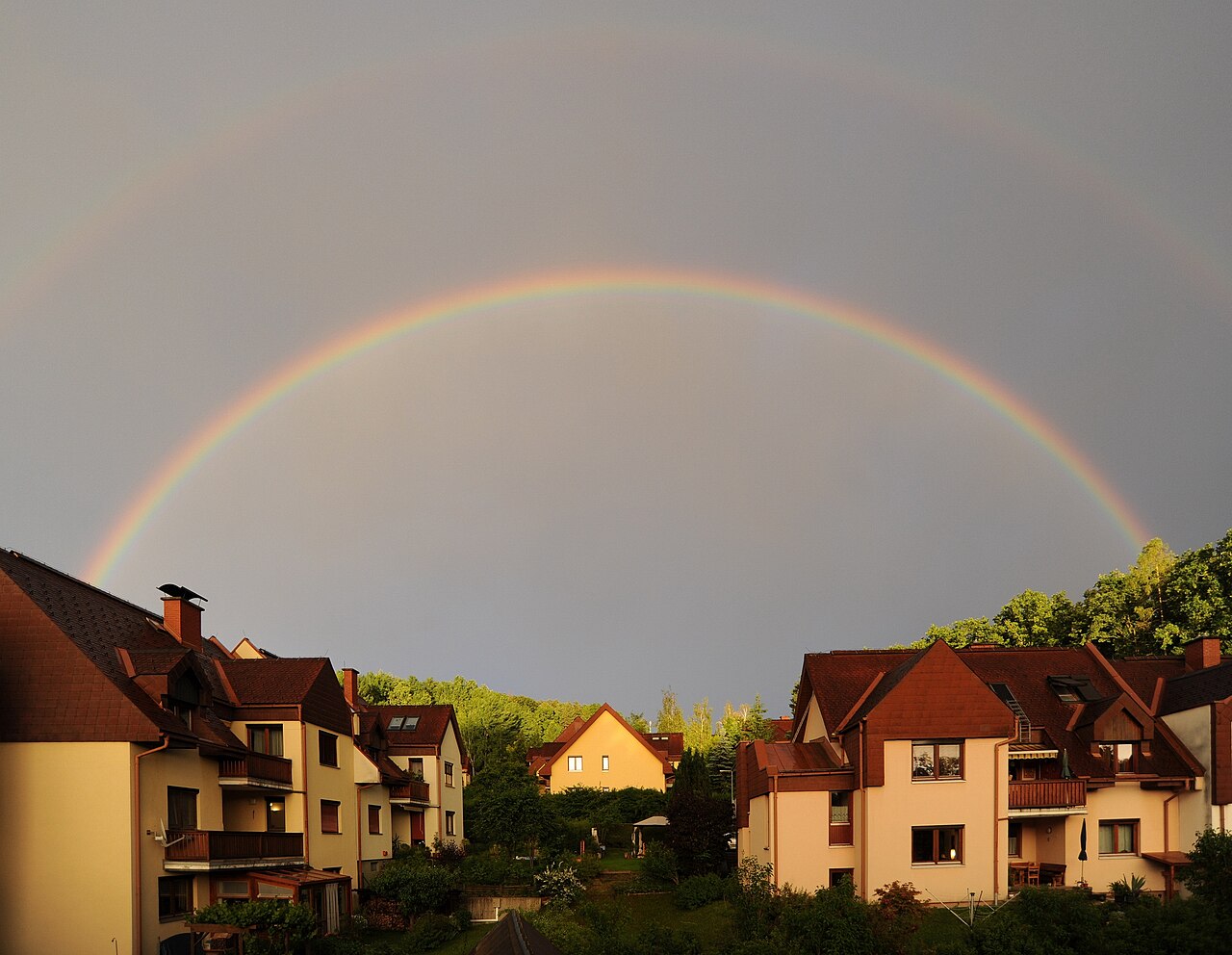
It is reversed
It is the same
It has no colours
It has only red and violet
The secondary bow comes from two internal reflections in each raindrop, which reverses the order of colours; it is fainter and lies at about 51°. Image: Dnalor 01, CC BY-SA 3.0, via Wikimedia Commons.
The H-alpha line, normally at 656.3 nm, is observed at 662.9 nm in a distant galaxy. Estimate the recession speed.
About 3.0×10⁸ m/s
About 6.6×10⁶ m/s
About 1.0×10⁴ m/s
About 3.0×10⁶ m/s
m/s (1% of c).
