Quiz · Hard
Twenty questions on CAPM, WACC, Modigliani and Miller, leverage, liquidity ratios, the cash conversion cycle, DuPont, free cash flow and payout.
Risk-free rate 4%, stock beta 0.8, market risk premium 5.5%. The CAPM cost of equity is:
9.5%
8.4%
4.4%
5.5%
Re = 4% + 0.8 x 5.5% = 8.4%.
A firm borrows at 7% and has a 30% tax rate. Its after-tax cost of debt is:
4.9%
7.0%
2.1%
9.1%
Rd x (1 - T) = 7% x 0.70 = 4.9%.
Equity is 70% of capital at 11%. Debt is 30% at 6% before tax, and the tax rate is 20%. WACC is:
9.50%
8.30%
10.10%
9.14%
0.70 x 11% + 0.30 x 6% x 0.80 = 7.70% + 1.44% = 9.14%.
In a world with no taxes or distress costs (MM Proposition I), a firm that replaces equity with debt will see:
Higher firm value
Lower firm value
No change in total firm value
Lower WACC
Value depends on the cash flows generated by assets, not on how they are split between debt and equity.
An unlevered firm is worth $5,000. It borrows $1,500 permanently and the tax rate is 30%. By MM with taxes, the levered value is:
$5,000
$5,450
$6,500
$5,150
V_L = V_U + Tc x D = 5,000 + 0.30 x 1,500 = 5,450.
In the trade-off diagram, what is true at the debt-to-equity ratio D/E*?
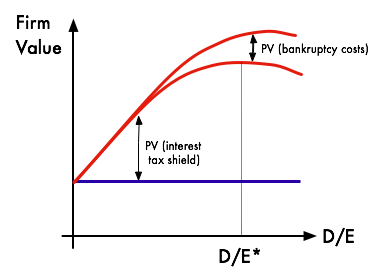
Firm value is maximized, as the marginal tax benefit equals the marginal distress cost
Bankruptcy costs are zero
The tax shield is zero
WACC is at its highest
Beyond D/E* additional debt adds more expected distress costs than tax benefits, so value falls.
Image: Suicup, CC BY-SA 3.0, via Wikimedia Commons.
According to the pecking order theory, the most preferred source of financing is:
New common equity
Preferred stock
A rights issue
Internal funds (retained earnings)
Information asymmetry makes outside financing costly, especially equity. The order is retained earnings, then debt, then equity.
A firm has fixed costs of $40,000, a price of $20 and variable cost of $12. Its break-even quantity is:
2,000 units
3,333 units
5,000 units
10,000 units
Q = F / (P - V) = 40,000 / 8 = 5,000.
With sales of 10,000 units, price $20, variable cost $12 and fixed costs $40,000, the degree of operating leverage is:
1.0
2.0
1.5
4.0
Contribution = 80,000 and EBIT = 40,000, so DOL = 80,000 / 40,000 = 2.0.
EBIT is $40,000 and interest expense $10,000. The degree of financial leverage is:
1.33
0.75
4.00
1.25
DFL = EBIT / (EBIT - Interest) = 40,000 / 30,000 = 1.33.
Current assets are $500, inventory is $200 and current liabilities are $250. The quick ratio is:
2.0
0.8
1.0
1.2
(500 - 200) / 250 = 1.2.
DIO is 60 days, DSO is 40 days and DPO is 35 days. The cash conversion cycle is:
135 days
85 days
65 days
-15 days
CCC = 60 + 40 - 35 = 65 days.
In the timeline, the firm delays paying suppliers from day 30 to day 40 and nothing else changes. The new cash conversion cycle is:
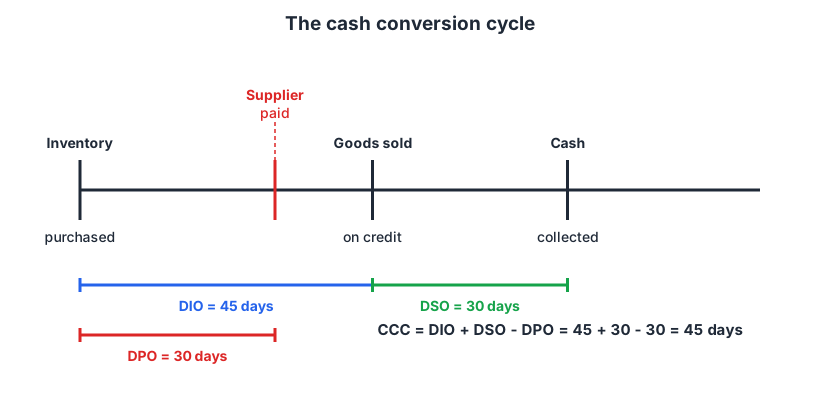
45 days
35 days
55 days
10 days
DPO rises from 30 to 40, so CCC = 45 + 30 - 40 = 35 days. Stretching payables shortens the cycle.
Net profit margin 5%, asset turnover 2.0 and equity multiplier 1.8. ROE is:
18%
10%
9%
20%
ROE = 0.05 x 2.0 x 1.8 = 0.18.
Annual demand is 3,600 units, ordering cost $40 per order and holding cost $2 per unit per year. The EOQ is closest to:
180 units
240 units
720 units
379 units
EOQ = sqrt(2 x 3,600 x 40 / 2) = sqrt(144,000) = 379.5.
Not taking a '2/10, net 30' cash discount is equivalent to borrowing at an effective annual rate of about:
2%
18%
45%
10%
The firm pays 2.04% extra to delay 20 days: (1 + 2/98)^(365/20) - 1 = 44.6%.
EBIT 150, tax rate 20%, depreciation 40, capital expenditure 60, increase in NWC 15. Free cash flow to the firm is:
130
85
95
145
FCFF = EBIT(1 - T) + Dep - CapEx - dNWC = 120 + 40 - 60 - 15 = 85.
FCFF next year is 100, WACC is 9% and long-run growth is 3%. The Gordon terminal value (at the start of next year's flow) is:
1,666.7
1,111.1
833.3
3,333.3
TV = FCFF / (WACC - g) = 100 / 0.06 = 1,666.7.
In perfect capital markets (Modigliani and Miller), a change in dividend policy:
Always raises the share price
Always lowers the share price
Changes WACC only
Does not change firm value, as shareholders can create homemade dividends
If investment policy is fixed, how earnings are split between dividends and retention is irrelevant to value.
A firm's ROE is 15% and it pays out 40% of earnings. Its sustainable growth rate is:
6%
15%
9%
25%
g = ROE x retention = 0.15 x 0.60 = 9%.
