Quiz · Medium
Covers HR planning, job analysis, recruitment and selection, validity, interviews, training models, appraisal, and compensation.
A firm forecasts that it will need 40 more engineers next year but expects only 25 to come from internal promotions and transfers. What is the next step in human resource planning?
Repeat the demand forecast with a different method
Write job specifications for all 40 positions
Plan actions to close the 15-person gap, such as external hiring or training
Lay off current engineers to cut cost
Demand minus supply identifies the gap, and action plans (recruit, train, outsource) come next. Writing job specifications comes after the plan is made. Layoffs address surpluses, not shortages.
Which document lists the knowledge, skills, abilities and other characteristics a person needs to do the job?
Job description
Job specification
Job evaluation report
Performance standard
The job specification describes the person. The job description describes the tasks, duties and responsibilities. Job evaluation determines the relative value of jobs for pay.
Which method of forecasting labor demand relies on anonymous rounds of expert estimates with feedback between rounds?
Markov analysis
Ratio analysis
Replacement charting
Delphi technique
Delphi collects expert views anonymously until they converge. Markov analysis and replacement charts are for internal supply, and ratio analysis is a quantitative demand method.
Adding planning and decision-making responsibility to a job to make it more motivating is called:
Job enlargement
Job enrichment
Job rotation
Job simplification
Enrichment is vertical loading (more responsibility and control, following Herzberg). Enlargement just adds similar tasks and rotation moves people between jobs.
Which is a typical DISADVANTAGE of filling vacancies from internal sources?
A limited pool of candidates and fewer new ideas
Higher recruiting cost
Lower morale among current staff
Longer orientation because the person is unknown
Internal hiring is cheaper, faster, builds morale, and candidates are known, but it limits fresh perspectives. The other options are advantages of internal hiring turned around.
A realistic job preview is most likely to:
Increase the number of applicants
Replace the need for structured interviews
Reduce early turnover by setting accurate expectations
Raise starting salaries
Showing both good and bad aspects helps self-selection and lowers early turnover. It may reduce applicants, and it does not replace valid selection tools.
A test gives almost the same scores when candidates retake it a week later, but the scores do not predict job performance. The test is:
Valid but not reliable
Reliable but not valid
Both reliable and valid
Neither reliable nor valid
Consistent scores mean reliable. Not predicting performance means low validity. A test cannot be valid without being reliable, so option 2 is impossible.
In a predictive validation study, the employer:
Tests current employees and correlates scores with current performance
Surveys managers about how good the test seems
Tests applicants, hires them, and later correlates scores with job performance
Checks that the test content looks like the job
Predictive validity follows applicants forward in time. Testing current employees is concurrent validity, and judging whether the content resembles the job is content validity.
A company interviews candidates using the same job-related questions for everyone, scored on a rubric. Compared with an unstructured interview, this approach generally:
Is more reliable and valid
Is less legally defensible
Gives interviewers more freedom to probe each person differently
Mostly measures the candidate's personality
Structure raises consistency and predictive power and reduces bias. Unstructured interviews let first impressions and similar-to-me bias creep in.
'Tell me about a time when you had to deliver bad news to a customer' is an example of which type of interview question?
Situational
Behavioral
Brainteaser
Stress
Behavioral questions ask about past behavior. Situational questions ask what the candidate WOULD do in a hypothetical scenario.
Under the Americans with Disabilities Act, when may an employer require a medical examination?
After a conditional job offer, if required of all entering employees in that job
Before the first interview, to screen out unfit applicants
Only after the employee has worked 12 months
Never
Medical exams are allowed only after a conditional offer, and the offer can be withdrawn only for job-related reasons. Pre-offer medical questions are prohibited.
In a multiple-hurdle selection model, a candidate:
Can offset a poor score with a very high score elsewhere
Is judged only by a final interview
Takes all tests at once
Must pass each stage in sequence to continue
Hurdles are sequential eliminations. Offsetting scores is the compensatory model.
Which training model has the phases Analyze, Design, Development, Implementation, Evaluation?

Kirkpatrick
Kolb
ADDIE
Tuckman
ADDIE is a design process. Kirkpatrick evaluates training, Kolb describes learning, and Tuckman describes team stages.
Image: Finckit, Vanessa Rodgers, CC BY-SA 4.0, via Wikimedia Commons.
A company surveys trainees right after a course and asks whether they enjoyed it. Which Kirkpatrick level is this?
Level 2: learning
Level 1: reaction
Level 3: behavior
Level 4: results
Reaction measures satisfaction. Learning would need a test, behavior would need on-the-job observation, and results would measure business outcomes.
In Kolb's learning cycle, which stage comes directly after concrete experience?
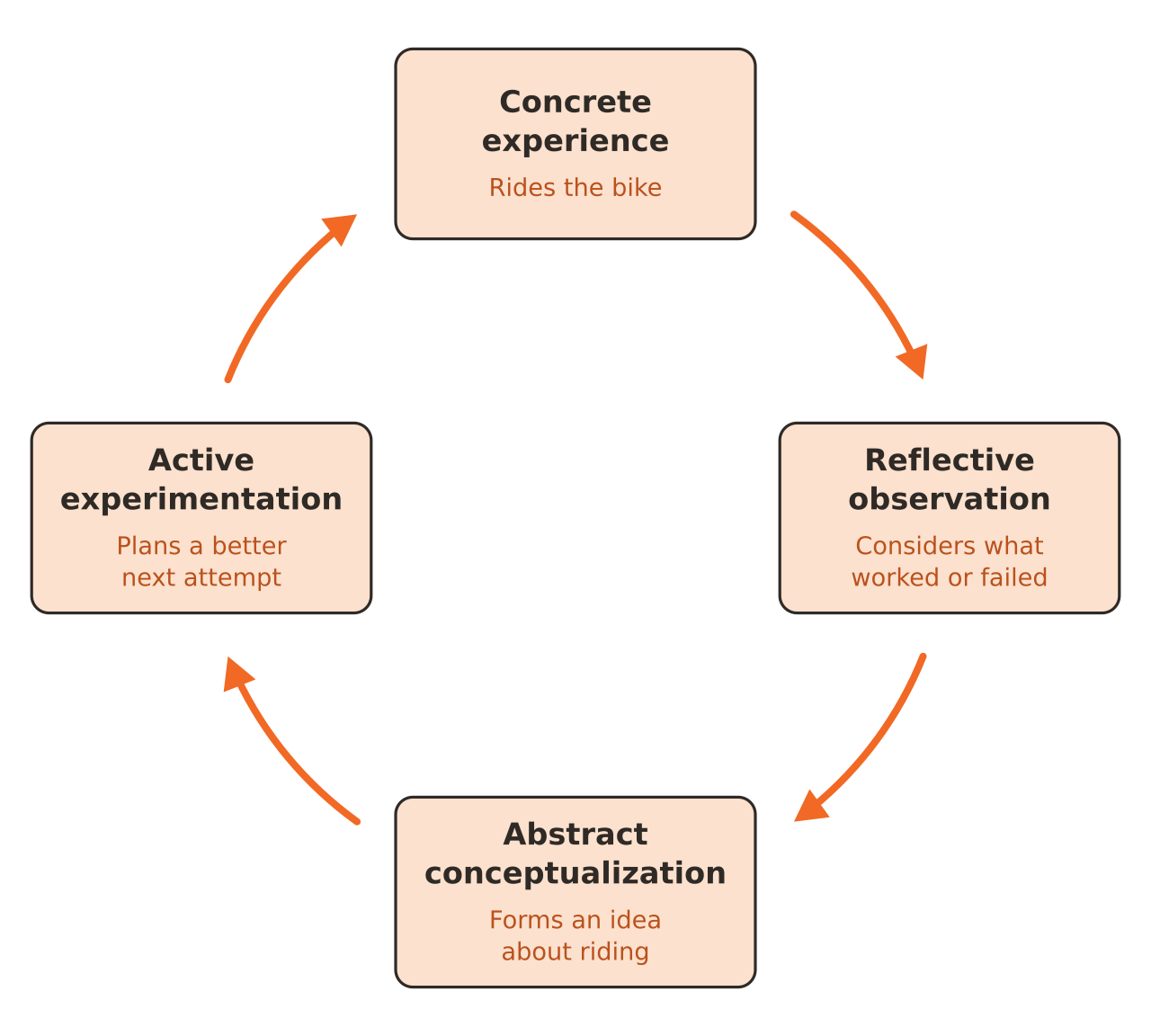
Abstract conceptualization
Active experimentation
Concrete planning
Reflective observation
The cycle runs: concrete experience, reflective observation, abstract conceptualization, active experimentation. Image: Derek Jansen, CC BY 4.0, via Wikimedia Commons.
Which rating scale ties each score to examples of actual job behavior?
Graphic rating scale
Behaviorally anchored rating scale (BARS)
Forced distribution
Simple ranking
BARS uses specific behavioral examples for each point. Graphic scales use vague trait labels, and forced distribution and ranking compare employees with one another.
A manager rates every employee 'meets expectations' to avoid conflict. This is:
Central tendency error
Halo effect
Recency bias
Horn effect
Central tendency bunches ratings in the middle. Halo and horn let one trait distort the whole rating, and recency overweights recent events.
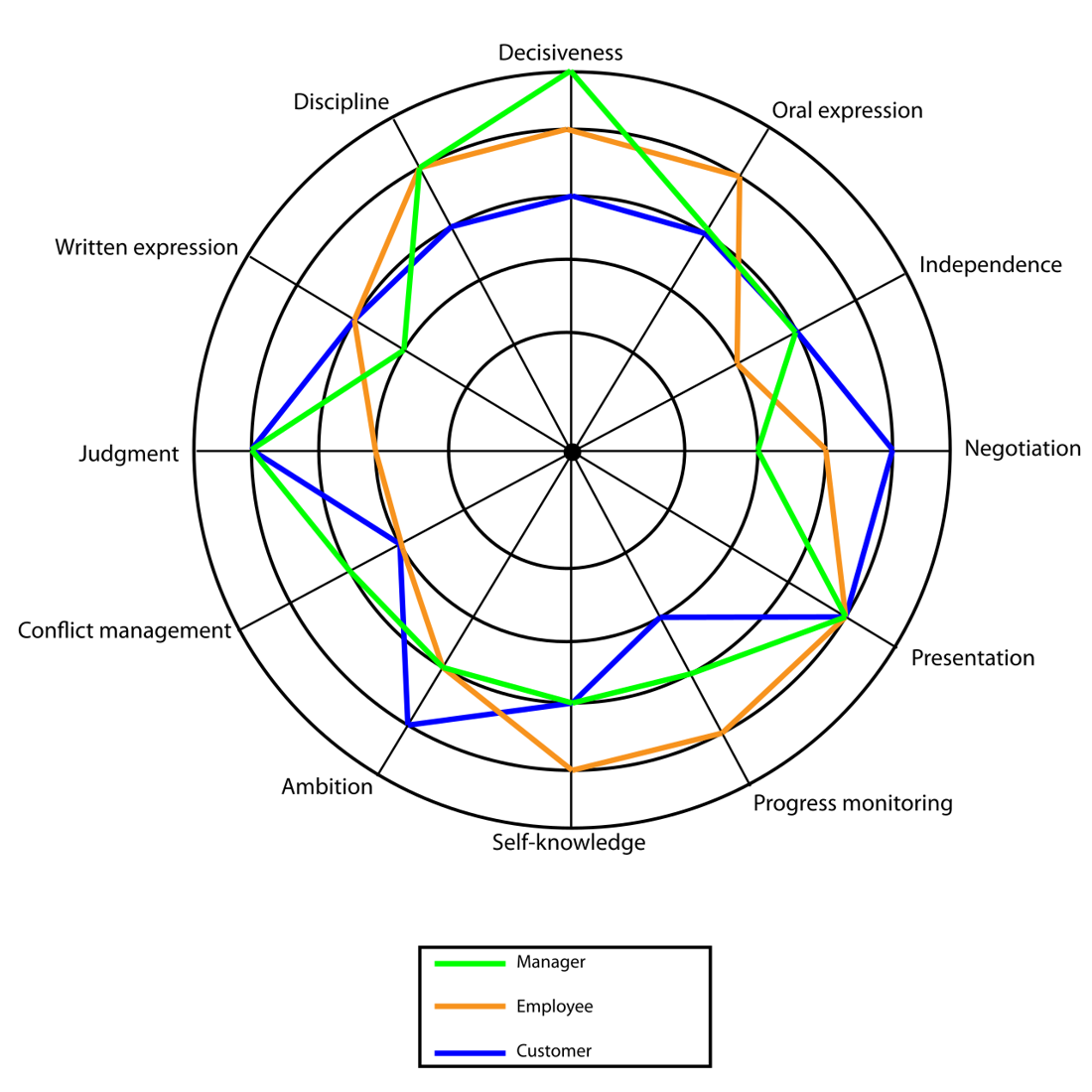
The chart shows ratings of one person from a manager, an employee and a customer. This is an example of:
Management by objectives
Forced distribution
360-degree feedback
A graphic rating scale from one rater
360-degree feedback gathers ratings from several sources around the person. MBO is about goals and forced distribution is about ranking within a group. Image: Zirguezi, CC0, via Wikimedia Commons.
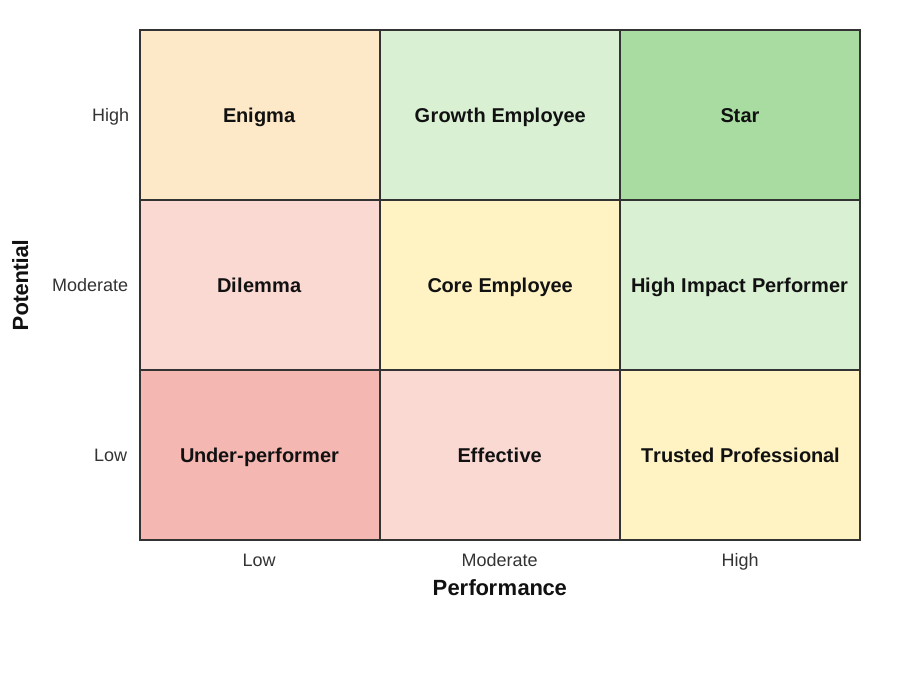
In the nine-box grid shown, an employee with high potential and high performance would be placed in the box labeled:
Star
Enigma
High Impact Performer
Trusted Professional
Star is top-right (high on both axes). Enigma is high potential but low performance. High Impact Performer is high performance with moderate potential.
An employee earns $48,000. The midpoint of her pay range is $60,000. What is her compa-ratio?
1.25
0.80
0.20
0.48
Compa-ratio = pay / midpoint = 48,000 / 60,000 = 0.80. 1.25 is the inverse (midpoint / pay).
A company deliberately pays above the labor-market median to attract top talent. This is a:
Match pay strategy
Lag pay strategy
Gainsharing plan
Lead pay strategy
Lead pays above market, match pays at market and lag pays below market.
Which compensation plan shares with employees the gains from productivity or cost improvements that they can influence?
Profit sharing
Gainsharing (such as the Scanlon plan)
Merit pay
A signing bonus
Gainsharing links rewards to group-controlled performance. Profit sharing depends on overall profit, which many factors affect, and merit pay is an individual base-pay increase.
Which of these is NOT a traditional job evaluation method?
Behaviorally anchored rating
Point-factor
Ranking
Classification
Behaviorally anchored rating is an appraisal method. Point-factor, ranking and classification all value jobs.
The photo shows a panel interview, in which several interviewers meet one candidate. What is a key advantage of this format?

It is always cheaper than a one-on-one interview
It removes the need for structured questions
Several evaluators bring multiple perspectives to the decision
It guarantees no interviewer bias
Multiple raters can improve consistency and balance individual biases, but panels cost more in time and need structure. Image: Alan Cleaver from Whitehaven, United Kingdom, CC BY 2.0, via Wikimedia Commons.
