Quiz · Hard
Triads, seventh chords, inversions, Roman numerals, harmonic function and cadences.
What is a suspension?
A note that jumps to a new chord tone
A note tied across the bar line
A held note that clashes and resolves down by step
A rest in all voices
Common patterns are 4-3, 7-6 and 9-8.
A major triad is built from which intervals above the root?
Minor third and perfect fifth
Major third and perfect fifth
Major third and diminished fifth
Minor third and diminished fifth
Major third (4 semitones) plus perfect fifth (7 semitones): C E G.
Which triad is a minor third plus a minor third?
Augmented
Major
Diminished
Minor
0-3-6 semitones; for example B D F.
In a major key, which diatonic triad is diminished?
ii
vii°
iii
vi
Only the triad on the leading tone is diminished.
In the C major row of this excerpt, which Roman numeral labels the Dm chord?
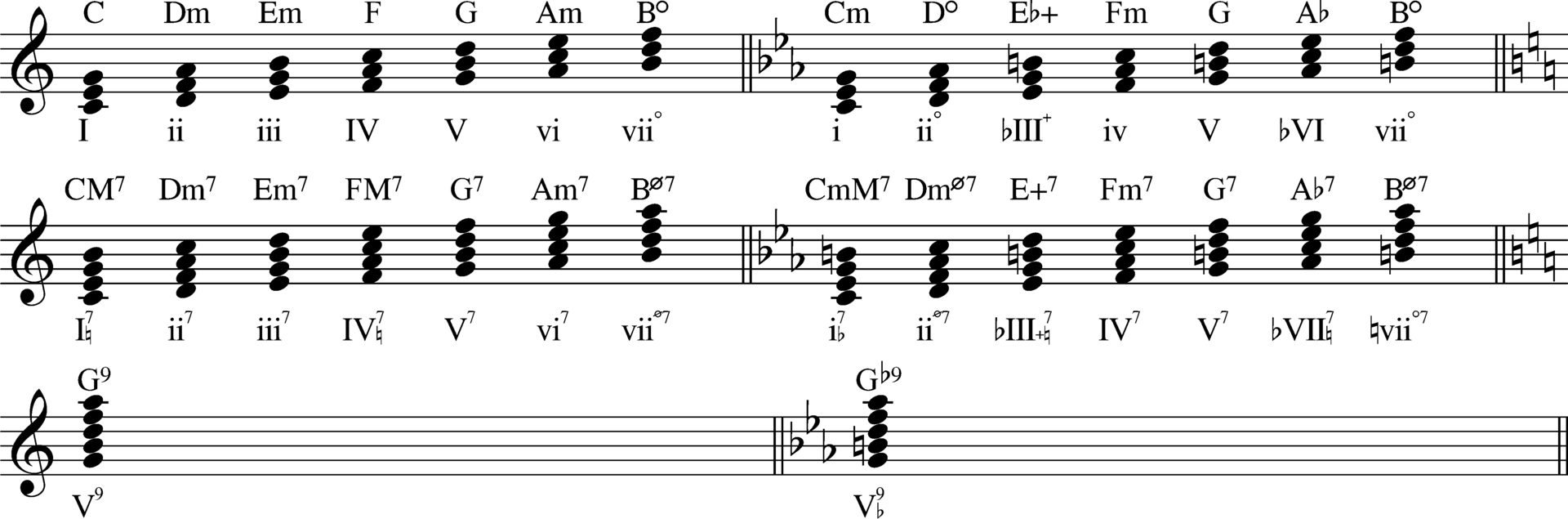
ii
IV
iii
vi
Dm is the supertonic chord: ii.
Image: Hyacinth (scan of Ziehn, 1907), public domain, via Wikimedia Commons.
The three chords shown are all C major. What is the second one called?
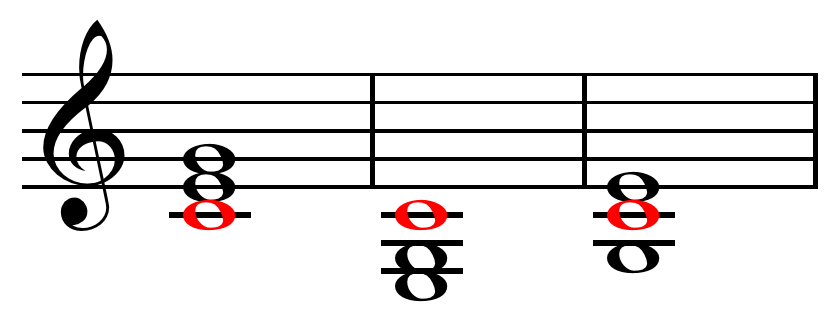
Root position
Second inversion
Third inversion
First inversion
E is in the bass, so it is first inversion (figured 6).
Image: Created by Hyacinth using Sibelius 5, public domain, via Wikimedia Commons.
Which figured bass symbol indicates a second-inversion triad?
6
6/4
7
4/2
The bass is the fifth of the chord: intervals of a sixth and a fourth above the bass.
What are the notes of a G7 chord?
G B D F
G B-flat D F
G B D F-sharp
G B D A
Major triad plus minor seventh: G B D F.
In F major (one flat), what is the V7 chord shown here?
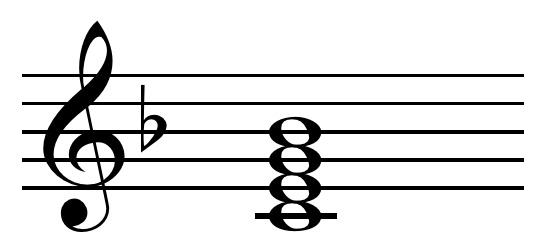
F A C E
C E G B-flat
C E-flat G B-flat
B-flat D F A
V is C; with the minor seventh B-flat, C7 = C E G B-flat.
Image: Unknown author, public domain, via Wikimedia Commons.
Which seventh chord is built from a diminished triad plus a minor seventh?
Half-diminished
Dominant seventh
Minor seventh
Fully diminished
Half-diminished (ø7): for example B D F A.
Which pair of chords makes up the harmonic function 'predominant'?
I and vi
V and vii°
ii and IV
iii and V
ii and IV usually lead to the dominant.
What cadence is shown by this V to I progression in root position with the tonic on top?
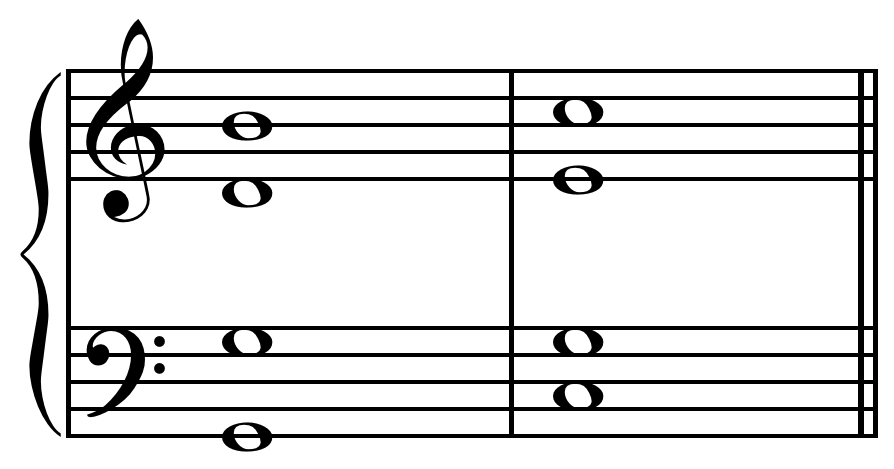
Plagal
Deceptive
Half
Perfect authentic
The leading tone resolves to C while the bass moves G to C.
Image: Hyacinth, CC BY-SA 3.0, via Wikimedia Commons.
In C major, the movement from F major to C major shown here is which cadence?
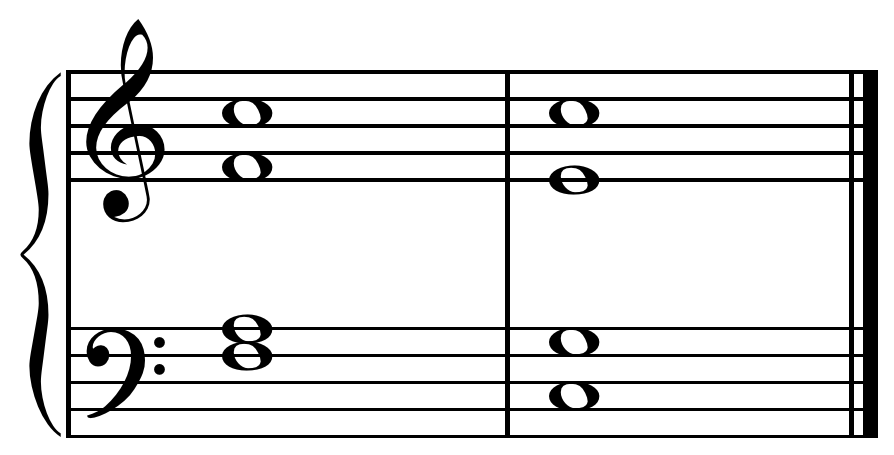
Authentic
Plagal
Half
Deceptive
IV to I is the 'Amen' cadence.
Image: Hyacinth, CC BY-SA 3.0, via Wikimedia Commons.
Which cadence moves from V to vi?
Half cadence
Deceptive cadence
Phrygian half cadence
Plagal cadence
The ear expects I but hears vi.
A phrase ending on the dominant chord, like a comma, is called which cadence?
Half cadence
Perfect authentic cadence
Plagal cadence
Deceptive cadence
Half cadences end on V and leave the phrase open.
In the key of C major, which chord is V/V (the secondary dominant of V)?
F major
G7
Dm
D major or D7
D7 is the dominant of G, so it tonicizes V.
Which progression is a typical ii-V-I in C major?
Dm7 G7 Cmaj7
Fm7 B-flat7 E-flat
Em7 A7 Dmaj7
C7 F7 G7
Supertonic, dominant, tonic.
What is the Picardy third?
A minor chord at the end of a major piece
A major tonic chord at the end of a minor-key piece
A dissonant suspension
A modulation to the relative minor
The final chord is major in a piece that is otherwise minor.
Which voice-leading practice is traditionally avoided in four-part harmony?
Contrary motion
Common tones kept
Parallel perfect fifths
Stepwise motion
Parallel fifths and octaves weaken the independence of voices.
Which chord contains the tritone that drives resolution to the tonic?
IV
V7
vi
I
V7 has a tritone between its third (leading tone) and seventh.
