Quiz · Hard
Numerical tariff problems, terms of trade, customs unions, exchange rates and the balance of payments.
World price $10. Domestic demand Qd = 60 - P and supply Qs = P. Under free trade, imports are...
10
50
30
40
Qd = 50 and Qs = 10, so imports = 40. The 10 is domestic supply and 50 is domestic consumption.
A $5 tariff is added to that market. The new quantity of imports is...
20
45
30
40
The domestic price is 15. Qd = 45, Qs = 15, and imports = 30.
With the $5 tariff, what is the government's tariff revenue?
$225
$150
$25
$200
5 x 30 = 150. The $25 is the deadweight loss, not the revenue.
What is the deadweight loss of that $5 tariff?
$12.5
$150
$25
$237.5
Two triangles: 1/2 x 5 x 5 (production) + 1/2 x 5 x 5 (consumption) = 12.5 + 12.5. The 237.5 is the consumer surplus loss.
Which pair of triangles forms the deadweight loss of a tariff?
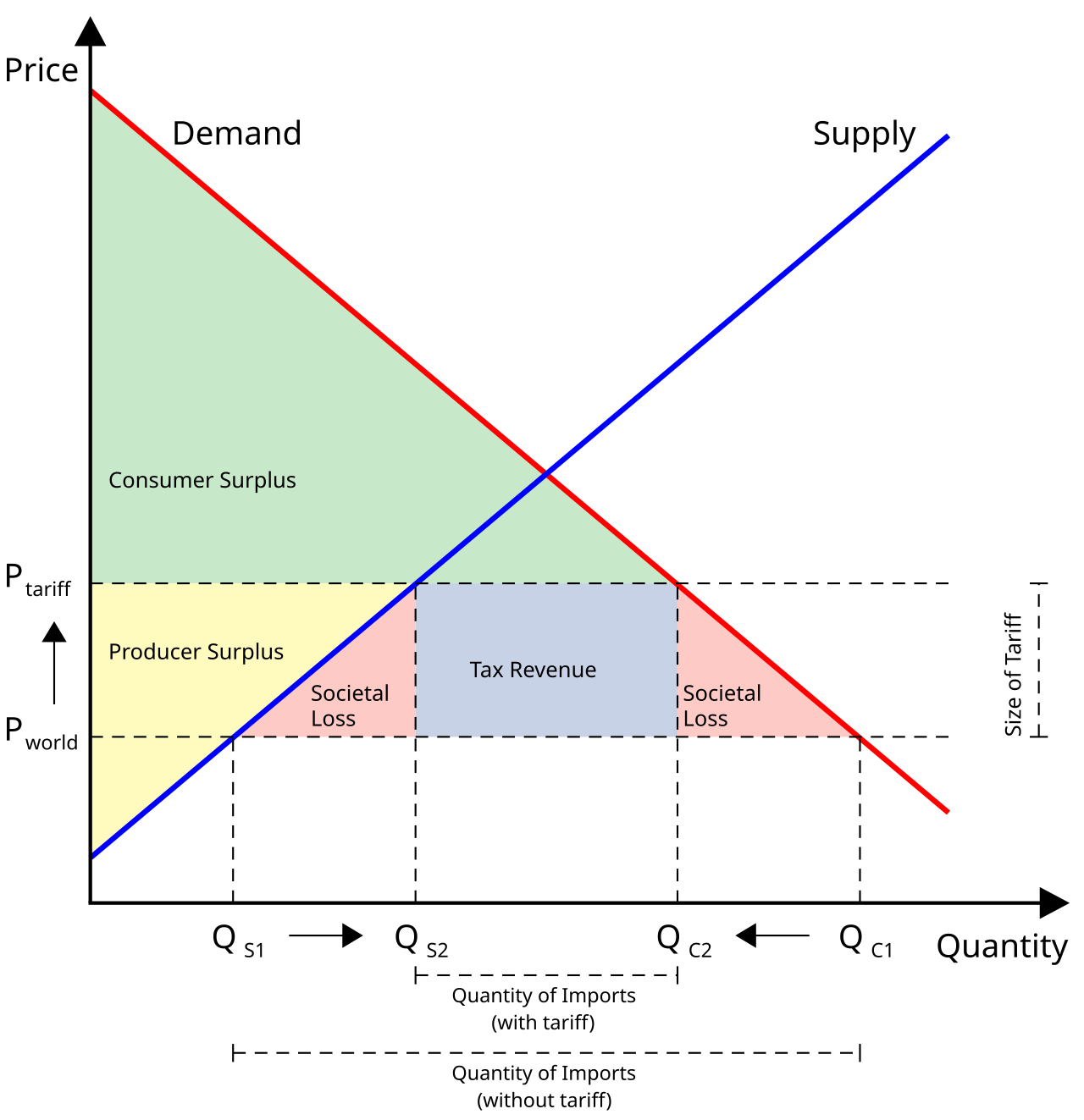
The shortage and the surplus
Consumer surplus and producer surplus
Producer surplus and tax revenue
Overproduction at higher domestic cost and underconsumption of cheap imports
The left triangle is the cost of replacing cheaper imports with costly domestic output. The right triangle is lost consumer value.
Image: Austin512, CC BY 3.0, via Wikimedia Commons.
An import quota that gives the same domestic price as a $5 tariff would differ in that...
imports are higher
the $150 rent goes to license holders
consumers pay less
the deadweight loss is zero
Prices, quantities and the deadweight loss are the same. The tariff revenue becomes quota rent.
Country A: 12 hours per computer, 4 hours per ton of wheat. Country B: 6 hours per computer, 3 hours per ton. Which statement is correct?
A should specialize in computers
There are no gains from trade
B has the absolute advantage in both, and A has the comparative advantage in wheat
B has the comparative advantage in wheat
A's opportunity cost of wheat is 1/3 computer (4/12), B's is 1/2 (3/6). A has the comparative advantage in wheat.
In the previous example, what terms of trade (computers per ton of wheat) would make both countries better off?
Less than 1/3
Between 1/3 and 1/2
More than 1/2
Exactly 1
A will accept at least 1/3 computer per ton and B will pay at most 1/2.
According to the Stolper-Samuelson theorem, trade raises the real income of...
the owners of the scarce factor
only consumers
everyone equally
the owners of the abundant factor
Winners and losers exist within a country. Total gains exceed the losses, which makes compensation possible.
The Leontief paradox found that the United States...
exported capital-intensive goods
had no trade
imported only raw materials
exported relatively labor-intensive goods and imported capital-intensive ones
This contradicted the prediction of Heckscher-Ohlin for a capital-abundant country.
Trade creation in a customs union occurs when...
members replace high-cost domestic production with cheaper partner imports
imports switch from a low-cost outsider to a higher-cost member
tariffs are raised
trade falls
The second option describes trade diversion.
A depreciation improves the trade balance if...
the import price falls
the interest rate is zero
exports are inelastic
the sum of the export and import demand elasticities exceeds 1
This is the Marshall-Lerner condition.
After a depreciation the trade balance first worsens and then improves. This is called...
the Laffer curve
the Lorenz curve
the J-curve
the Phillips curve
Import prices rise at once, while quantities adjust slowly.
A current account deficit must be matched by...
falling imports
a higher export price
a budget surplus
a net capital inflow
The balance of payments sums to zero, so the deficit is financed by foreigners buying assets or lending.
The current account is roughly equal to...
exports plus imports
investment minus saving
national saving minus investment
government spending minus taxes only
Since S = Y - C - G, we have CA = S - I.
Which situation can worsen a country's terms of trade?
Import prices fall
Export prices fall relative to import prices
Export prices rise
The exchange rate is fixed
Terms of trade = export prices divided by import prices. A fall means each export buys fewer imports.
Which of these is a non-tariff barrier?
A technical standard that foreign products must meet
A customs union
A 10 percent import duty
A trade deficit
Standards, licensing and quotas are non-tariff barriers if used as disguised protection.
The effective rate of protection for an industry can be higher than the nominal tariff on its output when...
the tariff on its inputs is low
the industry exports
the tariff on its inputs is high
there is a quota
Low input tariffs raise the protection of value added.
Which dispute-settlement fact about the WTO is correct?
It can impose taxes directly
Disputes are settled by the UN Security Council
It only handles tariffs
The Appellate Body has not functioned since 2019
The US has blocked appointments of Appellate Body members.
Which statement about comparative advantage and absolute advantage is correct?
Comparative advantage requires equal productivity
Absolute advantage determines the pattern of trade
Only the country with an absolute advantage gains
A country with no absolute advantage can still gain from trade
Opportunity costs differ even if one country is less productive at everything.
