Quiz · Medium
Twenty questions on price takers, profit maximization, the shutdown rule, monopoly pricing and long-run outcomes, with diagram questions.
Which feature is NOT part of perfect competition?
Identical products
Many buyers and sellers
Free entry and exit
Firms face a downward-sloping demand curve
A competitive firm is a price taker and faces a horizontal demand curve at the market price.
A perfectly competitive firm produces where...
price equals average total cost
price equals marginal cost
total revenue is maximized
marginal revenue equals average revenue only
Profit maximization means MR = MC, and for a price taker MR = P. The ATC condition holds only in long-run equilibrium.
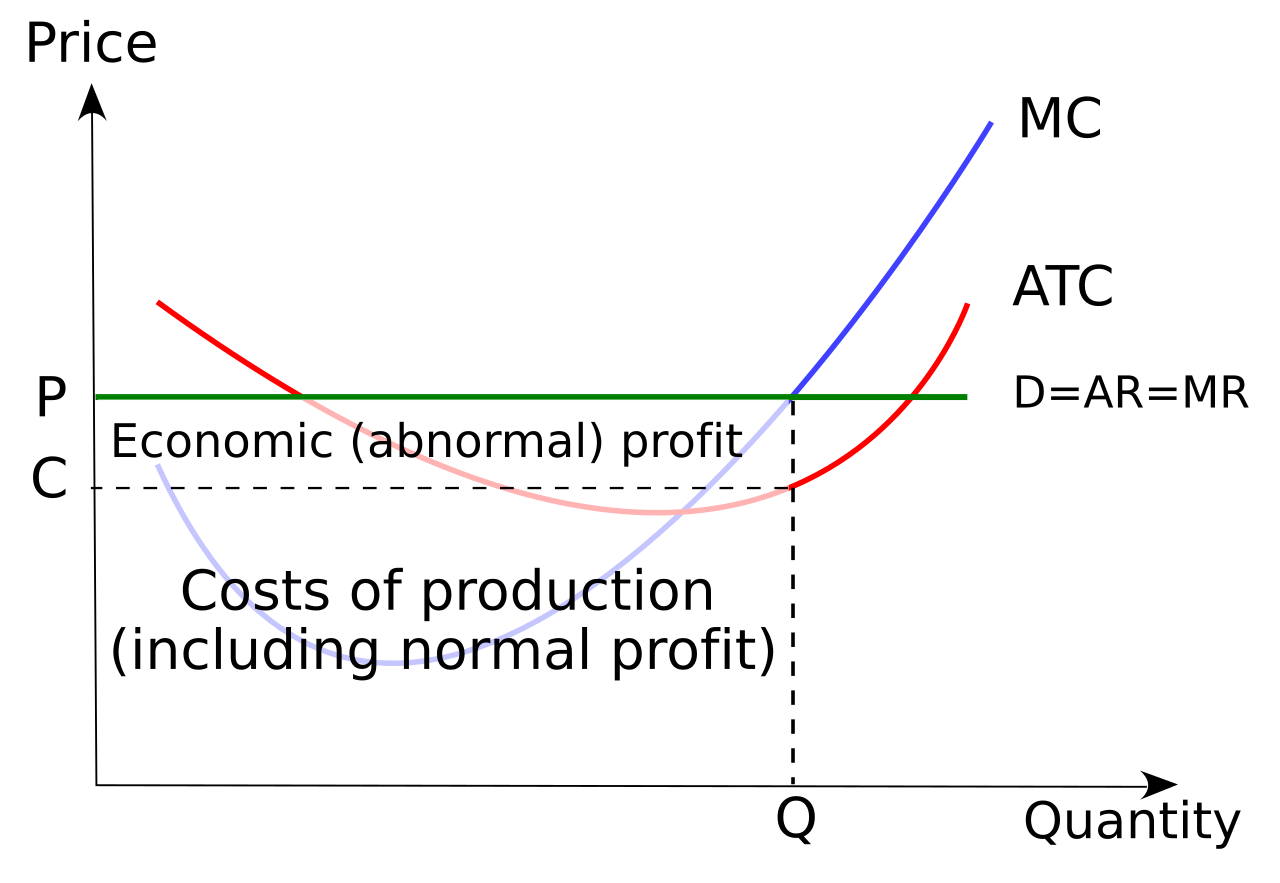
In this diagram the firm sells at price P above ATC at Q. What does it earn?
Only normal profit
An economic loss
Economic profit
Zero economic profit
The area between P and ATC out to Q is economic profit. It attracts new firms in the long run.
Image: Jarry1250, CC BY-SA 3.0, via Wikimedia Commons.
A competitive firm's price falls below its average variable cost. In the short run it should...
continue producing since it still pays fixed costs
raise price
raise output
shut down
If P < AVC it loses more by producing than by stopping, since it can't cover even variable costs.
In long-run perfectly competitive equilibrium, which is true?
P > MC and economic profit is positive
P = MC = minimum ATC and economic profit is zero
P = ATC but P < MC
P = MC but economic profit is positive
Entry and exit drive profit to zero, and firms produce at the lowest point of ATC.
Economic profit in perfect competition leads to...
no change in the market
exit of firms and a higher price
entry of new firms and a lower market price
a higher price as firms raise output
Profit attracts entrants, shifting supply right and lowering price until profit is zero.
Which is the best example of monopolistic competition?
The two largest aircraft makers
A local water utility
Restaurants in a city
A wheat farm
Many restaurants offer differentiated products and entry is easy.
Why is marginal revenue below price for a monopolist?
It can't price discriminate
It faces rising marginal cost
To sell more it must cut the price on all units
Demand is perfectly elastic
The price cut on earlier units is a revenue loss that offsets part of the gain from the extra unit.
A monopolist's demand is P = 100 - 2Q and MC = 20. What quantity does it produce?
40
10
30
20
MR = 100 - 4Q. Setting MR = MC gives 100 - 4Q = 20, so Q = 20. Q = 40 is the competitive output where P = MC.
In the same market, what price does the monopolist charge?
100
40
60
20
The price is read from the demand curve at Q = 20: P = 100 - 40 = 60. The tempting 20 is MC, which is not the price.
Which statement about monopoly is true?
The monopolist always earns a profit
Price equals marginal cost
The monopolist produces where P = MR
Price is above marginal cost and output is below the efficient level
A monopoly restricts output to charge a higher price. It may not earn a profit if ATC is above the price.
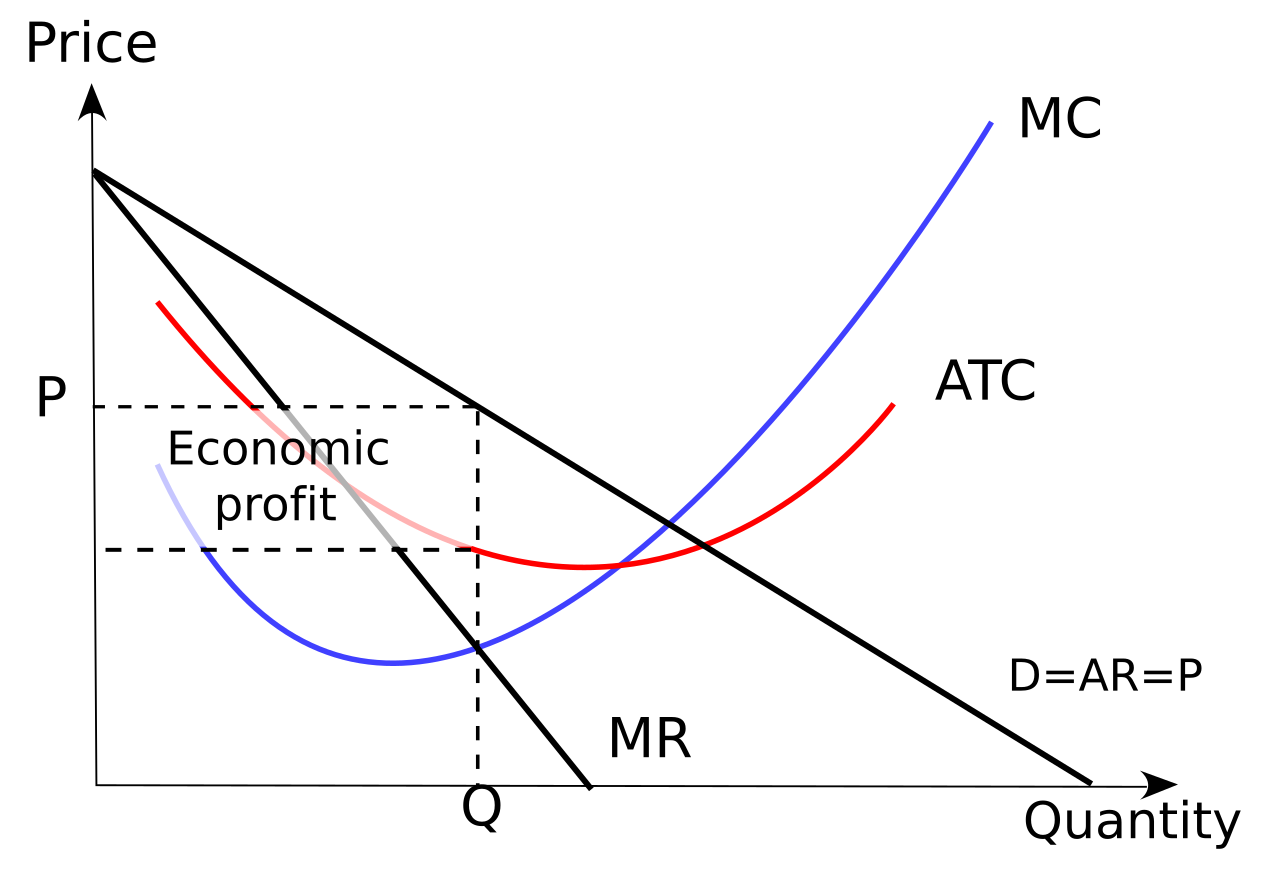
Where does a profit-maximizing monopolist produce in the diagram?
Where MR is zero
Where ATC is lowest
Where demand meets MC
At the quantity where MR = MC, with price from the demand curve
The firm picks Q from MR = MC and then reads the price off demand above that quantity.
Image: Sheitan (English Wikipedia) and Jarry1250, CC BY-SA 3.0, via Wikimedia Commons.
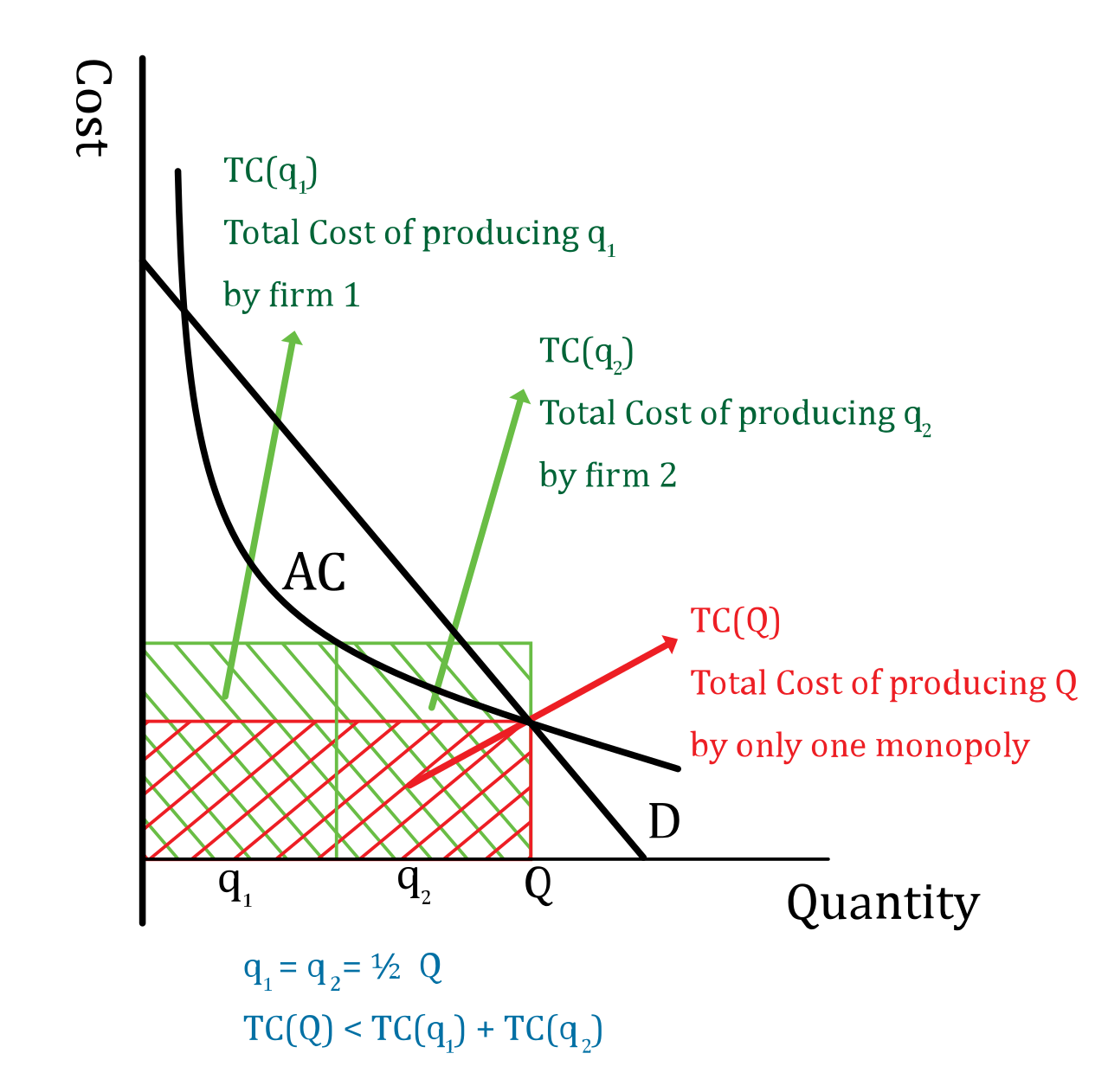
A natural monopoly exists when...
firms collude
one firm can serve the market at lower average cost than two or more firms
a firm owns a patent
the government licenses one seller
Economies of scale over the relevant range of demand cause it. Typical examples are water and electricity networks.
Image: CoolKoon, CC BY-SA 4.0, via Wikimedia Commons.
Which is a form of third-degree price discrimination?
Charging each buyer their maximum willingness to pay
Student discounts at a cinema
A bulk discount for buying 10 units
A coupon for a free item
Third-degree discrimination charges different prices to identifiable groups. Bulk discounts are second-degree, and charging each buyer's maximum is first-degree.
In the long run a monopolistically competitive firm earns...
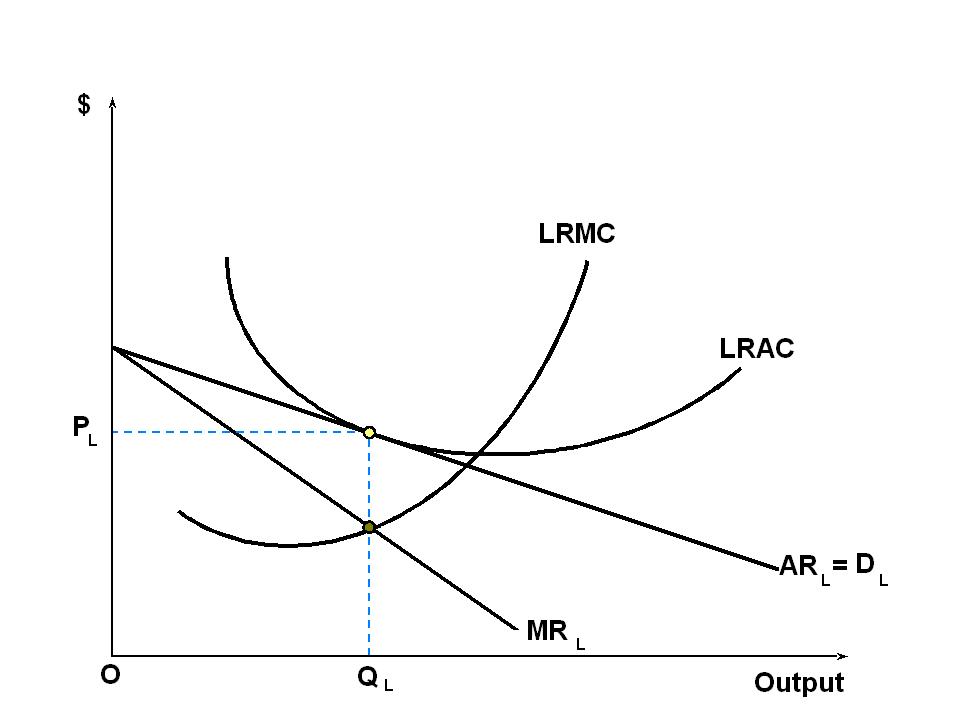
zero economic profit, with price equal to average cost
positive economic profit
zero profit with price equal to marginal cost
economic losses
Entry shifts demand left until it is tangent to average cost.
Image: Sheitan (English Wikipedia), CC BY-SA 3.0, via Wikimedia Commons.
Excess capacity in monopolistic competition means...
firms earn positive profit
there is a shortage
firms have unsold inventory
firms produce above minimum ATC
firms produce below the output where ATC is lowest
The tangency occurs on the falling part of ATC, so each firm could lower average cost by producing more.
Only perfect competition has price equal to marginal cost in the long run. True or False?
False
True
Other structures have market power, so P > MC.
The market structure with the highest barriers to entry is...
monopolistic competition
oligopoly
monopoly
perfect competition
Monopoly typically has near-complete barriers. Oligopoly's barriers are high but not total.
Which statement about a perfectly competitive firm's supply curve is correct?
It is the entire ATC curve
It is the horizontal price line
It is the part of the MC curve above AVC
It is the demand curve
Below the minimum AVC the firm shuts down, so quantity supplied is zero.
Which pair is correctly matched?
Patented drug: monopolistic competition
Wheat farmers: oligopoly
Wireless carriers: oligopoly
Hair salons: perfect competition
Hair salons are monopolistic competition, wheat farming is close to perfect competition, and a patented drug is a monopoly for that drug.
