Quiz · Hard
Twenty Level I style questions on financial statements, inventory, depreciation, equity method, cash flows, elasticity, forward rates and the IPS.
Which is NOT one of Porter's five forces?
Government regulation
Threat of substitutes
Bargaining power of buyers
Rivalry among competitors
The five forces are entrants, suppliers, buyers, substitutes and rivalry.
The lower of an investor's ability and willingness to take risk governs:
The tax constraint
The time horizon
Security selection
The risk objective in the IPS
If a client is willing but unable to take risk, the ability dominates.
Under US GAAP, dividends paid are classified in cash flow from:
Operating activities only
Investing activities
Financing activities
Non-cash disclosures
IFRS allows operating or financing.
Under the standard DuPont analysis ROE equals:
Margin / turnover / leverage
Net profit margin x asset turnover x financial leverage
ROA / equity multiplier
EBIT / interest
ROE = NI/Sales x Sales/Assets x Assets/Equity.
Prices are rising. Compared with FIFO, LIFO will report:
Higher COGS and lower net income
Lower COGS and higher net income
The same net income
Higher inventory
LIFO matches the newest, higher costs against revenue, lowering profit and taxes.
Inventory: 100 units at $10, then 100 at $12. 150 units are sold. FIFO cost of goods sold is:
$1,700
$1,650
$2,200
$1,600
100 x 10 + 50 x 12 = 1,600. LIFO would be 1,700.
Which method is prohibited under IFRS?
FIFO
Weighted average
LIFO
Specific identification
LIFO is permitted only under US GAAP.
An asset costs $50,000, salvage $5,000, life 5 years. First-year double-declining-balance depreciation is:
$9,000
$20,000
$18,000
$10,000
Rate 2/5 = 40% of the 50,000 book value = 20,000. Straight-line gives 9,000.
A company owns 30% of an investee and has significant influence. The investee earns $1,000 and pays $100 in dividends. The investor reports equity income of:
$300
$30
$100
$1,000
Equity method income is the share of profit, 30% x 1,000 = 300. The dividend lowers the investment account.
Net income 500, depreciation 100, increase in receivables 40, increase in payables 30. Cash flow from operations is:
$500
$630
$690
$590
500 + 100 - 40 + 30 = 590.
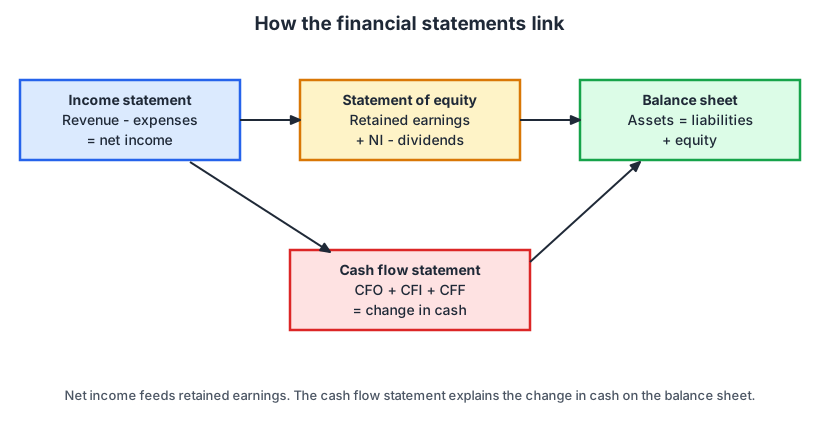
The diagram shows that net income flows to:
Cash flow from financing only
The audit report
Retained earnings, linking the income statement to the balance sheet
Inventory
Net income less dividends raises retained earnings.
Price rises 10% and quantity demanded falls 15%. Demand is:
Inelastic, with elasticity 0.67
Elastic, with elasticity 1.5, so total revenue falls
Unit elastic
Elastic, and total revenue rises
|E| = 15 / 10 = 1.5 > 1.
The expenditure approach defines GDP as:
C + I + G + (X - M)
C + I + G + X + M
W + R + i + P
C - I + G
Net exports (X - M) subtract imports.
One-year spot rate 2%, two-year spot rate 3%. The one-year forward rate one year from now is closest to:
3.00%
2.50%
5.00%
4.01%
1.03^2 / 1.02 - 1 = 4.01%.
A hedge fund earns 15% on assets. It charges 2% management and 20% of profits after the management fee. Net return is:
10.0%
11.0%
10.4%
12.0%
13% after the management fee, less 20% x 13% = 2.6%, gives 10.4%.
Which is the largest risk of mortgage pass-through securities, resulting from borrowers refinancing?
Currency risk
Prepayment risk
Commodity risk
Inflation-linked risk
Falling rates bring prepayments (contraction), and rising rates slow them (extension).
A 20% to 50% ownership stake with significant influence is usually accounted for using:
Consolidation
The equity method
Fair value through profit or loss only
The cost method
Above 50% (control) requires consolidation.
A deferred tax liability usually arises when:
Taxable income is lower than accounting profit due to temporary differences
Taxable income exceeds accounting profit
A company has no taxable income
Dividends are paid
Faster tax depreciation is a common cause. It reverses later.
Strategic asset allocation refers to:
Short-term bets on market views
Security selection within a sector
Rebalancing every day
Long-term target weights set from the IPS
Tactical allocation is the short-term deviation from strategic weights.
Supervised machine learning requires:
No data
Only clustering
Labeled training data
Only text data
Regression and classification are supervised. Unsupervised learning finds structure in unlabeled data.
