Quiz · Medium
Twenty questions on 1789, the Haitian and Latin American revolutions, Napoleon, Vienna and the unifications of Italy and Germany.
Why did the Third Estate declare itself the National Assembly in June 1789?
The king had dissolved the Estates-General and ordered the Third Estate to leave Paris
It was angry that voting by estate let the clergy and nobles outvote it despite representing most of France
It wanted to abolish the monarchy immediately
It had been offered power by the Directory
Voting by estate gave each estate one vote, so the two privileged estates could always outvote the commoners. The abolition of the monarchy came three years later, in 1792.
Which event of 14 July 1789 became a symbol of the French Revolution?
The storming of the Bastille
The Tennis Court Oath
The execution of Louis XVI
The Women's March on Versailles
The Bastille was a royal fortress-prison. The Tennis Court Oath was in June, the women's march in October and the king's execution in January 1793.
What was the main purpose of the Committee of Public Safety?
To write the Napoleonic Code
To choose a new king after 1793
To negotiate peace at the Congress of Vienna
To defend the Republic against internal and external enemies during the Terror
It was led by Robespierre in 1793-94 and directed the Reign of Terror. The Code came under Napoleon in 1804.
Which statement about the Haitian Revolution is correct?
It was led by the French Jacobins and ended slavery for good in 1794
It ended with Haiti becoming a French province
It created the first Black-led republic, after enslaved people defeated French forces
It was a short rebellion that failed within a year
Haiti became independent on 1 January 1804. The French abolished slavery in 1794 but Napoleon tried to restore it in 1802, which the Haitians resisted.
Napoleon's Continental System tried to:
Unite all European currencies
Cut Britain off from European trade
Open Europe to British goods
Build a canal across Egypt
The blockade was meant to ruin Britain economically, but it was leaky and unpopular, and Russia's defection helped trigger the 1812 invasion.
What was the most important cause of Napoleon's failure in Russia in 1812?
Distance, scorched-earth retreat and winter destroyed his army before it could force a decisive battle
Britain invaded France while his army was away
Austria overthrew him in a coup
His soldiers refused to fight at Borodino
Borodino was fought and Moscow was taken, but the Russians would not surrender, and starvation and cold destroyed the Grande Armee on the retreat.
Which principle at the Congress of Vienna meant restoring Europe's 'rightful' rulers?
Self-determination
Popular sovereignty
Laissez-faire
Legitimacy
Legitimacy supported the return of the Bourbons in France. Self-determination and popular sovereignty were what the revolutionaries wanted.
Which pair of leaders is correctly matched with their contribution to Latin American independence?
San Martin - led Brazil's independence; Bolivar - liberated Haiti
Hidalgo - first president of Gran Colombia; Bolivar - freed Mexico
San Martin - crossed the Andes to free Chile; Bolivar - freed Venezuela and Colombia
Bolivar - liberated Argentina; San Martin - founder of Venezuela
Brazil's independence in 1822 was led by Pedro I. Hidalgo started Mexico's war in 1810; Haiti freed itself.
The painting in this image commemorates which event?
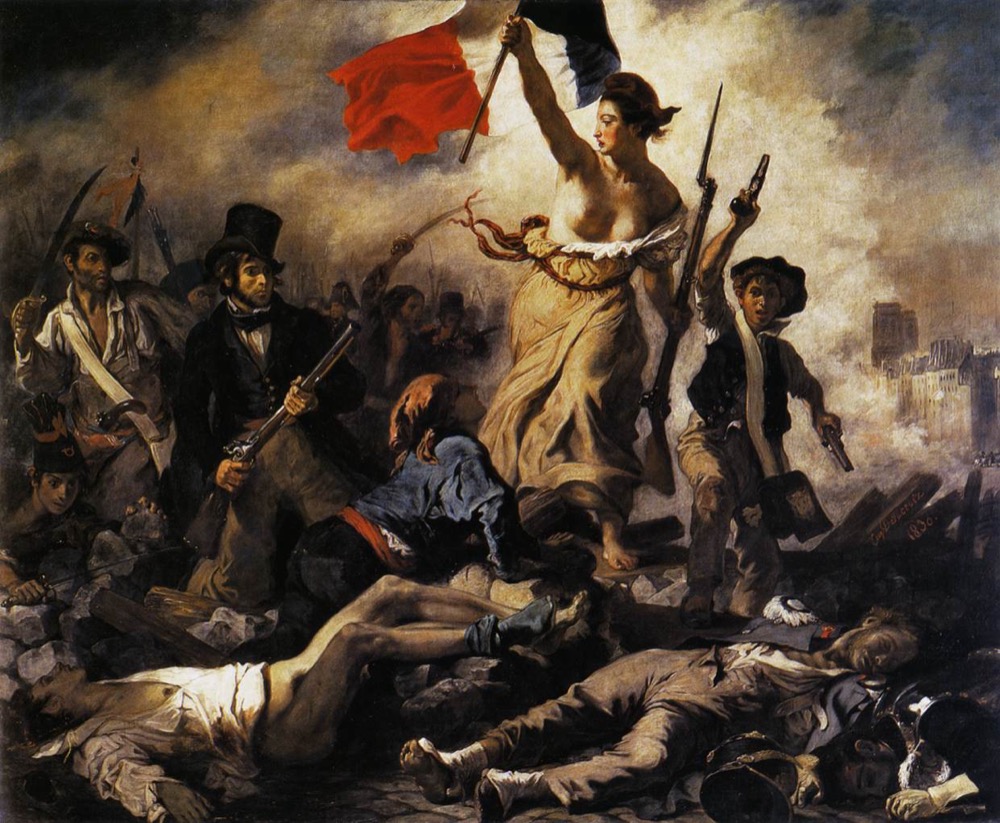
The storming of the Bastille in 1789
The July Revolution of 1830
The Paris Commune of 1871
The 1848 Revolution
Delacroix's 'Liberty Leading the People' shows the 1830 uprising that overthrew Charles X.
Which statement about the 1848 revolutions is most accurate?
They broke out across Europe, but most were suppressed within a year
They permanently ended monarchy in Germany and Austria
They were confined to France
They were led by the Concert of Europe
Their lasting results included the end of serfdom in the Habsburg lands and the Second French Republic (which soon became an empire under Napoleon III).
Which sequence correctly lists Bismarck's wars for German unification?
France, Denmark, Russia
Austria, France, Denmark
Denmark, Russia, Austria
Denmark (1864), Austria (1866), France (1870-71)
Each war removed an obstacle: Denmark (Schleswig-Holstein), Austria (leadership in Germany) and France (final unification).
Cavour, Garibaldi and Victor Emmanuel II are associated with the unification of:
Germany
Greece
Italy
Poland
Garibaldi's Red Shirts conquered Sicily and Naples in 1860 and handed them over to Victor Emmanuel II; the kingdom was proclaimed in 1861.
The Napoleonic Code gave women equal legal rights with men.
True
False
It confirmed equality for men before the law but kept married women legally subordinate to their husbands.
This image shows the Boston Tea Party. It was a protest against:
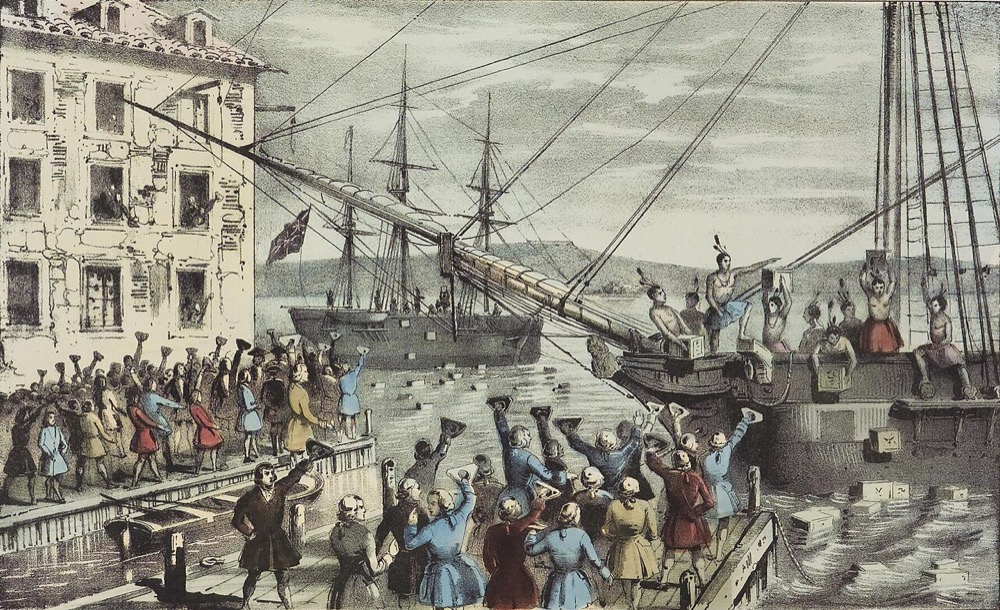
The Stamp Act repeal
The Tea Act and taxation without representation
The French and Indian War treaty
The Townshend Acts' ban on tea imports
The Tea Act of 1773 let the East India Company undercut local merchants; the response led to the Coercive Acts of 1774. The Stamp Act (1765) was earlier.
Which Enlightenment thinker is best linked to the idea of separation of powers?
Montesquieu
Rousseau
Hobbes
Voltaire
Rousseau emphasized the general will; Hobbes defended strong sovereign power; Voltaire championed tolerance and free speech.
Which was a direct result of the Reform Act of 1832 in Britain?
Every adult man could vote
Women gained the vote
The House of Lords was abolished
Rotten boroughs were abolished and more middle-class men gained the vote
Full male suffrage came later (1918 for nearly all men, with women over 30). The Chartists wanted universal manhood suffrage in the 1830s-40s.
The 'Great Fear' of 1789 led directly to:
The execution of Louis XVI
The Treaty of Versailles
The abolition of feudal privileges on 4 August 1789
The Reign of Terror
Peasant panic and attacks on manors pressured the Assembly into ending feudal dues and privileges.
Which statement about slavery in the age of revolutions is correct?
Britain abolished slavery before France
France abolished it in 1794, Napoleon restored it in 1802, and Britain abolished it in 1833
The US ended slavery in 1783
Haiti kept slavery after independence
Haiti's independence in 1804 was the first lasting abolition of slavery in the Americas; the US abolished slavery in 1865.
The 1815 settlement tried to prevent another French threat mainly by:
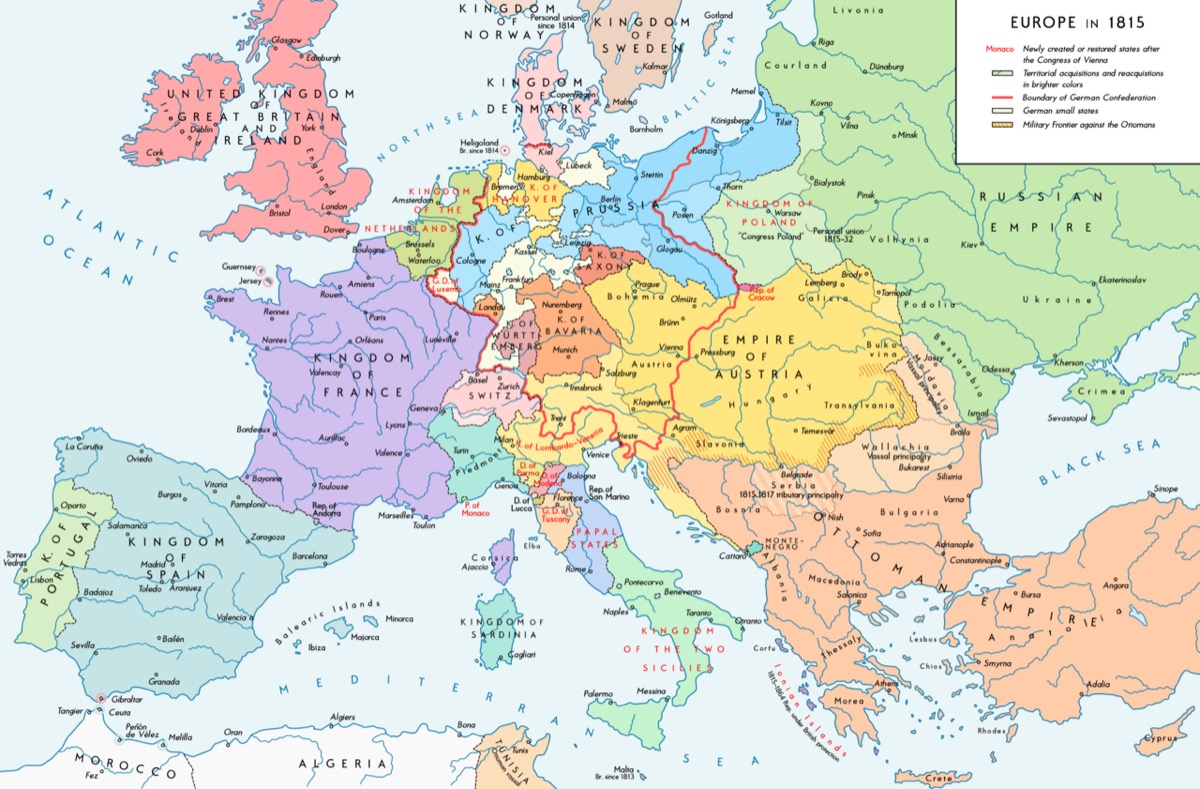
Strengthening states around France, such as the Netherlands and Prussia on the Rhine
Dividing France between the winners
Abolishing the French monarchy
Making France pay for a permanent occupation
France was returned to roughly its 1790 borders under a restored Bourbon king, and its neighbors were strengthened. Image: Alexander Altenhof, CC BY-SA 4.0, via Wikimedia Commons.
