Quiz · Medium
Twenty-two questions on river valley civilizations, Greece, Rome, India, China and the Americas.
Why did Egypt tend to be politically more unified than Mesopotamia?
It was conquered early by Persia, which imposed unity
It had no agriculture, so no rival cities formed
Deserts protected it, and the Nile's regular flood supported a single central state
Its rivers flooded unpredictably, forcing farmers to cooperate
Desert barriers and a predictable Nile flood favored one kingdom under the pharaoh. Option A describes the Tigris and Euphrates, which is why Mesopotamia split into rival city-states.
How did Augustus keep the appearance of a republic?
He abolished the Senate and became king
He kept the Senate and magistracies but controlled the army and key offices
He gave every citizen a vote on laws
He divided power with two other emperors
He claimed to have restored the Republic while holding real power. Calling himself 'king' would have repeated Caesar's fatal mistake.
What is shown on this artifact, and why did it matter?
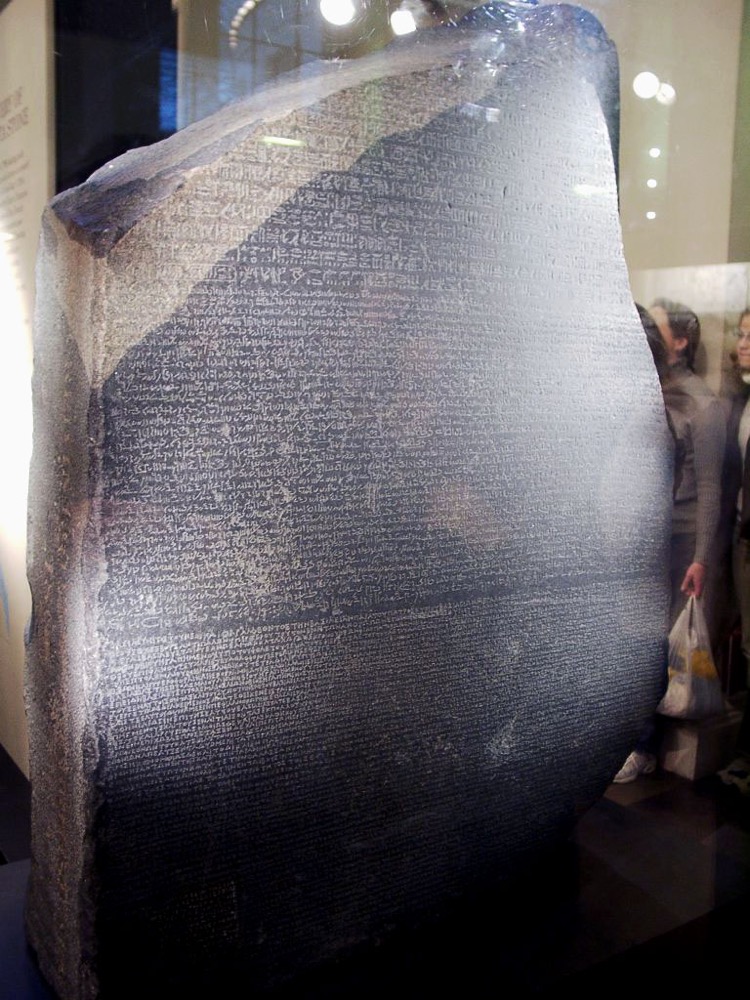
A Sumerian law code that inspired Hammurabi
A Persian tax decree that explained satrapies
A Roman treaty with Egypt after Actium
A Greek, Demotic and hieroglyphic decree that allowed hieroglyphs to be deciphered
The Rosetta Stone carries the same decree in three scripts, and the Greek text let Champollion decode hieroglyphs in 1822. The other options name real documents but not this one.
Which feature best describes the Code of Hammurabi?
It was a written public law code with penalties that varied by social class
It was a Greek constitution that created assemblies
It treated everyone equally regardless of rank
It was a religious text about the afterlife
The code was inscribed on a public stele, but penalties differed for nobles, commoners and slaves. 'Eye for an eye' did not apply equally across classes.
Who was the first ruler to unify Upper and Lower Egypt around 3100 BCE?
Ramses II
Tutankhamun
Narmer (Menes)
Khufu
Narmer, traditionally Menes, united the two lands. Khufu built the Great Pyramid centuries later, and Ramses II and Tutankhamun were New Kingdom rulers.
Which statement about Athenian democracy is accurate?
A king still held veto power over the Assembly
Citizens voted directly on laws, but citizenship was limited to free adult men with Athenian parents
Representatives were elected to vote for the people
All residents could vote, including women and slaves
It was direct, not representative, and it excluded women, slaves and metics.
Which city-state is correctly paired with its society?
Athens: ruled by two hereditary kings
Sparta: a militarized society supported by helot labor
Sparta: a trading democracy focused on the arts
Athens: a military state with helot serfs
Sparta's helots farmed the land so that Spartan citizens could train as soldiers. Athens had no kings in the Classical period.
What did Darius I do to govern the Persian Empire?
Divided it into satrapies and built the Royal Road
Forced all subjects to adopt Zoroastrianism
Moved the capital to Athens
Gave each region full independence under local kings
Satrapies, inspectors and the Royal Road tied the empire together. Persia generally tolerated local religions.
What was the result of the Greek victory at Salamis (480 BCE)?
It began the Peloponnesian War
It ended Athens's democracy
It made Sparta rule Persia
It crippled the Persian fleet and helped force Xerxes's retreat
The naval victory, led by Themistocles, threatened Xerxes's supply lines. The next year the Greeks won at Plataea.
Why is the period after Alexander's death called Hellenistic?
Greece became a democracy again
The Greeks switched to worshipping Egyptian gods
Rome conquered Greece at once
Greek language and culture spread across the lands he conquered
Greek culture blended with Egyptian, Persian and other traditions in cities like Alexandria. Roman conquest came gradually, ending with Egypt in 30 BCE.
What structure is shown here, and who built it?
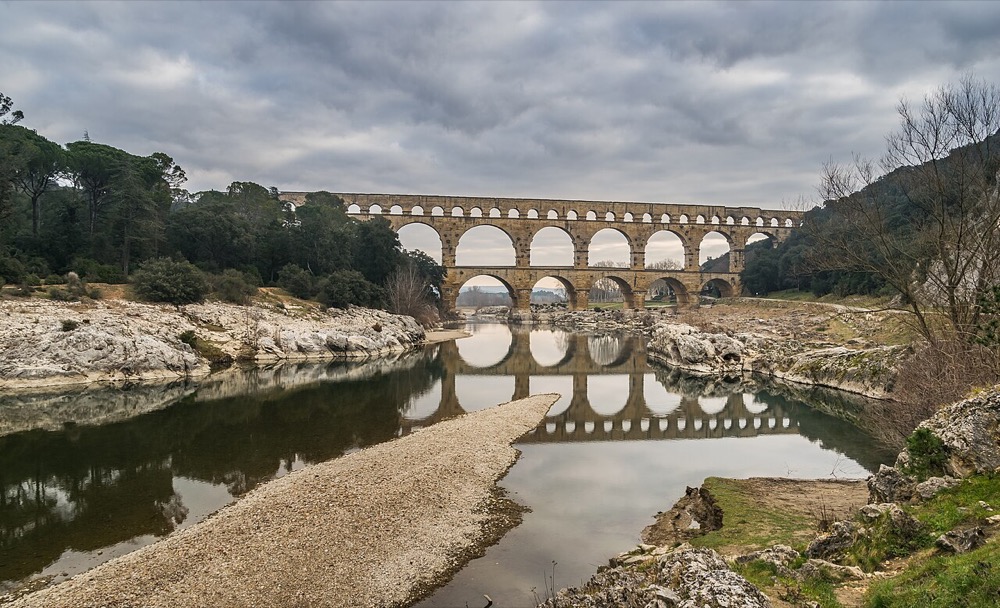
A Greek temple to Athena
A Chinese defensive wall
A Roman aqueduct in Gaul, built to carry water to a city
A Persian ceremonial gate
The Pont du Gard carried water by gravity to Nîmes. Aqueducts like this show Roman engineering with arches and precisely measured gradients. Image: Krzysztof Golik, CC BY-SA 4.0, via Wikimedia Commons.
Which was a major cause of tension between Rome's rich and poor in the 2nd century BCE?
Heavy taxation of Senate members
The end of grain imports
A ban on legions in Italy
Latifundia worked by slaves displaced small farmers
Large estates using slave labor pushed small farmers into the cities, which led to the Gracchi land reforms.
What is the Pax Romana?
About two centuries of relative peace and stability under the early emperors
A Roman law code
Constantine's religious edict
A peace treaty ending the Punic Wars
It began with Augustus (27 BCE) and ended around 180 CE with Marcus Aurelius. Peace was a relative claim, since there were frontier wars.
Which pairing of ancient Indian rulers and achievements is correct?
Chandragupta Maurya: Gupta golden age
Chandragupta Maurya: built the Great Bath
Ashoka: spread Buddhist-inspired moral edicts after Kalinga
Ashoka: founded the Gupta Empire
Ashoka's edicts promoted dhamma. Chandragupta founded the Mauryan Empire, and the Gupta golden age came later, 300s–500s CE.
What was the Mandate of Heaven?
A Han trade treaty
A Daoist text about the Dao
A Legalist law code of the Qin
The idea that Heaven grants the right to rule to a just ruler and may withdraw it
Used by the Zhou to justify overthrowing the Shang, it underlies the dynastic cycle.
Which first emperor standardized Chinese weights, writing and currency?
Confucius
Qin Shi Huang
Liu Bang
Emperor Wu of Han
Qin Shi Huang (221 BCE). Liu Bang founded the Han, and Confucius was a philosopher, not a ruler.
Which philosophy supported strict laws and harsh punishments?
Buddhism
Legalism
Daoism
Confucianism
Legalists argued that people are self-interested and need strong control. Confucianism relies on moral example.
The Indus Valley city of Mohenjo-daro is known for:
Pyramid-tombs for kings
A written law code
Cuneiform libraries
A planned grid layout with drainage and a Great Bath
Its script is still undeciphered, and no palaces are clearly identified. The planning and drains are the best-known features.
The Maya are known for all of the following EXCEPT:
Use of the concept of zero
Advanced astronomy and calendars
A glyph writing system
A single empire ruled from one capital in 500 CE
Classic Maya society was a set of rival city-states such as Tikal and Calakmul, not a single empire.
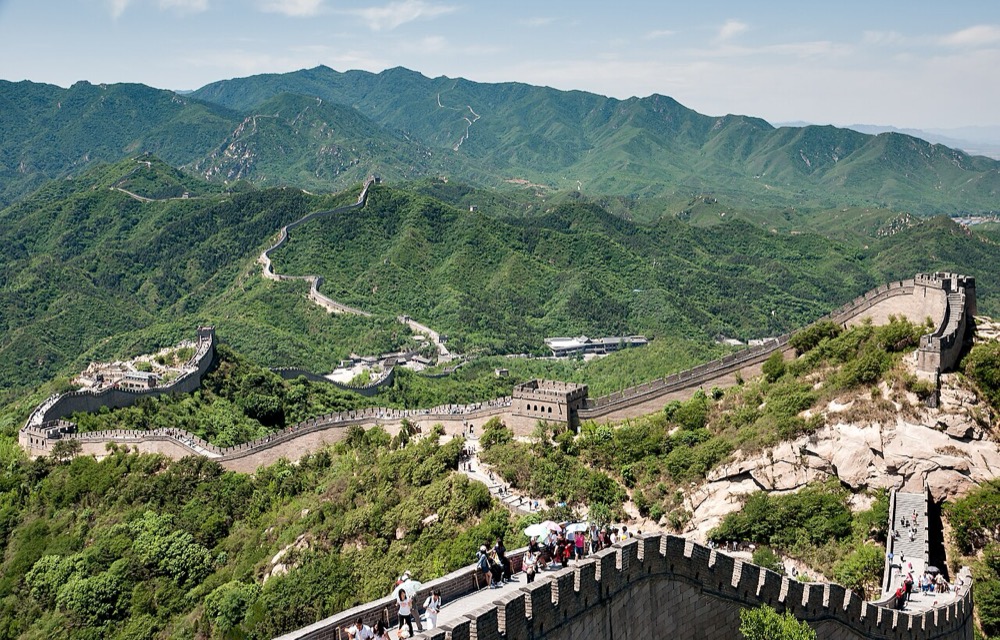
True or False: The Great Wall of China seen by most tourists today was built mainly by the Qin dynasty.
True
False
False. The Qin joined earlier walls, but most surviving stone-and-brick sections near Beijing date from the Ming dynasty (1368–1644). Image: CEphoto, Uwe Aranas, CC BY-SA 3.0, via Wikimedia Commons.
In what order did these Roman events happen?
Punic Wars, Augustus, Caesar's dictatorship, Constantinople founded
Augustus, Punic Wars, Caesar's dictatorship, Constantinople founded
Caesar's dictatorship, Punic Wars, Augustus, Constantinople founded
Punic Wars, Caesar's dictatorship, Augustus, Constantinople founded
Punic Wars (264–146 BCE), Caesar (d. 44 BCE), Augustus (27 BCE), Constantinople (330 CE).
What was the Roman Republic's main safeguard against a king?
Two consuls with one-year terms, each able to veto the other
Rule by the tribunes alone
A single dictator with unlimited power
A permanent army under the Senate
Annual terms and shared power limited any individual. Dictators were allowed only temporarily in emergencies; Caesar broke that norm.
