Quiz · Hard
Exam-style questions on the classical arguments for God, the problem of evil and theodicies, miracles, experience and religious language.
Otto described religious experience as:
Mysterium tremendum et fascinans
Verification
A language game
Analogy
The numinous: awe-inspiring and fascinating, wholly other.
True or false: Reformed epistemology holds that belief in God needs evidence from arguments to be rational.
True
False
Plantinga argues it can be properly basic, rational without argument.
Which council defined Christ as one person in two natures?
Nicaea
Constantinople
Chalcedon
Trent
Chalcedon, 451. Nicaea (325) was on homoousios.
Which pairing is correct?
Panentheism: universe is God
Pantheism: universe is in God but God is more
Deism: God created but does not intervene
Theism: God never acts
Pantheism identifies God and universe; panentheism says the universe is in God.
Anselm's ontological argument concludes that God exists because:
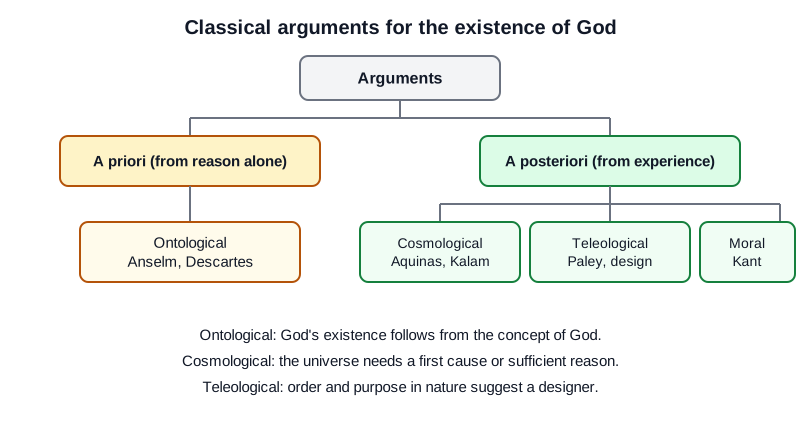
The universe needs a first cause
God is that than which nothing greater can be conceived, and existing in reality is greater
The world shows design
Moral laws need a lawgiver
It starts from the concept of God. Options 1, 3 and 4 are cosmological, teleological and moral arguments.
Which argument category is the cosmological argument?
A priori
A posteriori
Deductive only
Neither
It begins from an observed fact, the universe's existence; the ontological argument is the a priori one.
Kant's famous objection to the ontological argument is that:
Perfection is meaningless
Existence is not a predicate
God is not conceivable
The island is greater
Existence adds no property to a concept. Gaunilo used the perfect island.
Which is a premise of the Kalam argument?
Whatever begins to exist has a cause
Every event has a purpose
Existence is a predicate
God is omnibenevolent
The Kalam says the universe began to exist and so has a cause.
Paley's design argument uses the analogy of:
A ship
A watch
A tree
A river
The watch implies a watchmaker; Hume and Darwin challenged it.
Which thinker is associated with the free will defense?
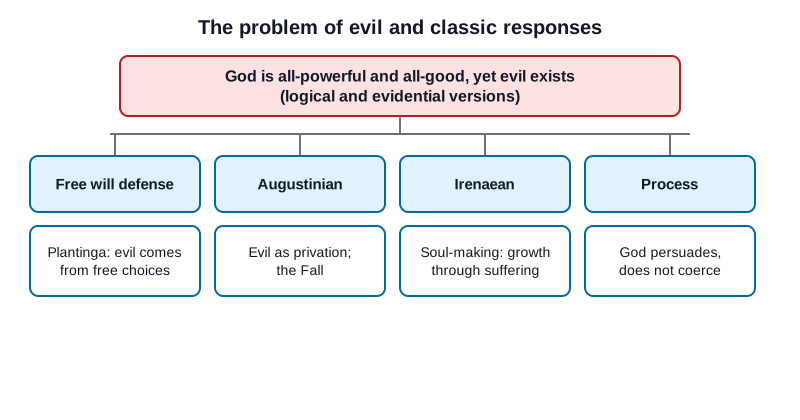
Plantinga
Hick
Aquinas
Hume
Plantinga; Hick is Irenaean, Aquinas wrote the Five Ways, and Hume raised objections.
The Irenaean theodicy sees suffering as:
Punishment for the Fall
An illusion
Necessary for soul-making
A privation
Growth toward God's likeness through difficulty; privation and the Fall are Augustinian.
The logical problem of evil claims that:
Evil is improbable given God
God and evil cannot both exist
Evil is just privation
God does not know evil
Mackie argued inconsistency; the evidential problem says only improbability.
Which statement distinguishes a defense from a theodicy?
A defense shows compatibility; a theodicy gives God's actual reasons
They are identical
A defense is atheistic
A theodicy is only logical
Plantinga offered a defense, not a full theodicy.
Hume's argument on miracles says:
Miracles are impossible by definition
The evidence for natural law outweighs testimony for a miracle
Miracles prove God
Only saints see miracles
He argued a wise person proportions belief to evidence, so testimony rarely suffices.
The via negativa describes God by:
Analogy
Saying what God is not
Metaphors of fathers
Scripture alone
Apophatic theology; analogy is Aquinas's alternative.
Flew's falsification challenge asks:
What would count against a belief?
Is God omnipotent?
Is religion useful?
Where is evidence for faith?
A claim that nothing could falsify says nothing.
Pascal's wager is a form of:
Ontological argument
Argument from pragmatic or expected-value reasoning
Cosmological argument
Moral argument
It argues belief is rational by comparing outcomes.
In the Euthyphro dilemma, the second horn (God commands it because it is good) implies:
Morality is arbitrary
Goodness is independent of God's will
God is evil
Atheism is true
If goodness exists independently, God's commands do not create it; the first horn makes morality arbitrary.
Which is NOT an objection to the design argument?
Darwinian evolution
Hume's weak analogy
Mill on nature's cruelty
Kant's existence is not a predicate
That one targets the ontological argument.
The Epicurean trilemma suggests that if evil exists then God is:
Unwilling, unable or not existing
Only unwilling
Only impossible
Not relevant
Either unable, unwilling, or the pair of attributes needs reconsideration.
Aquinas's analogy teaches that religious words are:
Univocal
Equivocal
Analogical
Meaningless
Terms are used in related but not identical senses for God and creatures.
