Quiz · Hard
Harder questions comparing reformers and settlements, and on the French Wars of Religion, the Dutch Revolt and the Thirty Years' War.
Which of the following best explains why Luther's movement survived despite the Edict of Worms?
The pope withdrew the excommunication.
Charles V converted to Lutheranism.
Princes such as Frederick the Wise protected him, and Charles V was occupied by wars with France and the Ottomans.
Luther raised his own army.
Political fragmentation of the Empire let princes protect reform. The pope never withdrew the excommunication and Charles remained Catholic.
Why did Luther condemn the rebels in the Peasants' War (1524-25)?
He feared that peasants would convert to Calvinism.
He believed Christians should obey secular authority and that the rebels were using the gospel for social revolt.
He supported the princes' attempt to restore Catholicism.
The rebels demanded a return to Catholic rule.
In Against the Murderous, Thieving Hordes of Peasants he urged princes to crush the rebels. This made Lutheranism dependent on princes and cost him support among the lower classes.
Which statement correctly contrasts Luther and Calvin?
Calvin stressed predestination and church government by elders, while Luther kept a hierarchy tied to princes and a real presence in the Eucharist.
Calvin accepted the pope's authority; Luther did not.
Luther taught predestination; Calvin taught free will.
Both taught that works earn salvation.
Both affirmed justification by faith. Presbyterian forms of church governance come from Calvinism.
How did the Peace of Augsburg (1555) fall short as a settlement?
It banned Lutheranism.
It gave the pope authority over German princes.
It ended the Holy Roman Empire.
It excluded Calvinists and Anabaptists, left individuals no freedom of conscience, and included the 'ecclesiastical reservation' that remained disputed.
These unresolved issues (Calvinist growth, church lands) fed tensions that led to 1618.
Which was NOT a feature of the Elizabethan Settlement (1559)?
The queen as Supreme Governor of the Church of England
A common Book of Common Prayer required by the Act of Uniformity
Restoring papal authority over the English church
A doctrine broadly Protestant with some Catholic-style ceremony
The settlement kept the break from Rome. It was a compromise that satisfied most English people but not zealous Puritans or Catholics.
Why was the Dissolution of the Monasteries politically significant?
It enriched the crown and created a class of landowners with a stake in the Reformation.
It ended all poor relief and led to immediate war with Spain.
It restored land to the peasantry.
It was reversed immediately after Henry's death.
Much monastic land was sold to gentry and nobles who then had reason to resist a Catholic restoration, as under Mary I.
Which of these was a goal of the Council of Trent?
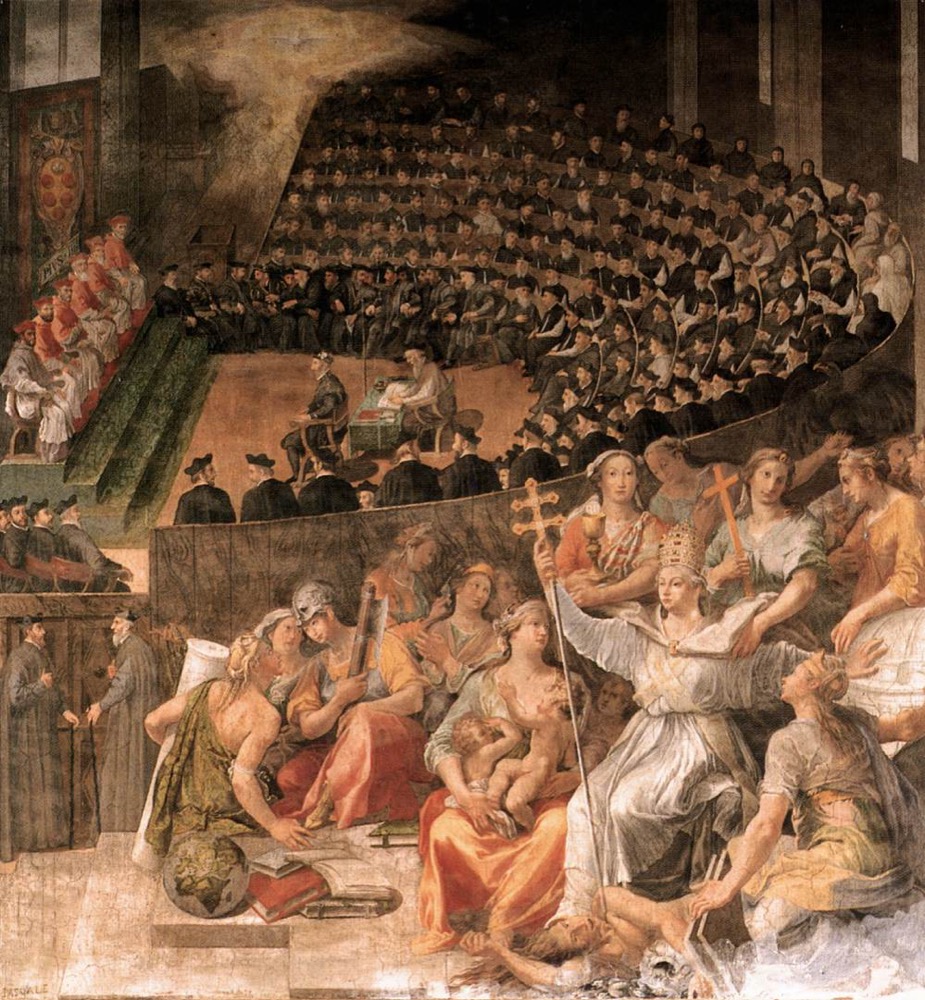
To reconcile with Lutherans by compromise
To abolish the Latin Mass
To end the Roman Inquisition
To clarify doctrine in response to Protestantism and to reform the clergy
Trent set the template for Catholicism until Vatican II in the 1960s, including the Tridentine Mass and seminaries.
Which statement about the Jesuits is correct?
They were established to enforce the Edict of Nantes.
They emphasized education and missions and took a special vow of obedience to the pope.
They rejected papal authority.
They were a Protestant order.
Jesuit colleges trained Catholic elites, and Jesuit missionaries traveled to Asia and the Americas.
What distinguished the Roman Inquisition (1542) from the Spanish Inquisition?
The Roman one only investigated Jews.
The Roman one was run by the papacy; the Spanish one was controlled by the Spanish crown.
The Spanish one was set up by the Council of Trent.
There was no difference.
Both policed orthodoxy. The Spanish Inquisition (1478) preceded the Reformation and focused first on conversos.
Which factor most explains the length of the French Wars of Religion (1562-98)?
The invasion of France by Charles V.
A Huguenot majority in France.
Papal control of the French army.
Noble factions (Guise, Bourbon, Montmorency) used religion in a struggle for power around weak monarchs.
Huguenots were a minority (perhaps 10 percent) but included many nobles. The crown's weakness under the last Valois kings prolonged the conflict.
What did the Dutch Revolt combine?
Calvinist resistance, noble opposition to Philip II's centralization and anger over taxes
Lutheran conversion and a campaign against the pope
Spanish and French cooperation against England
A peasant revolt like the German Peasants' War
The revolt began around 1566 and ended with Spain's recognition in 1648. Calvinism provided identity, but the Dutch Republic also tolerated Catholics in practice.
Which of these is the correct sequence of phases in the Thirty Years' War?
Danish, Bohemian, French, Swedish
Swedish, Bohemian, Danish, French
Bohemian, Danish, Swedish, French
Bohemian, Swedish, French, Danish
Frederick V (1618-25), Christian IV and Wallenstein (1625-29), Gustavus Adolphus (1630-35) and France's open entry (1635-48).
Why did the Habsburg Emperor Ferdinand II's Edict of Restitution (1629) provoke Protestants?
It abolished the Lutheran church.
It declared war on the Dutch.
It ordered return of church lands taken since 1552 to Catholic hands and ignored Calvinists.
It gave German princes full sovereignty.
Even Lutheran princes loyal to the emperor, such as Saxony, felt threatened. It encouraged Swedish intervention.
Which of these ideas is most associated with the Peace of Westphalia?
Absolute papal authority over kings
A system of sovereign states without a universal religious authority
The creation of a single German state
Religious freedom for individuals in all of Europe
Westphalia confirmed princes' control of religion in their territories (with some minority protections) and is often seen as the start of the modern state system. It did not create a unified Germany.
On this map of the principal seats of war, 1618-1660, where did most of the fighting of the Thirty Years' War take place?
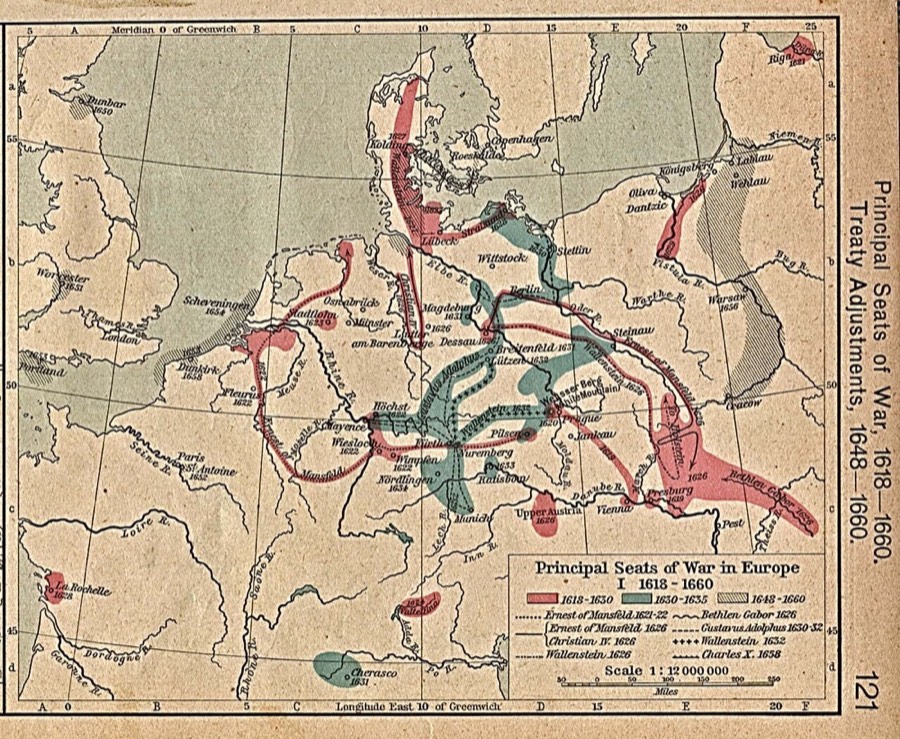
In the Holy Roman Empire, especially Germany and Bohemia
On the Iberian Peninsula
In the British Isles
In Scandinavia
Magdeburg, Breitenfeld, Lützen, Nördlingen and White Mountain (Prague) are all in the Empire. Sweden, Denmark, France, Spain and others sent armies there.
True or false: The Reformation led to religious toleration in all Protestant states by 1600.
True
False
Protestants also persecuted dissenters. Servetus was burned in Calvin's Geneva (1553), Anabaptists were drowned or burned, and the Peace of Augsburg gave only princes the choice. Real toleration developed slowly, as in the Dutch Republic.
