Quiz · Medium
Foundational practice on degree and classification, polynomial arithmetic, special products, factoring patterns and Pascal's triangle.
What is the degree of ?
4
5
6
3
Add the exponents in each term: has degree 5, has degree 4. The largest is 5. Answering 4 means you only looked at single-variable powers.
Which expression is a polynomial?
has a fractional coefficient, which is fine. The others put x in a negative exponent, under a root, or in a denominator.
Classify .
Cubic trinomial
Quadratic binomial
Cubic binomial
Quartic binomial
Degree 3 (cubic) and two terms (binomial).
Simplify .
Distribute the minus: . The x-terms cancel. comes from subtracting only the first term.
Expand .
. forgets the middle term; the last term is .
Multiply .
. The second option multiplies only the 2 into the constant.
The area model shows (a + b)². What is the combined area of the two green rectangles?
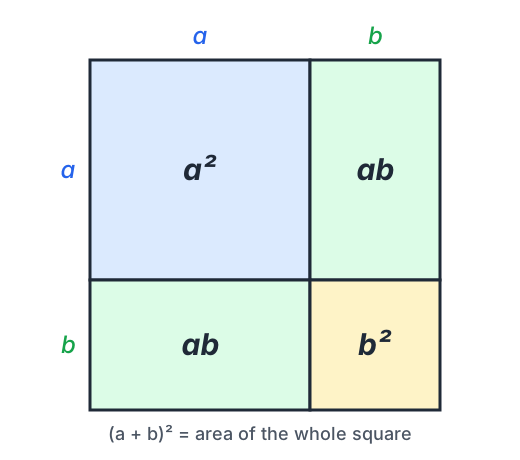
Each green rectangle is a by b, so together they give 2ab, the middle term of .
Factor .
Need two numbers with product +20 and sum -9: -4 and -5. (x - 2)(x - 10) has the right product but sum -12.
Factor .
It does not factor
Difference of squares: . would give a middle term of .
Factor completely: .
GCF 3x first, then . is correct but not complete.
Factor .
Check by expanding: . gives in the middle: the signs are swapped.
Factor .
Sum of cubes: with a = x, b = 2. SOAP: same sign, opposite sign, always positive.
Factor by grouping: .
.
Which polynomial cannot be factored over the real numbers?
A sum of squares has no real zeros, so no real linear factors. is a difference of cubes and factors as .
True or false: .
True
False
False. . Try a = b = 1: 8 is not 2.
What is the coefficient of in the expansion of ?
5
15
10
20
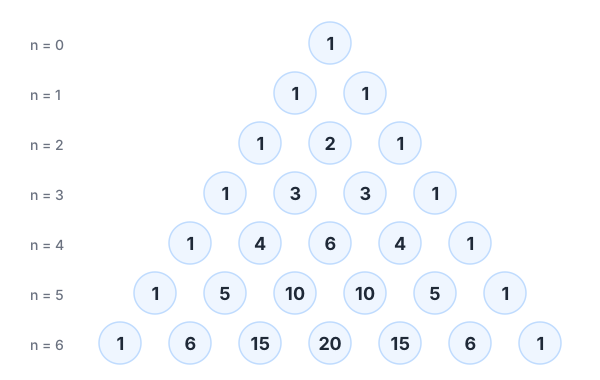
The term is . Row 5 of Pascal's triangle is 1, 5, 10, 10, 5, 1.
Using the pattern in the triangle, what is row n = 7?
1 7 20 35 35 20 7 1
1 7 21 35 35 21 7 1
1 6 21 35 21 6 1
1 7 22 34 34 22 7 1
Add neighbors in row 6 (1 6 15 20 15 6 1): 1, 1+6 = 7, 6+15 = 21, 15+20 = 35, then symmetric.
What is the degree of ?
12
4
7
3
When multiplying, degrees add: 3 + 4 = 7. 12 comes from multiplying the degrees instead.
What is the GCF of ?
GCF of 12 and 18 is 6; take the lowest power of each variable: x² and y².
