Quiz · Medium
Unit circle values, radians, quadrant signs, the six trig graphs, amplitude and period, SOH CAH TOA and basic identities.
Which graph shows y = cos x?
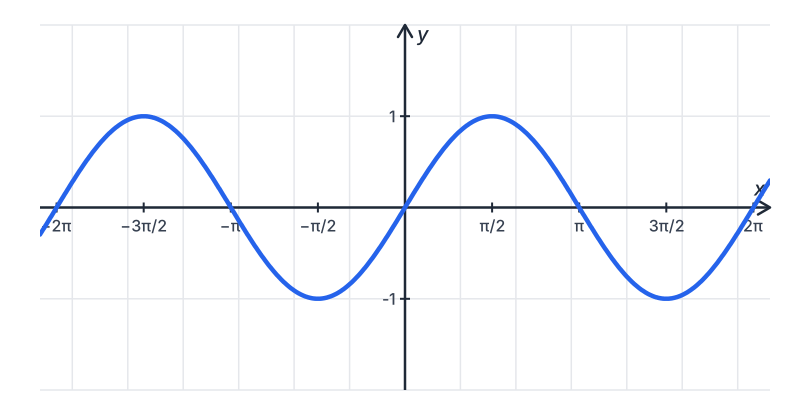
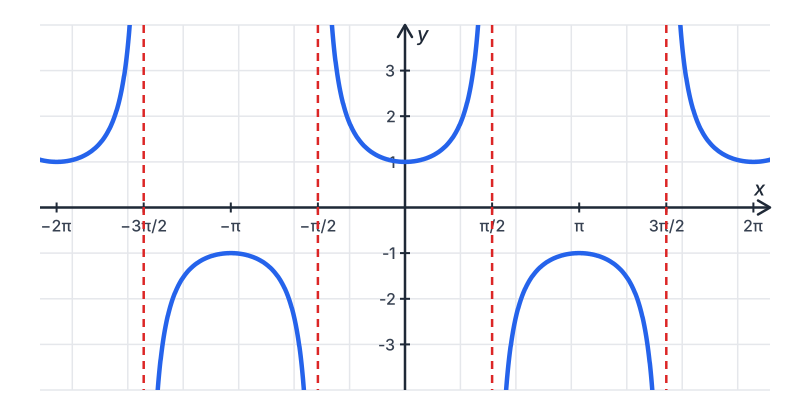
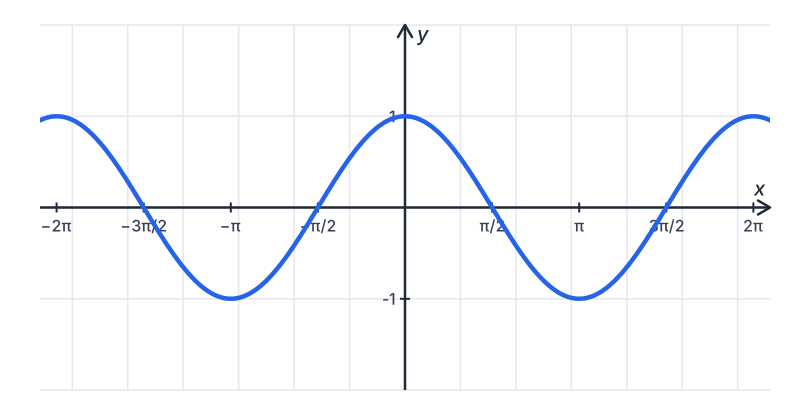
cos x has its maximum 1 at x = 0. sin x passes through the origin; sec x has asymptotes.
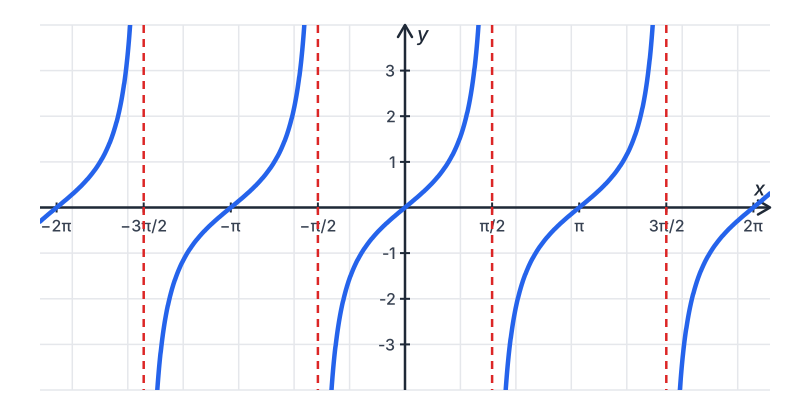
Which graph shows y = tan x?
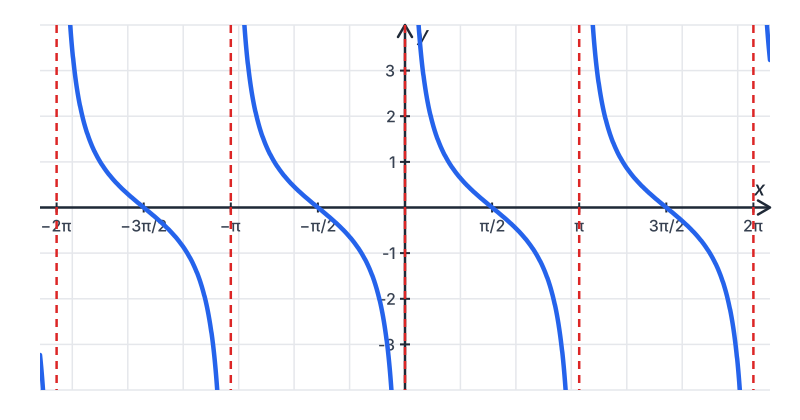
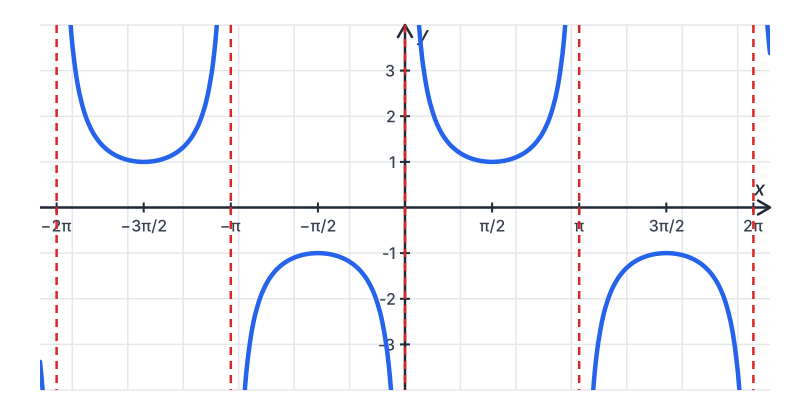
tan x passes through the origin and increases between asymptotes at ±π/2. cot x decreases and has asymptotes at multiples of π.
Which function is graphed?
y = sec x
y = csc x
y = tan x
y = cos x
The asymptotes are at multiples of π (where sin x = 0), so it is csc x. sec x has asymptotes at odd multiples of π/2.
Convert 210° to radians.
210 · π/180 = 7π/6. 5π/6 is 150°.
What is ?
Reference angle π/6 gives √3/2; cosine is negative in QII. −1/2 is cos(2π/3), the 120° value.
What is ?
−1
5π/4 is in QIII with reference angle π/4, and sine is negative there.
In which quadrant is tan θ positive but sin θ negative?
I
II
III
IV
sin < 0 means QIII or QIV. tan > 0 means QI or QIII. Both: QIII.
What are the coordinates of the point at angle π/3 on the unit circle?
(√3/2, 1/2)
(1/2, √3/2)
(√2/2, √2/2)
(1/2, √2/2)
(cos π/3, sin π/3) = (1/2, √3/2). (√3/2, 1/2) is the π/6 point.
What is the amplitude of the graphed sinusoid?
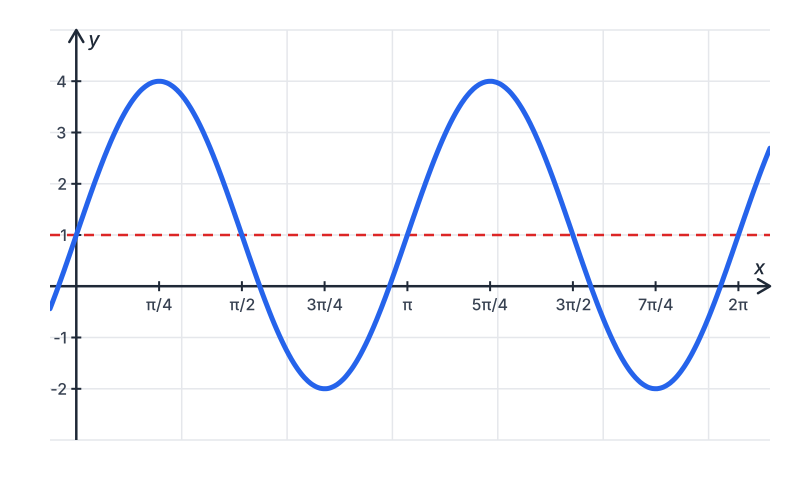
4
3
6
1
Max 4, min −2: amplitude = (4 − (−2))/2 = 3. 4 is the maximum, not the amplitude (the midline is y = 1).
What is the period of ?
3
Period = 2π/4 = π/2. 3 is the amplitude.
Which is equivalent to ?
1
Divide sin² + cos² = 1 by cos² to get tan² + 1 = sec². csc² equals 1 + cot².
In a right triangle, the side opposite θ is 5 and the hypotenuse is 13. What is cos θ?
5/13
12/13
5/12
13/12
The adjacent side is √(169 − 25) = 12, so cos θ = 12/13. 5/13 is sin θ.
A 30°-60°-90° triangle has a hypotenuse of 10. How long is the side opposite 60°?
5
5√3
10√3
5√2
Ratio 1 : √3 : 2 scaled by 5: short leg 5 (opposite 30°), long leg 5√3 (opposite 60°).
What is ?
0
cos(π/2) = 0 and π/2 is in arccos's range [0, π]. 3π/2 also has cosine 0 but is outside the range.
Find the arc length on a circle of radius 9 cut off by a central angle of .
120
s = rθ = 9 · 2π/3 = 6π. 120 is the angle in degrees, which does not work in s = rθ.
Which law should you use first to solve a triangle given all three sides (SSS)?
Law of Sines
Law of Cosines
Pythagorean theorem
SOH CAH TOA
With no angle known, the Law of Sines has no complete ratio to start from. The Law of Cosines finds an angle from three sides.
cos(−θ) = cos θ for every θ.
True
False
Cosine is an even function: its graph is symmetric about the y-axis.
What is the reference angle for 300°?
30°
60°
120°
300°
300° is in QIV; 360° − 300° = 60°.
Which value is undefined?
tan(π/2) = sin/cos = 1/0. cot(π/2) = cos/sin = 0/1 = 0, which is defined.
