Quiz · Hard
Exam-level questions on end behavior, multiplicity, the Remainder and Factor Theorems, rational and complex zeros, Descartes' rule and the Intermediate Value Theorem, with graph questions.
Which graph could belong to a polynomial of even degree with a negative leading coefficient?
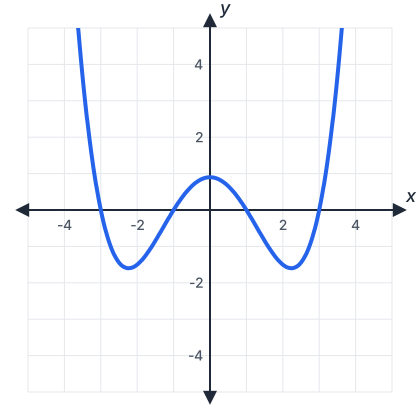
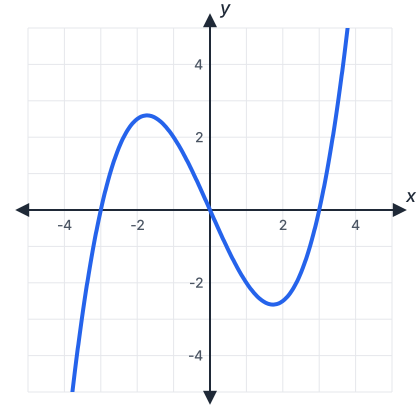
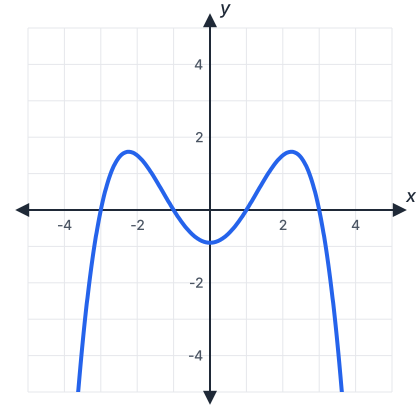
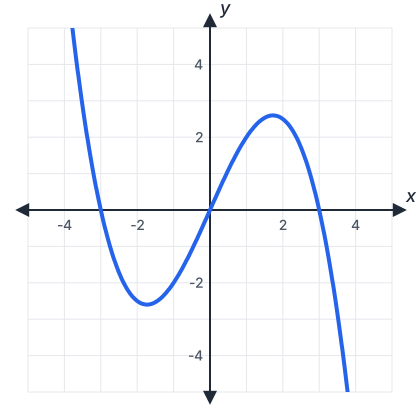
Even degree means both ends point the same way; a negative leading coefficient sends them both down. The first graph is even degree with a positive leading coefficient.
Which graph has the same end behavior as ?
Leading term : odd degree, negative coefficient, so it rises on the left and falls on the right.
This graph belongs to a degree-4 polynomial. Which equation could it be?
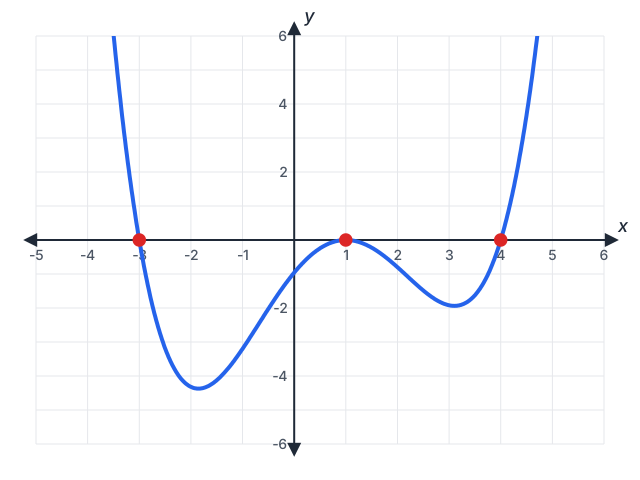
Zeros at -3, 1 and 4 with a touch at x = 1 means the factor is squared. Both ends rise, so the leading coefficient is positive. Squaring instead would make the graph touch at -3.
Which equation matches this graph?
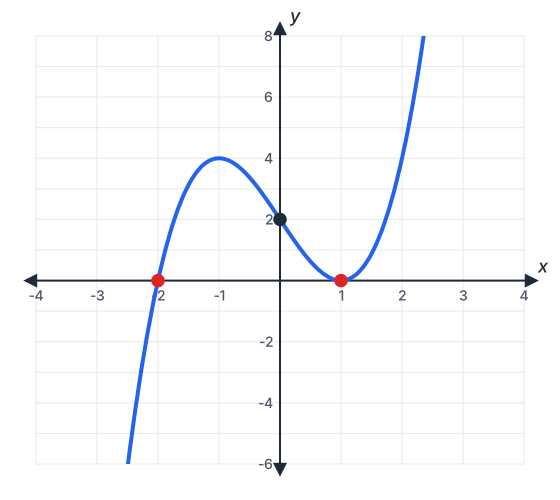
It crosses at -2 and touches at 1, so . The y-intercept checks: . The negative version would rise on the left.
What is the remainder when is divided by ?
9
-1
-9
3
Remainder Theorem: . No division needed.
In the synthetic division shown, what does the boxed 0 tell you?
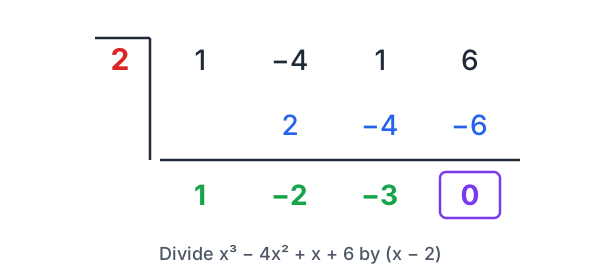
is a zero of the polynomial
is a factor, so is a zero
The quotient has no constant term
is a factor
The last number is the remainder P(2). A remainder of 0 means x - 2 divides evenly (Factor Theorem). The zero is c = 2, not -2.
Which is NOT a possible rational zero of ?
Candidates are with p dividing 4 and q dividing 3. In the numerator 3 does not divide 4: the theorem was applied upside down.
Find so that is a factor of .
-2
2
-4
0
Factor Theorem with c = -1: , so .
Given that is a zero, solve .
Synthetic division by 2 gives .
Divide: .
Quotient , remainder
Quotient , remainder
Quotient , remainder
Quotient , remainder
Check: . Synthetic division does not apply to a quadratic divisor.
A polynomial with real coefficients has zeros 2, -1 and 3 + i. What is its least possible degree?
3
5
4
6
3 + i forces 3 - i, so there are at least four zeros. Answering 3 forgets the conjugate.
What is the greatest number of turning points the graph of a degree-5 polynomial can have?
5
4
6
3
At most n - 1 = 4.
Descartes' Rule of Signs: how many positive real zeros can have?
Exactly 2
2 or 0
3 or 1
4, 2 or 0
Signs + - - + + change twice, so 2 or 0 (it decreases by even numbers). In fact the zeros are 1, 3, -1 and -2, so it has 2.
Between which two consecutive integers must have a zero?
0 and 1
1 and 2
2 and 3
3 and 4
and : the sign changes, so the Intermediate Value Theorem guarantees a zero in (2, 3). and are both negative.
At which zero does the graph of touch the x-axis without crossing?
The factor has even multiplicity 2, so the graph turns around at . At (multiplicity 3) it crosses and flattens.
What is the sum of the zeros of (counted with multiplicity)?
-2
2
6
Vieta: sum . The sign flip is the usual trap.
Which is the lowest-degree polynomial with real coefficients, leading coefficient 1, and zeros 3 and 2i?
. The first option does not have real coefficients.
True or false: every cubic polynomial with real coefficients has at least one real zero.
True
False
True. The two ends go in opposite directions, so the graph must cross the x-axis; non-real zeros also come in pairs, leaving at least one real zero.
An open box is made from a 12 in by 12 in sheet by cutting squares of side x from each corner. Its volume is V(x) = x(12 - 2x)². What domain makes sense?
All real numbers
Both the cut x and the base side 12 - 2x must be positive, so 0 < x < 6. At x = 6 the base disappears.
