Quiz · Easy
19 questions on the 28 letters, dot patterns, connecting vs non-connecting letters, sun and moon letters and the harakat. Good after the first alphabet decks.
Which letter has exactly one dot below?
ت
ي
ب
ن
ب (bāʾ) has one dot below. ن has one dot above, ت two above, ي two below.
How many letters are in the Arabic alphabet?
22
28
26
32
Standard Arabic has 28 letters. Hamza (ء) is usually treated as a 29th sign or as a seat, and ة, ى and the letter-forms are not separate letters.
In which direction is Arabic written and read?
Left to right
Right to left
Top to bottom
Right to left for letters, left to right for words
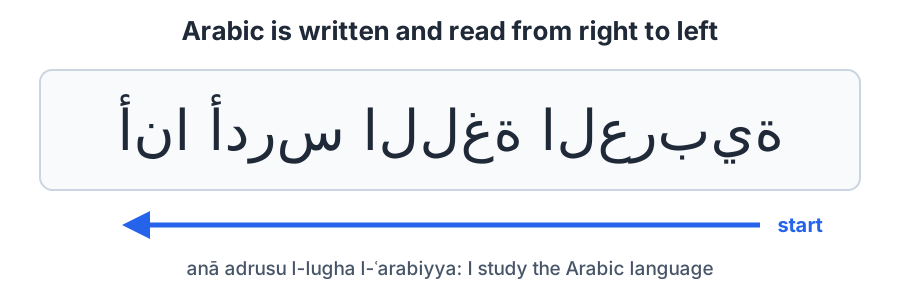
Arabic runs right to left, so the first letter of a word is the rightmost one. Only numbers written in digits (like ٢٠٢٤) are read left to right.
Which letter is thāʾ (ث), the sound of English th in 'think'?
One dot above
Three dots below
Three dots above
Two dots above
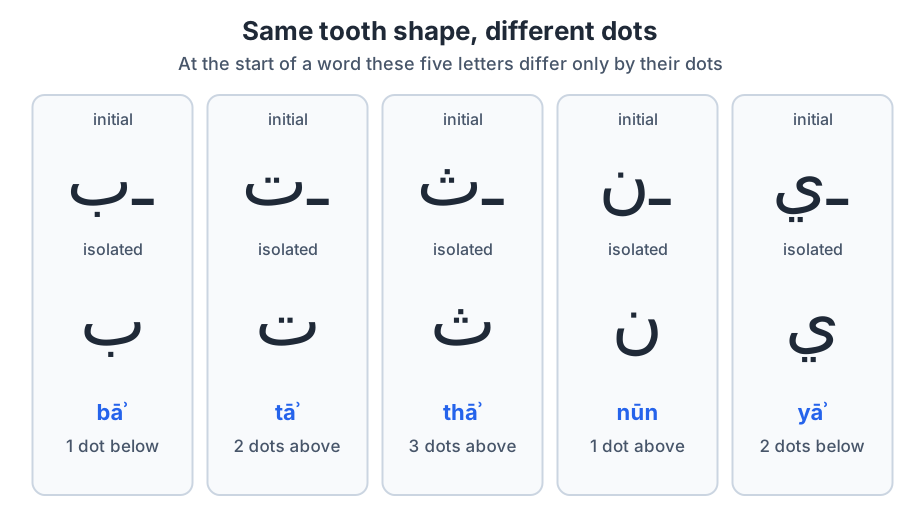
ث has three dots above: the same tooth as ب ت ن ي, only the dots change.
Which of these letters does NOT connect to the letter after it?
ن
س
ر
ب
ر never joins forward. The six non-connectors are ا د ذ ر ز و. A word like رَجُل (rajul) therefore leaves a small gap after ر.
Which list contains all six letters that do not connect to the following letter?
ا ب ت ث ج ح
د ر ز س و ي
ا د ذ ر ز و
ا د ر ز و ي
ا د ذ ر ز و. Mnemonic: they are the 'one-way' letters. ي looks similar to و but does join forward (يـ).
Which letter is a SUN letter (the ل of الـ is not pronounced before it)?
ب
م
ش
ج
Before ش the ل assimilates: ash-shams (الشَّمْس) and not al-shams. ج ب م are moon letters: al-jamal, al-bayt, al-madīna.
How is the word الْقَمَر (the moon) pronounced?
ul-qamar
ar-qamar
al-qamar
aq-qamar
ق is a moon letter, so the ل is pronounced: al-qamar. Compare ar-rajul (الرَّجُل), where ر is a sun letter.
Which vowel mark makes the syllable بُ (bu)?
A small circle above
A small diagonal stroke above
A small diagonal stroke below
A small curl like a tiny و above
Damma (ُ) looks like a tiny و above the letter: bu. Fatha (َ) is the stroke above (ba), kasra (ِ) the stroke below (bi), sukun (ْ) the small circle (no vowel).
What does the shadda (ّ) tell you?
The vowel is long
The consonant is doubled
The letter is silent
The word ends in -n
Shadda doubles (lengthens) the consonant: مُدَرِّس is mudarris with a doubled r, 'teacher'. A silent letter is marked by sukun, not shadda.
What does the sukun (ْ) mean on a letter?
The letter is doubled
A long ā follows
The letter is silent in every case
The letter carries no vowel
Sukun means 'no vowel after this consonant': كَتْب (katb) has k-a-t-b, with t closing the syllable. It does not make a letter silent in general.
In the word مَدْرَسَة, what is the ة at the end?
A long vowel
The definite article
A letter ه with two dots, ta marbuta, usually a feminine ending
The letter ت written in a different shape
ة (tāʾ marbūṭa) is a feminine ending: pronounced -a in pause (madrasa) and -at when a genitive follows (madrasat al-banāt).
Which letters can show a LONG vowel?
ة ه ى
ا و ي
ب ت ث
ء ع غ
ا = ā, و = ū, ي = ī. Compare بَ (ba) with بَا (bā), بُو (bū), بِي (bī).
Which letter is ع (ʿayn)?
A voiced sound from the throat
A hard k
A rolled r
A voiceless h
ع is a voiced pharyngeal sound produced by tightening the throat; there is no English equivalent. غ is the related sound like a French r.
Which pair is a classic mix-up because the sounds are produced deep in the mouth?
ب and م
ل and ن
ف and ب
ق and ك
ق (qāf) is a deep k made at the back of the mouth, ك (kāf) is a normal k: قَلْب (heart) vs كَلْب (dog).
Which three letters share the same shape and differ only by the dot?
س ش ص
ع غ ف
ج ح خ
د ذ ر
ج has a dot below (j), ح no dot (ḥ), خ a dot above (kh). The same trick works for ع/غ, د/ذ and ر/ز.
Which letter gives the sound 'kh' as in Scottish 'loch'?
غ
ح
ه
خ
خ is kh. ح is a breathy h from the throat, ه a normal English h, and غ a voiced, gargled sound.
Which letter has a dot and makes an emphatic d sound?
د
ض
ذ
ظ
ض (ḍād) is the emphatic d. د is the plain d, ذ is the th of 'this', and ظ is the emphatic dh.
Every Arabic letter has the same shape wherever it appears in the word.
True
False
False. Most letters have up to four forms: isolated, initial, medial and final (ع, عـ, ـعـ, ـع). The core skeleton stays recognisable.
