Quiz · Medium
Identifying the declension from the genitive, picking the right ending for each case and number, neuter and i-stem rules, irregular nouns and reading the endings tables.
Which declension has the genitive singular ending -ae?
2nd
1st
3rd
5th
Genitive singular endings: -ae (1st), -i (2nd), -is (3rd), -us (4th), -ei (5th). The 5th also has -ei, so look carefully: -ae vs -ei.
What is the genitive plural of "puella"?
puellarum
puellorum
puellis
puellae
1st declension genitive plural -arum. Puellorum would be 2nd declension (dominorum).
What is the accusative plural of "dominus"?
dominus
dominum
domini
dominos
2nd declension masculine accusative plural: -os. Dominum is the accusative singular.
What is the vocative singular of "Marcus"?
Marcus
Marco
Marce
Marci
2nd declension -us nouns change to -e in the vocative singular.
Which form is the ablative singular of "rex"?
regem
rege
regi
regis
3rd declension ablative singular: -e (stem reg- + e). Regem is accusative, regi dative, regis genitive.
"Reges" can be which cases?
Nominative, accusative or vocative plural
Genitive plural only
Dative plural
Ablative plural
3rd declension masculine/feminine: -es serves as nominative, accusative and vocative plural. Genitive plural is regum, dative/ablative regibus.
What is the nominative plural of "nomen"?
nomines
nominis
nomen
nomina
Neuter plurals end in -a. Nomen has stem nomin-, so nomina.
In which case does a neuter noun always have the same form as the nominative?
Genitive
Dative
Accusative
Ablative
The neuter rule: nominative = accusative (singular and plural), in every declension.
What is the genitive plural of "civis" (citizen)?
civum
civium
civibus
civis
Civis is an i-stem (parisyllabic), so its genitive plural has -ium.
Which declension does "manus, manus" (hand) belong to?
4th
2nd
3rd
5th
The genitive in -us signals the 4th declension. Manus is feminine despite the -us ending.
What is the dative singular of "res"?
re
rem
rebus
rei
5th declension dative singular -ei: rei. Re is the ablative.
What is the gender of "poeta" (poet)?
Feminine
Neuter
Masculine
It can be any gender
1st declension nouns are usually feminine, but nouns for male occupations (poeta, nauta, agricola) are masculine.
What is the ablative plural of "corpus, corporis"?
corpora
corporibus
corporum
corporis
3rd declension ablative plural: stem corpor- + ibus. Corpora is nominative/accusative plural.
Which case is identical to the dative in the plural of all nouns?
Ablative
Genitive
Accusative
Vocative
Dative plural = ablative plural in every declension (puellis, dominis, regibus, manibus, rebus).
How do you find the stem to which endings are added?
Drop -us from the nominative
Use the nominative only
Drop the last three letters of any form
Drop the genitive singular ending
Regis -> reg-; nominis -> nomin-; corporis -> corpor-. The nominative can hide the stem.
What is the genitive singular of "iter" (journey)?
iteris
iteri
itineris
itinis
The stem is itiner-. This is one of the irregular nominatives where the stem changes.
Which noun is irregular and has "vim" as the accusative singular?
via
vis
vir
vita
Vis (force) has accusative vim, ablative vi, plural vires. Via (road) is regular: viam.
"Dies" is a 5th declension noun. What is the genitive singular?
diei
dies
die
dieum
5th declension genitive singular -ei. Die is the ablative.
Which form is the ablative singular of "mare" (sea)?
mare
maris
marem
mari
Neuter i-stem nouns take -i in the ablative singular (mari), -ia in nominative plural (maria) and -ium in genitive plural.
What can "domini" mean?
Only genitive plural
Dative singular
Genitive singular or nominative plural of dominus
Ablative singular
2nd declension -i is both the genitive singular (of the master) and the nominative plural (the masters); context decides. Genitive plural is dominorum, dative/ablative singular domino.
Look at the table. Which form fills the genitive plural of "puella"?
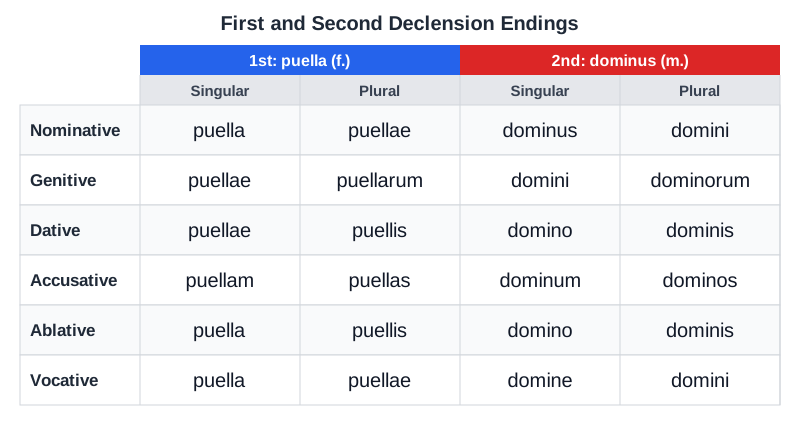
puellis
puellarum
puellae
puellorum
1st declension genitive plural -arum, shown in the first table.
In the table, what is the form of "dominus" in the vocative singular?
domine
dominus
domino
domini
The vocative singular of -us nouns ends in -e: "Salve, domine!"
Look at the third-declension table. How do the neuter plural forms of "nomen" end?
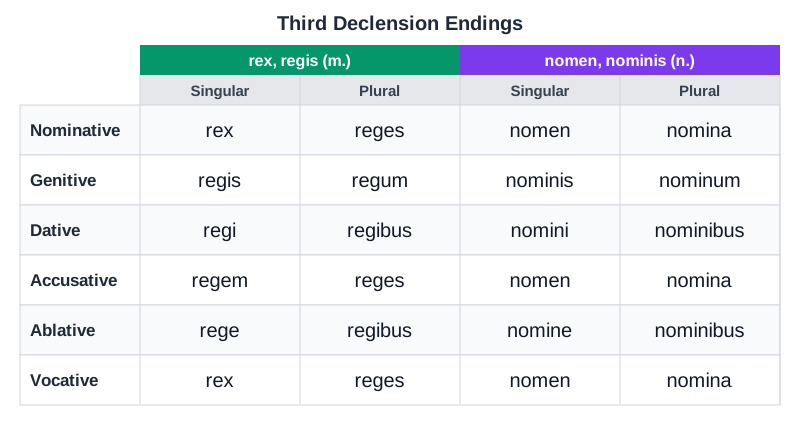
-es (nomines)
-ia (nomina)
-ibus
-a (nomina)
Neuter nominative and accusative plural end in -a. Only i-stem neuters (mare) have -ia.
In the third-declension table, which two forms of "rex" are the same in the singular?
Genitive and dative
Accusative and ablative
Nominative and vocative
Dative and ablative
Nominative and vocative singular are identical (rex). The vocative differs from the nominative only in 2nd declension -us nouns.
Which pronoun form means "of this (one)"?
hunc
huius
hoc
hi
Hic, haec, hoc: genitive singular huius for all genders. Hunc is accusative masculine, hoc nominative/accusative neuter, hi nominative masculine plural.
The 3rd declension adjective "fortis" has ablative singular...
forti
forte
fortis
fortem
3rd declension adjectives are i-stems and have -i in the ablative (forti). Fortem is accusative masculine singular.
