Quiz · Hard
Twenty-one applied questions on severe preeclampsia, magnesium toxicity, cord prolapse, Category III tracings, hemorrhage, ectopic pregnancy and newborn emergencies.
A client at 37 weeks has a BP of 164/112, a headache, blurred vision and epigastric pain. Her platelet count is 82,000/mm3 and AST is three times normal. Which condition is most consistent?
Preeclampsia with severe features and HELLP syndrome
Gestational hypertension
Chronic hypertension
Eclampsia
Severe-range BP, neurologic symptoms, thrombocytopenia and elevated liver enzymes indicate severe preeclampsia with HELLP (hemolysis, elevated liver enzymes, low platelets). Eclampsia requires a seizure. The definitive treatment is delivery.
A client with severe preeclampsia receiving magnesium sulfate has a respiratory rate of 10, absent patellar reflexes and a urine output of 20 mL/hr. What is the priority nursing action?
Slow the infusion and recheck in 30 minutes
Stop the magnesium infusion and notify the provider; prepare calcium gluconate
Administer naloxone
Increase IV fluids and continue the infusion
These are signs of magnesium toxicity: respiratory depression, loss of reflexes, oliguria. Stop the infusion, call for help, give oxygen and be ready to give calcium gluconate IV. Magnesium is renally excreted, so low urine output increases risk.
A client is receiving oxytocin for induction. Contractions occur every 90 seconds, last 100 seconds, and the FHR shows recurrent late decelerations. What is the nurse's first action?
Stop the oxytocin infusion
Decrease the rate of the primary IV infusion
Prepare to administer terbutaline immediately before any other action
Ask the client to bear down
Hyperstimulation with a Category II/III pattern requires stopping the oxytocin first, then repositioning (left lateral), giving oxygen and fluids and notifying the provider. Terbutaline may be ordered next.
A woman in labor has a sudden gush of clear fluid and the nurse sees a loop of cord at the vaginal opening. What is the priority?
Gently push the cord back into the vagina
Apply a dry sterile dressing and wait for the provider
Turn the woman onto her right side and give oxygen
Elevate the presenting part off the cord with a gloved hand and place the woman in knee-chest position
A prolapsed cord is an obstetric emergency. Keep the presenting part lifted off the cord, position knee-chest or Trendelenburg, cover the cord with saline-moistened gauze, give oxygen and prepare for cesarean birth. Never replace the cord.
An Rh-negative woman with a negative indirect Coombs test delivers an Rh-positive infant. When should RhoGAM be given?
Only if the infant's direct Coombs test is positive
At the start of the next pregnancy
Intravenously immediately after delivery of the placenta
Within 72 hours after birth
RhoGAM (300 mcg IM) is given within 72 hours of delivery to an unsensitized Rh-negative mother with an Rh-positive infant, and also at 28 weeks. A positive maternal indirect Coombs means she is already sensitized and RhoGAM will not help.
A client at 30 weeks has regular contractions every 5 minutes, cervical dilation of 2 cm and intact membranes. Which medication will the nurse anticipate to improve fetal lung maturity?
Betamethasone
Terbutaline
Oxytocin
Methylergonovine
Antenatal corticosteroids (betamethasone) given between about 24 and 34 weeks accelerate surfactant production. Tocolytics delay birth long enough to give the steroids; oxytocin and methylergonovine would stimulate the uterus.
A client with gestational diabetes delivered a 9 lb 12 oz newborn. The newborn is now jittery with a weak cry. Which action is most important?
Obtain a serum bilirubin level
Place the newborn under a radiant warmer and observe
Obtain a chest X-ray
Check the newborn's blood glucose
Infants of diabetic mothers have hyperinsulinism after cord clamping and are at risk for hypoglycemia. Jitteriness, a weak cry and lethargy call for an immediate glucose check, then feeding or IV dextrose per protocol.
The nurse reviews the fetal monitor strip: baseline 140 bpm, absent variability, and recurrent variable decelerations. How is this tracing categorized, and what is the best response?
Category I: continue routine monitoring
Category III: intervene immediately and prepare for expedited delivery
Category II: no action is needed
Category I: reposition and reassess in an hour
Absent variability with recurrent variable or late decelerations or bradycardia is Category III (abnormal), a sign of possible fetal acidemia. Use intrauterine resuscitation measures and prepare for prompt delivery.
A postpartum client who delivered 1 hour ago has a firm fundus, but is saturating a pad every 15 minutes with bright red blood. The nurse suspects which cause?
Uterine atony
Retained placental fragments
Laceration of the cervix or vagina
Endometritis
A firm fundus with continuous bright red bleeding points to trauma (a laceration) rather than atony. Retained fragments typically cause a boggy uterus and later bleeding. The nurse notifies the provider and prepares for repair.
Which medication should the nurse question for a postpartum client with severe hypertension who is bleeding from uterine atony?
Oxytocin
Methylergonovine
Misoprostol
Tranexamic acid
Methylergonovine causes vasoconstriction and can severely raise BP, so it is contraindicated in hypertension and preeclampsia. Carboprost is avoided in asthma. Oxytocin is first line.
A woman 8 weeks pregnant presents with right lower quadrant pain, spotting, and a BP of 82/50 with HR 128. She says her shoulder hurts. What should the nurse suspect, and what is the priority?
Ruptured ectopic pregnancy; establish IV access and prepare for emergency surgery
Threatened miscarriage; administer pain medication and schedule an ultrasound
Appendicitis; keep the client NPO and observe
Normal early pregnancy discomfort; reassure
Pain with spotting and signs of shock in early pregnancy mean a ruptured ectopic pregnancy until proven otherwise. Shoulder pain is referred pain from blood irritating the diaphragm. Large-bore IV access, fluids and surgery are urgent.
A client is receiving methotrexate for an unruptured ectopic pregnancy. Which statement by the client indicates a need for further teaching?
I will avoid ibuprofen and alcohol.
I should continue taking my prenatal vitamins with folic acid.
I will return for blood tests to track my hCG levels.
I should avoid sexual intercourse until my doctor says it is safe.
Methotrexate is a folate antagonist: folic acid-containing vitamins can reduce its effect. NSAIDs and alcohol are also avoided. Follow-up hCG levels confirm resolution.
A nurse at the first prenatal visit finds a client's fundal height is 30 cm at 24 weeks. Which cause is most important to consider?
Multiple gestation or polyhydramnios
Oligohydramnios
Intrauterine growth restriction
Fetal anomaly with renal agenesis
Fundal height more than 2 cm above the expected value suggests twins, polyhydramnios, a larger fetus (diabetes) or incorrect dates. A small fundal height suggests oligohydramnios or growth restriction.
The nurse is preparing a woman for an amniocentesis at 17 weeks. Which statement is correct?
The woman should have a full bladder for the entire procedure.
The procedure is performed through the cervix.
RhoGAM is not needed if the woman is Rh-negative.
The fetal heart rate should be checked before and after the procedure.
FHR is documented before and after; ultrasound guides the needle through the abdomen. Rh-negative women need RhoGAM after amniocentesis in case of fetomaternal bleeding.
A newborn is placed under phototherapy for hyperbilirubinemia. Which nursing action is correct?
Apply lotion to the skin to prevent drying
Keep the infant swaddled in blankets to maintain warmth
Reduce feedings to decrease bowel movements
Cover the infant's eyes with eye shields and expose as much skin as possible
Eyes must be protected from the light and as much skin as possible exposed. Avoid lotions and oils (burns). Feed frequently to promote excretion of bilirubin in stool; monitor temperature and hydration.
A mother reports that her 3-day-old breastfed infant has only had one wet diaper in 24 hours and the infant appears sleepy and jaundiced. Which assessment is a priority?
Teach the mother to introduce water between feeds
Recommend stopping breastfeeding and switching to formula
Reassure her that this is normal at 3 days
Weigh the infant and assess feeding effectiveness
Few wet diapers, sleepiness and jaundice suggest inadequate intake (dehydration). Weigh the infant, observe a feeding and arrange follow-up. Water offers no calories and worsens jaundice.
Which statement by a client taking combined oral contraceptives requires immediate follow-up?
I have breast tenderness.
I noticed light spotting between periods in the first month.
I feel slightly nauseated in the morning.
I have had a severe pain in my left calf for two days.
Calf pain suggests deep vein thrombosis, one of the ACHES warning signs (Abdominal pain, Chest pain, Headaches, Eye problems, Severe leg pain). The other symptoms are common early side effects.
A client with HIV is at 36 weeks of gestation with a viral load of 5,000 copies/mL. Which birth plan does the nurse anticipate?
Vaginal birth with artificial rupture of membranes early
Vaginal birth with a fetal scalp electrode
Breastfeeding after birth to give the infant antibodies
Scheduled cesarean at 38 weeks with intravenous zidovudine
With a viral load above 1000 copies/mL cesarean birth reduces perinatal transmission. IV zidovudine is given during labor, and formula feeding is advised in the United States. Avoid invasive procedures such as scalp electrodes.
A woman is 6 weeks postpartum and tearful, with insomnia, and states she sometimes thinks the baby would be better off without her. What is the best nursing action?
Screen for suicidal or harmful thoughts and notify the provider promptly
Reassure her that this is normal baby blues
Recommend she sleep when the baby sleeps
Schedule a routine appointment in 2 months
Symptoms that persist beyond 2 weeks suggest postpartum depression, and statements about the baby being better off without her require immediate safety assessment and referral. Baby blues resolve within about 2 weeks.
A newborn's mother is HBsAg positive. Which intervention is appropriate within 12 hours of birth?
Hepatitis B immune globulin and the first hepatitis B vaccine
Hepatitis B vaccine only, within 24 hours
Hepatitis B immune globulin only
Defer the vaccine until the 2-month visit
Infants of HBsAg-positive mothers receive both HBIG (passive) and vaccine (active), each at a separate site, within 12 hours of birth.
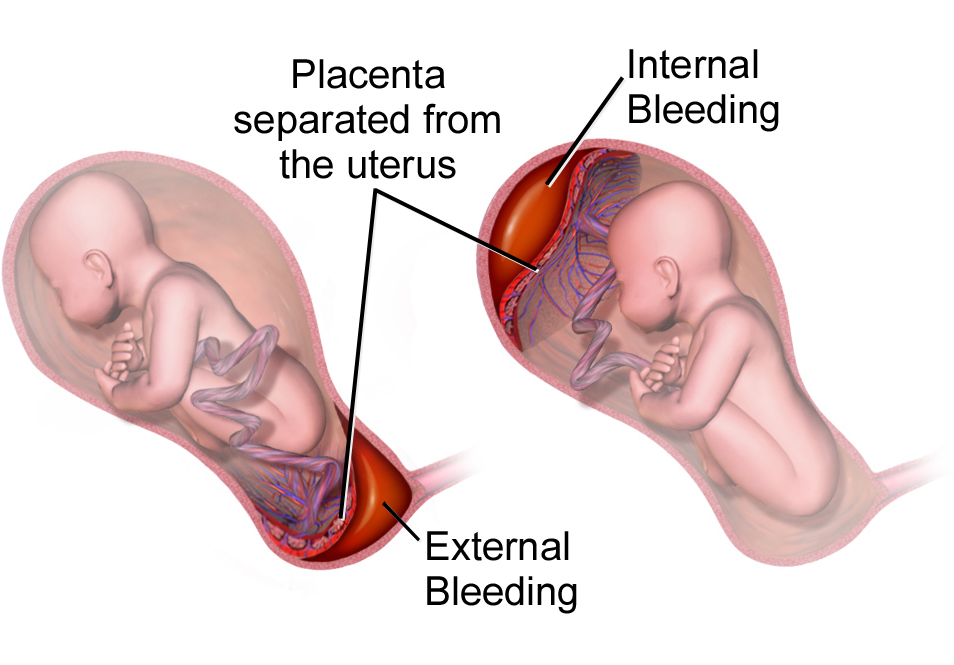
A woman at 33 weeks has sudden severe abdominal pain, a rigid uterus and dark red bleeding. Her uterus is also enlarging. Which diagram matches the suspected diagnosis?
A placenta lying over the cervical os
Premature separation of the placenta with concealed (internal) bleeding behind it
An embryo implanted in the fallopian tube
A normally implanted placenta at the fundus
This is a placental abruption. In a concealed abruption blood collects behind the placenta so the uterus becomes hard, tender and enlarges, with little visible bleeding. Watch for DIC and fetal distress. Image: BruceBlaus (Blausen.com staff), CC BY 3.0, via Wikimedia Commons.
