Quiz · Hard
Clinical cases on controlled substances, high-alert medications, devices, boxed warnings and antidotes.
An order reads 'Morphine 5.0 mg IV q4h'. What is the safety concern?
Morphine cannot be given every 4 hours
The route is wrong
There is no safety concern
The trailing zero could be misread as 50 mg, so the order should be clarified
Trailing zeros are on the Joint Commission 'Do Not Use' list. Always write 5 mg.
Which drug is a Schedule II controlled substance?
Alprazolam
Oxycodone
Pregabalin
Zolpidem
Alprazolam and zolpidem are C-IV, pregabalin is C-V. Schedule II drugs have no refills.
A patient arrives with confusion, bradycardia, salivation, lacrimation and diarrhea after exposure to a pesticide. Which treatment combination is correct?
Atropine and pralidoxime
Naloxone and flumazenil
Fomepizole and hemodialysis
Vitamin K and protamine
Organophosphates inhibit acetylcholinesterase. Atropine blocks muscarinic effects; pralidoxime reactivates the enzyme.
A patient on warfarin has an INR of 9 and active intracranial bleeding. What is the best reversal?
Oral vitamin K alone
Protamine sulfate
Fresh frozen plasma alone
Prothrombin complex concentrate with intravenous vitamin K
Life-threatening bleeding needs immediate factor replacement (PCC) plus vitamin K for sustained reversal. Protamine reverses heparin.
A patient on apixaban has life-threatening bleeding. Which agent can reverse it?
Idarucizumab
Protamine sulfate
Andexanet alfa
Vitamin K
Idarucizumab reverses dabigatran only. Andexanet binds factor Xa inhibitors.
A patient with ethylene glycol ingestion has a high anion gap acidosis and calcium oxalate crystals in urine. What is the antidote?
Naloxone
Fomepizole
Acetylcysteine
Deferoxamine
Fomepizole blocks alcohol dehydrogenase, preventing production of toxic metabolites.
A patient receiving magnesium sulfate for preeclampsia has absent deep tendon reflexes and a respiratory rate of 8. What is the first drug to prepare?
Naloxone
Flumazenil
Calcium gluconate
Vitamin K
Calcium antagonizes magnesium's neuromuscular and respiratory effects.
A patient with severe hypotension and bradycardia after a calcium channel blocker overdose is given fluids. Which treatment is most appropriate next?
Glucagon only
Intravenous calcium, with high-dose insulin and glucose if refractory
Flumazenil
N-acetylcysteine
Calcium overcomes channel blockade. Glucagon is the key agent for beta-blocker overdose.
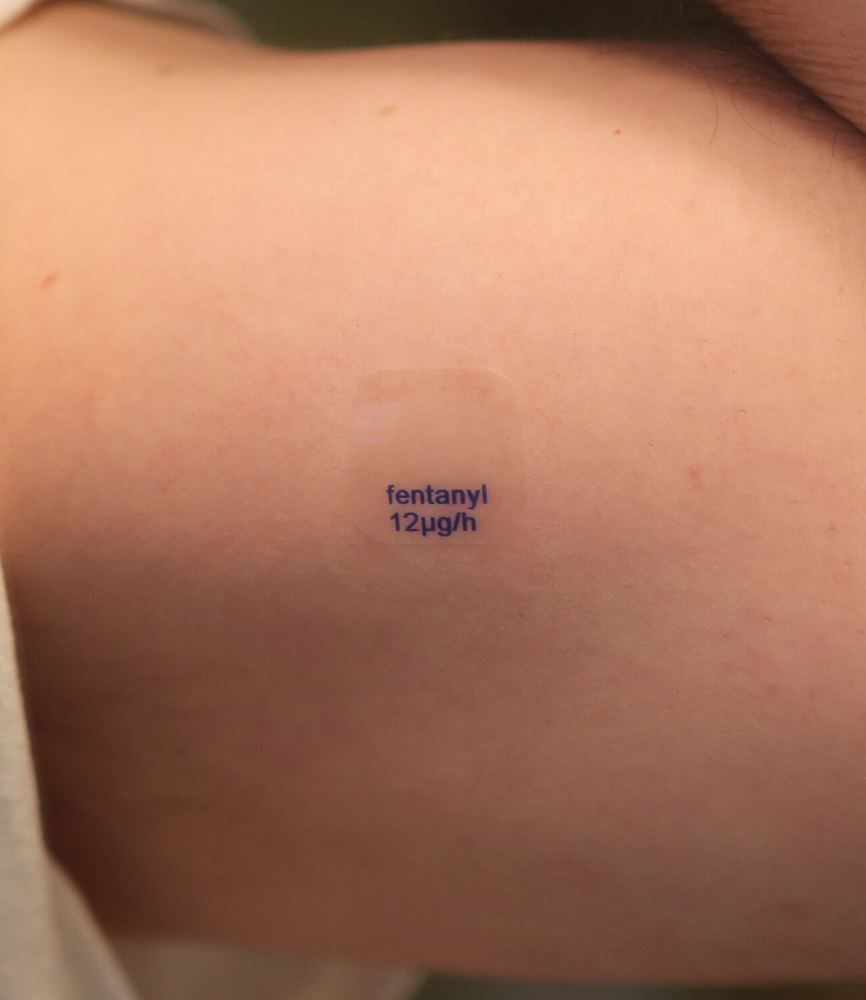
A patient on fentanyl patches develops a fever of 39 C. What is the nursing concern?
Reduced analgesia
Patch adhesion failure only
Hypoglycemia
Increased absorption leading to overdose
Heat raises transdermal absorption, so monitor sedation and respiratory rate and report the fever. Image: DanielTahar, CC BY-SA 4.0, via Wikimedia Commons.
Which medication combination has a boxed warning because of profound respiratory depression and sedation?
Metformin plus glipizide
Lisinopril plus furosemide
Opioid plus benzodiazepine
Albuterol plus ipratropium
Concurrent opioids and benzodiazepines (or other CNS depressants) increase risk of death from respiratory depression.
Which patient should not receive sildenafil?
A patient taking metformin
A patient taking amoxicillin
A patient taking isosorbide mononitrate
A patient taking albuterol
PDE5 inhibitors plus nitrates cause profound vasodilation and hypotension.
Which pregnant patient's medication should be changed immediately?
A patient taking lisinopril
A patient taking labetalol
A patient taking levothyroxine
A patient taking insulin
ACE inhibitors cause fetal renal toxicity and are contraindicated in pregnancy.
A patient with rheumatoid arthritis takes methotrexate. Which dosing error is most dangerous?
Taking it daily instead of weekly
Taking it with folic acid
Taking it on the same weekday
Taking it with food
Daily methotrexate can cause fatal myelosuppression and mucositis. Verify weekly dosing; leucovorin rescues toxicity.
Which patient is a candidate for a long-acting beta agonist such as salmeterol?
A patient with mild intermittent asthma only
A patient needing relief for an acute attack
A patient with asthma taking nothing else
A patient with asthma already taking an inhaled corticosteroid
LABAs are combined with ICS for persistent asthma. They are not rescue drugs and are not monotherapy for asthma.
A nurse is about to give an extended-release tablet to a patient who cannot swallow it whole. What is the best action?
Crush the tablet and mix with applesauce
Split the tablet in half
Contact the prescriber or pharmacist for a liquid or immediate-release alternative
Dissolve it in water and give by tube
Crushing ER tablets causes dose dumping and potential toxicity.
A patient prescribed ketorolac asks how long it can be used. What is the correct answer?
Up to 30 days
Indefinitely if taken with food
Only on weekends
No more than 5 days total
Ketorolac carries risk of GI bleed and kidney injury, so total duration (IV and oral) is limited to 5 days.
