Quiz · Hard
Harder, exam-style questions: Simpson's index, mark-recapture, species-area and island biogeography, trophic cascades and reserve design.
A community has three species with 50, 30 and 20 individuals. Using Simpson's diversity index D = 1 - sum of (n/N)^2, what is D?
0.50
0.33
0.62
0.38
N = 100. Sum of squares = 0.25 + 0.09 + 0.04 = 0.38. D = 1 - 0.38 = 0.62. The value 0.38 is the sum before subtracting from 1.
Which community would have the HIGHEST Simpson's (1 - sum) diversity index?
Two species with 50 individuals each
Four species with 70, 10, 10 and 10 individuals
Four species with 25 individuals each
Ten species where one species has 91 individuals and the others 1 each
Four even species: D = 1 - 4(0.0625) = 0.75. Two even species give 0.5. The dominated communities score far lower.
In a mark-recapture study, 60 turtles are marked and released. A later sample of 45 turtles contains 9 marked. What is the best estimate of the population size?
300
405
54
135
N = (M x C)/R = (60 x 45)/9 = 300. Choosing 135 or 405 means mis-handling the ratio.
Which assumption is required for the Lincoln-Peterson method to give a reliable estimate?
All animals have been marked
The sample size equals the population size
Marked animals are easier to catch
Marked individuals mix randomly with the population and there are no births, deaths or migration between samples
If marked animals are trap-shy or trap-happy, or the population changes, the estimate is biased.
A population of 40 individuals is isolated after habitat fragmentation. Which process is the MOST direct threat to its long-term persistence?
Competitive exclusion
Inbreeding depression and loss of genetic diversity
Succession
Natural selection for faster growth
Small populations lose alleles by genetic drift and show reduced fitness when relatives mate; the extinction vortex follows.
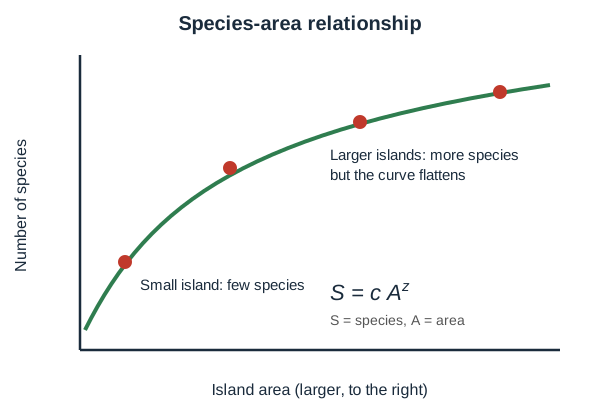
Using the species-area relationship, which is the MOST likely long-term consequence of clearing 90% of a forest island's habitat?
Loss of all species
Loss of about half of its species
Loss of about 10% of its species
No loss, because each species needs very little space
A common rule of thumb from the species-area curve is that a tenfold reduction in area eventually cuts species numbers roughly in half.
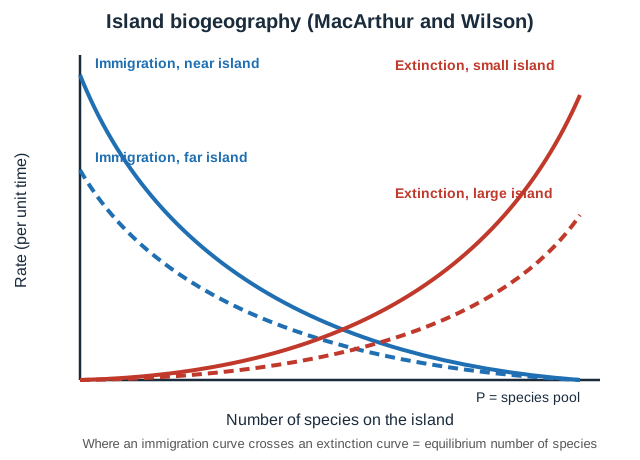
On the island biogeography graph, which change would INCREASE the equilibrium number of species on an island?
Moving the island farther from the mainland
Building a land bridge or stepping-stone islands that raise immigration, or enlarging the island
Reducing the island's area
Adding a new predator that kills many species
Higher immigration (nearer) and lower extinction (larger) shift the crossing point to more species.
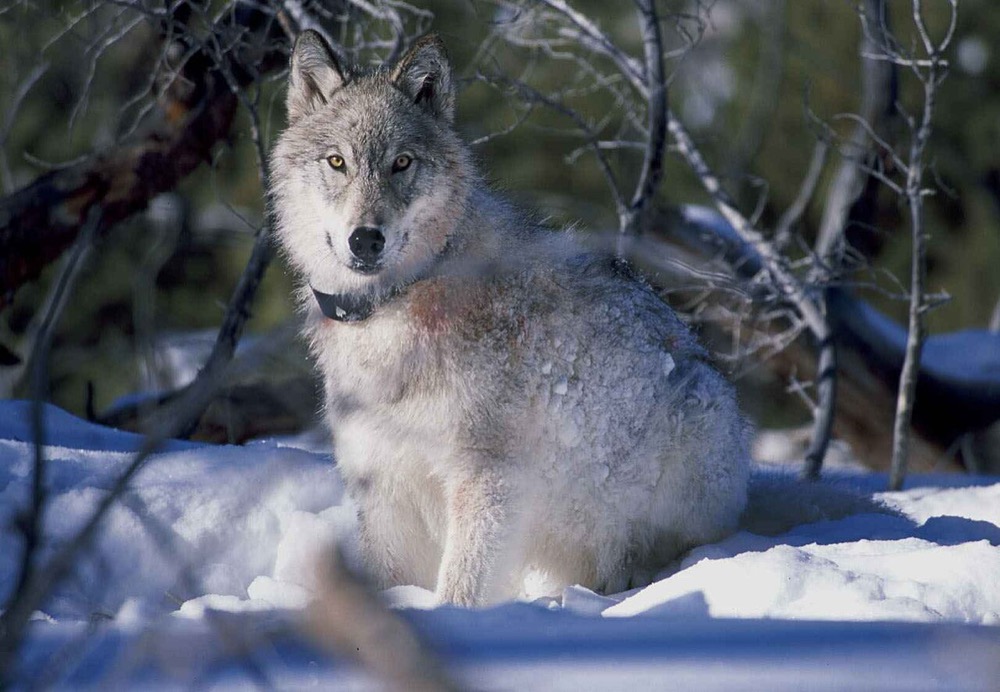
A wolf pack is reintroduced and elk begin avoiding open river valleys. Willows regrow and beavers return. This chain of effects is best described as:
Competitive exclusion
A genetic bottleneck
Adaptive radiation
A trophic cascade
Changes at the top predator ripple down to plants and other species. Competitive exclusion and adaptive radiation involve different mechanisms.
Which pair is correctly matched?
Foundation species: coral that builds reef habitat. Umbrella species: a wide-ranging predator whose protection also protects many species
Indicator species: ones that protect others by their large range. Flagship species: ones that signal pollution
Umbrella species: species that fill any niche. Generalists: species that need specific habitat
Keystone species: always the most abundant. Foundation species: always a top predator
Foundation species create habitat; umbrella species need large areas so protecting them shelters many others. The other options mix up the definitions.
A rainforest and a nearby savanna both lose 20% of their area. Researchers expect greater species loss in the rainforest per unit area lost. Which is the MOST likely reason?
Rainforests have lower species richness
Species-area curves do not apply to rainforests
Rainforests have many specialists and endemic species with small ranges
Savanna species are all invasive
Specialists with narrow ranges lose their entire habitat quickly. The hotspots idea (high endemism plus habitat loss) rests on this.
Which graph shape would you expect if reserve size is plotted against species richness for ten forest patches?
Sharp drop beyond a certain size
Linear decline
Rising but leveling off as area increases
Flat line
Species richness rises with area at a decreasing rate (S = cA^z with z less than 1).
Which of the following would be the BEST design for a nature reserve to protect a wide-ranging carnivore?
One large round reserve linked to other reserves by corridors
Many tiny reserves with no connection
A small reserve surrounded by farmland with no buffer
A long, narrow reserve along a highway
Large round areas minimize edge effects, and corridors allow movement and gene flow. Narrow shapes maximize edge.
The Gros Michel banana was nearly wiped out by Panama disease and the Cavendish variety is now threatened by a new strain. What does this illustrate?
The importance of ex situ conservation only
The benefit of hybrid vigor
The effect of ocean acidification
The danger of low genetic diversity in monoculture crops
Genetically uniform plantations share the same susceptibility, so one pathogen can devastate them.
Which strategy offers the greatest long-term benefit for conserving biodiversity per dollar spent on invasive species?
Ignoring species that are not yet harming agriculture
Preventing introduction through inspection and early detection
Waiting until the species is widespread, then using pesticides
Releasing a new predator from another continent right away
Prevention and rapid response cost much less than managing established invaders. New predators risk creating a second invasion.
A study finds that bird diversity in a forest is highest at sites cleared by small, occasional fires, and lower both in untouched forest and in frequently burned areas. This supports:
The competitive exclusion principle
The species-area relationship
The enemy release hypothesis
The intermediate disturbance hypothesis
Moderate disturbance prevents dominance while allowing recolonization, giving maximum diversity.
