Quiz · Hard
Twenty applied priority questions on lethal arrhythmias, stroke, increased ICP, DKA, pulmonary embolism, anaphylaxis, sepsis, autonomic dysreflexia and delegation.
A client is receiving a heparin infusion and the aPTT is 120 seconds. The client has blood in the urine. What does the nurse expect to prepare?
Vitamin K
Protamine sulfate
Naloxone
Flumazenil
A markedly elevated aPTT with bleeding requires stopping the infusion and giving protamine sulfate, the heparin antidote.
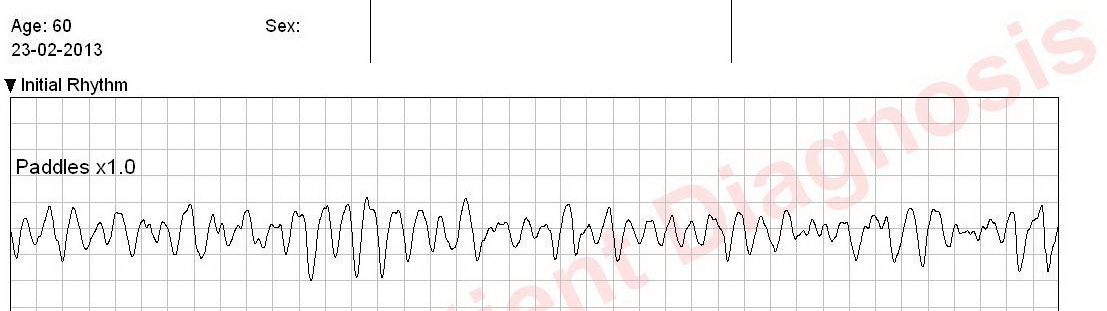
A client post-MI is in the ICU. The monitor shows the following rhythm. The client is unresponsive and pulseless. What is the nurse's first action?
Give amiodarone 150 mg IV and wait
Perform synchronized cardioversion
Begin CPR and defibrillate as soon as possible
Check the leads and reapply
This is ventricular fibrillation, a lethal shockable rhythm with no cardiac output. CPR and immediate defibrillation are the priority, followed by epinephrine and amiodarone. Synchronized cardioversion is for rhythms with a pulse. Image: Antoine Ayer, CC BY-SA 4.0, via Wikimedia Commons.
A client with palpitations has this rhythm strip at 192 bpm: wide, regular complexes. The BP is 70/40 and the client is confused. What does the nurse anticipate?

Adenosine 6 mg rapid IV push
Oral amiodarone
Defibrillation at 360 joules
Synchronized cardioversion
Unstable ventricular tachycardia with a pulse needs synchronized cardioversion. Defibrillation is for pulseless VT or VF; adenosine is for SVT. Image: Glenlarson, public domain, via Wikimedia Commons.
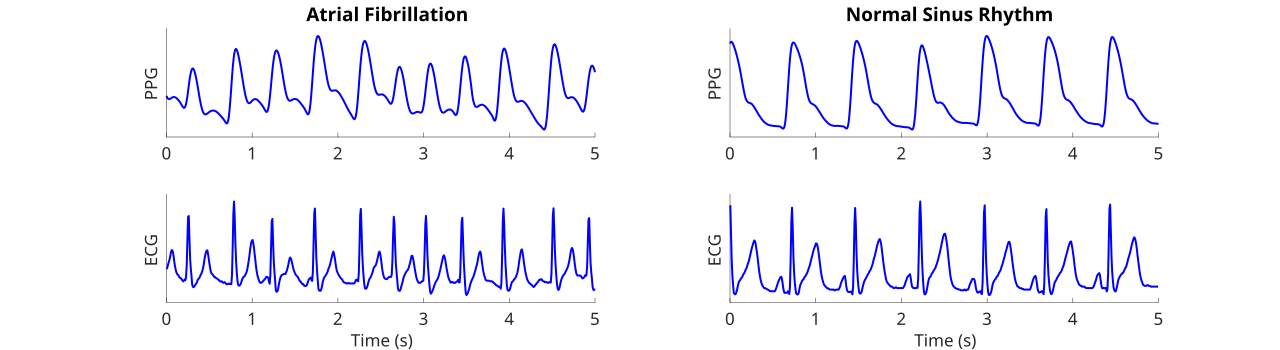
Which ECG finding best matches atrial fibrillation in this tracing (left) versus normal sinus rhythm (right)?
Irregularly irregular rhythm with no distinct P waves
Regular rhythm with a P wave before each QRS
Saw-tooth flutter waves at a rate of 300
Wide QRS complexes at a rate of 200
In atrial fibrillation the R-R intervals vary randomly and P waves are absent. Anticoagulation is needed to prevent stroke. Image: Peterhcharlton, CC BY 4.0, via Wikimedia Commons.
A client presents with sudden left-sided weakness, facial droop and slurred speech that started 90 minutes ago. After checking airway, vital signs and the time of onset, what is the next priority?
Prepare for a stat non-contrast head CT
Administer aspirin 325 mg
Give a drink of water to check swallowing
Lower the BP to 120/80
CT excludes hemorrhage before thrombolysis. Do not give aspirin or oral intake before imaging and a swallow screen.
A client who has had a head injury has a BP rising from 120/80 to 170/70, HR 52 and irregular breathing. What is the nurse's priority action?
Notify the provider immediately and keep the head of the bed at 30 degrees
Administer a sedative and recheck in 30 minutes
Place the client in Trendelenburg
Suction the airway for 30 seconds
This is Cushing's triad, a sign of severe increased ICP and impending herniation. Elevate the head, keep the neck neutral, avoid factors that raise ICP and call for emergency help.
A client with type 1 diabetes has a glucose of 520 mg/dL, Kussmaul respirations and fruity breath. The potassium is 3.0 mEq/L. What should the nurse do before starting an insulin infusion?
Start insulin right away and recheck potassium tomorrow
Clarify with the provider and replace potassium first
Give a bolus of dextrose
Administer sodium bicarbonate immediately
Insulin drives potassium into cells, so a potassium below 3.3 mEq/L must be corrected before insulin to avoid dangerous hypokalemia and arrhythmias.
A client 2 days after hip surgery develops sudden dyspnea, pleuritic chest pain, a heart rate of 120 and SpO2 of 86 percent. What is the nurse's first action?
Raise the head of the bed and apply oxygen
Ambulate the client to improve circulation
Massage the calf
Administer an IV opioid for the chest pain
This is suspected pulmonary embolism. Support breathing first, then notify the provider and anticipate imaging and anticoagulation. Do not massage or exercise the legs.
A client is stung by a bee and develops stridor and a blood pressure of 78/40. Which prescription takes priority?
Diphenhydramine 50 mg IV
Methylprednisolone 125 mg IV
Albuterol nebulizer
Epinephrine 0.3 mg IM into the thigh
Anaphylaxis requires immediate IM epinephrine. Antihistamines, steroids and bronchodilators are adjuncts.
A client with a spinal cord injury at T4 has a BP of 220/118, pounding headache and flushed skin above the injury. The nurse finds the client lying flat. What is the first action?
Administer a PRN opioid
Lower the head of the bed to improve perfusion
Obtain a urine culture
Sit the client upright and check for bladder distention
This is autonomic dysreflexia. Sitting up reduces BP; then remove the stimulus (full bladder, fecal impaction, tight clothing) before using antihypertensives.
A nurse is caring for a client with sepsis (BP 82/48, lactate 4.5). Which prescription should be completed first?
Obtain blood cultures and start broad-spectrum antibiotics within one hour
Give a 250 mL fluid bolus
Order a chest X-ray
Collect a 24-hour urine
Cultures are obtained before antibiotics, but antibiotics should not be delayed. The hour-1 bundle also includes 30 mL/kg of crystalloid for hypotension or lactate of 4 or more.
Which client should the nurse assess FIRST?
A client with a stage 3 pressure injury who needs a dressing change
A client with diabetes who has a glucose of 180 mg/dL
A client on a heparin drip with an aPTT of 70 seconds
A client 1 day post-thyroidectomy with a hoarse voice and noisy breathing
Stridor or noisy breathing after thyroidectomy suggests airway compromise from swelling or hematoma. This is an airway problem. The other clients are stable or in range.
The nurse is delegating tasks. Which task can be assigned to a nursing assistant?
Assess the wound for signs of infection
Teach wound care to the client
Reposition a stable client with a stage 2 pressure injury every 2 hours
Evaluate the client's response to the dressing
Repositioning is a routine task. Assessment, teaching and evaluation require nursing judgment and cannot be delegated to unlicensed personnel.
A client receiving a continuous oxytocin infusion has 7 contractions in 10 minutes and recurrent late decelerations. What is the nurse's first action?
Increase the IV fluids and reassess in an hour
Stop the oxytocin infusion
Start oxygen then continue the oxytocin
Prepare for a vaginal exam
Tachysystole with late decelerations indicates uteroplacental insufficiency. Stopping the oxytocin removes the cause; then reposition left lateral, give oxygen and notify the provider.
A client with hepatic encephalopathy asks, 'Why do I need lactulose when I have no constipation?' What is the best answer?
'It lowers the ammonia level by promoting excretion in the stool.'
'It cleans out the intestines before surgery.'
'It prevents infection.'
'It increases the potassium level.'
Lactulose traps ammonia in the colon and promotes its removal in stool, reducing confusion. The goal is 2 to 3 soft stools a day.
A client receiving gentamicin reports ringing in the ears. What is the nurse's priority?
Give the dose and monitor
Hold the next dose and notify the provider
Encourage fluids and continue
Document as an expected effect
Tinnitus can signal ototoxicity, which may be irreversible. Notify the provider before the next dose and check renal function and drug levels.
Which statement made by the client with heart failure indicates teaching on daily weights is effective?
'I'll call if I gain 3 pounds in a day.'
'I'll weigh myself once a week.'
'I'll weigh myself after dinner.'
'I'll call if I lose 5 pounds.'
Weight should be taken at the same time each morning after voiding. A gain of 2 to 3 lb in a day or 5 lb in a week signals fluid retention.
The nurse is caring for a client who just returned from cardiac catheterization via the femoral artery. The client reports a cool, numb leg. What is the priority?
Elevate the head of bed to 45 degrees
Encourage ambulation
Apply warm compresses to the leg
Check the pulses, color and temperature of the leg and notify the provider
A cool, numb extremity after femoral access suggests arterial occlusion or bleeding. Assess distal pulses and notify the provider promptly; keep the leg straight.
Which statement by a client on lithium should be reported to the provider immediately?
'I feel thirsty and urinate more than before.'
'I have a slight tremor in my fingers.'
'I take my medication with breakfast.'
'I've had vomiting and diarrhea for 2 days and my hands are shaking badly.'
Vomiting, diarrhea and coarse tremor suggest lithium toxicity, especially with dehydration. A fine tremor, thirst and taking it with food are expected.
A client with a nasogastric tube is receiving continuous enteral feeding and suddenly begins to cough with a drop in SpO2 to 88 percent. What is the nurse's first action?
Increase the feeding rate
Flush the tube with 60 mL of water
Check the residual volume only
Stop the feeding and elevate the head of the bed
Suspected aspiration: stop the feeding, suction and support breathing, keep the head up and notify the provider.
