Quiz · Medium
Collisions and impulse, torque and rolling, simple harmonic motion, Kepler's third law and equilibrium, with the common wrong answers explained.
A 2.0 kg cart moving at 6.0 m/s collides with a stationary 4.0 kg cart and they stick together. What is their speed immediately after?
3.0 m/s
2.0 m/s
1.5 m/s
4.0 m/s
Momentum is conserved: , so m/s. 3.0 m/s is the simple average of the two velocities (0 and 6), which ignores the masses.
A constant 20 N force acts on a 2.0 kg object, initially at rest, for 0.50 s. What is its final speed?
5.0 m/s
10 m/s
2.5 m/s
20 m/s
Impulse = N·s , so m/s. Using (10 m/s) forgets to multiply by the time interval.
Which quantity is conserved in every collision between objects in an isolated system?
Total kinetic energy
Each object's speed
Each object's momentum
Total momentum
Isolated systems conserve total vector momentum whether the collision is elastic or not. Kinetic energy is conserved only in elastic collisions, and individual objects' momenta change during the collision.
A moving ball strikes an identical ball at rest in a head-on elastic collision. Afterward…
both balls move forward with half the original speed
the first ball bounces back and the second moves forward
the first ball stops and the second moves off with the first ball's original speed
both balls stop
With equal masses in a 1D elastic collision, the velocities are exchanged. Both-at-half-speed conserves momentum but not kinetic energy (it is the sticking outcome).
Where is the centre of mass of a 2 kg mass at x = 0 and a 6 kg mass at x = 4 m?
x = 2 m
x = 1 m
x = 2.5 m
x = 3 m
m. The midpoint (2 m) would be correct only for equal masses.
A figure skater spinning with arms extended pulls her arms in. What happens to her angular momentum and angular speed?
Angular momentum increases; angular speed is unchanged
Angular momentum is unchanged; angular speed increases
Both stay the same
Angular momentum decreases; angular speed increases
No external torque acts, so is constant. Decreasing forces to increase. Her kinetic energy increases because she does work pulling her arms in.
A solid sphere, a solid cylinder and a hoop of equal mass and radius are released from rest at the top of a ramp and roll without slipping. Which reaches the bottom first?
The solid sphere
The hoop
The solid cylinder
They all arrive together
The sphere has the smallest , so the largest fraction of its energy becomes translational KE. The hoop (1.0) is slowest. They would tie only if they were sliding without friction.
A 50 N force acts at 30° to a 0.40 m wrench handle (angle between the force and the handle). What torque does it produce?
20 N·m
17 N·m
25 N·m
10 N·m
N·m. 20 N·m would be the maximum torque (90°); 17 N·m uses cosine instead of sine.
The radius of a hoop is doubled while its mass stays the same. By what factor does its moment of inertia change?
2
8
4
1/2
scales with : . Mass distribution far from the axis counts quadratically.
The mass on a spring is quadrupled. What happens to the period of oscillation?
It quadruples
It doubles
It halves
It stays the same
, so 4× the mass gives 2× the period. The period does not depend on amplitude.
The length of a simple pendulum is increased by a factor of 4. How does its period change (small angles)?
It doubles
It quadruples
It is halved
It is unchanged
. Mass and amplitude (for small angles) do not matter.
At which point of the motion of a mass on a horizontal spring is the speed greatest and the net force zero?
At maximum displacement
Halfway between equilibrium and maximum displacement
At the point where the potential energy is greatest
At the equilibrium position
At equilibrium the spring is unstretched, so F = 0 and all the energy is kinetic. At the turning points the speed is zero and the force is maximum.
The amplitude of a mass-spring oscillator is doubled. Which statement is correct?
The period doubles and the maximum speed is unchanged
The maximum speed and the period both double
The maximum speed doubles and the period is unchanged
The maximum speed quadruples and the period doubles
with fixed, so doubles. The total energy quadruples (), but the period is independent of amplitude.
A mass-spring system has total energy E. When the displacement is half the amplitude, what fraction of E is kinetic?
1/2
3/4
1/4
1/8
, so . Half-and-half occurs at , not at .
A 30 kg child sits 1.5 m from the pivot of a uniform seesaw. Where must a 45 kg child sit on the other side to balance it?
1.0 m from the pivot
2.25 m from the pivot
1.5 m from the pivot
0.67 m from the pivot
Balance torques: → m. The heavier child sits closer; 2.25 m inverts the ratio.
A planet orbits at 4 times the orbital radius of another planet around the same star. By what factor is its orbital period longer?
4
16
8
2
Kepler's third law : .
Why do astronauts in the International Space Station appear weightless?
Gravity is zero at that altitude
They are in continuous free fall around Earth
They are too far from Earth for gravity to act
The station's rotation cancels gravity
Gravity at ISS altitude is still about 90% of its surface value. Station and astronauts fall together around Earth, so no normal force is needed or felt.
An airbag reduces injury in a crash mainly because it…
increases the time over which the passenger's momentum changes, lowering the average force
reduces the passenger's change in momentum
reduces the passenger's mass
increases the impulse on the passenger
The impulse (change in momentum) is fixed by the passenger going from speed v to rest. falls when Δt is larger.
A wheel starts from rest and has a constant angular acceleration of 2.0 rad/s². Through what angle does it turn in 5.0 s?
10 rad
50 rad
12.5 rad
25 rad
rad. 10 rad is the final angular speed, .
In the incline diagram, which expression gives the component of the block's weight acting down the slope?
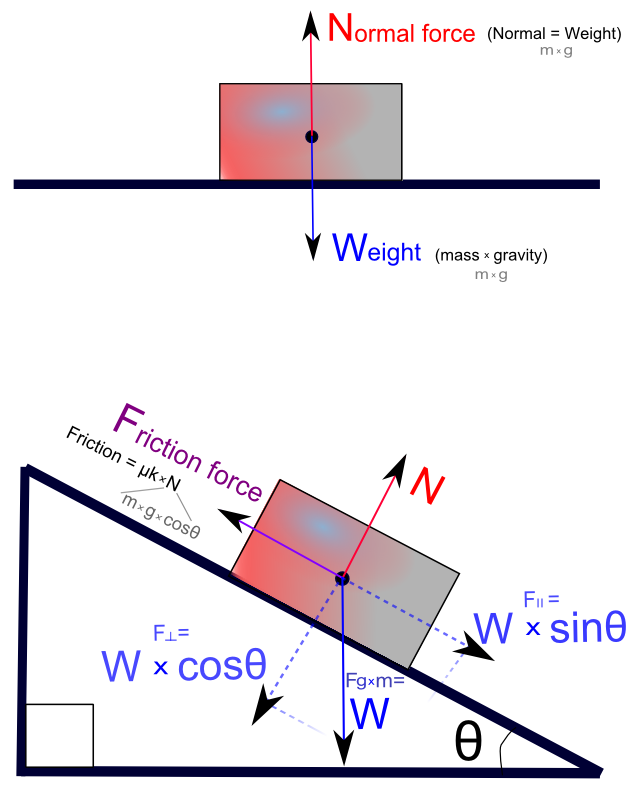
Resolve the weight into a component along the slope, , and one perpendicular to it, (balanced by the normal force). The cos component is the one that sets the friction. Image: Penubag, public domain, via Wikimedia Commons.
In a pendulum, doubling the mass of the bob doubles the period of small oscillations.
True
False
False. has no mass in it: a heavier bob feels a proportionally larger restoring force and also has proportionally more inertia.
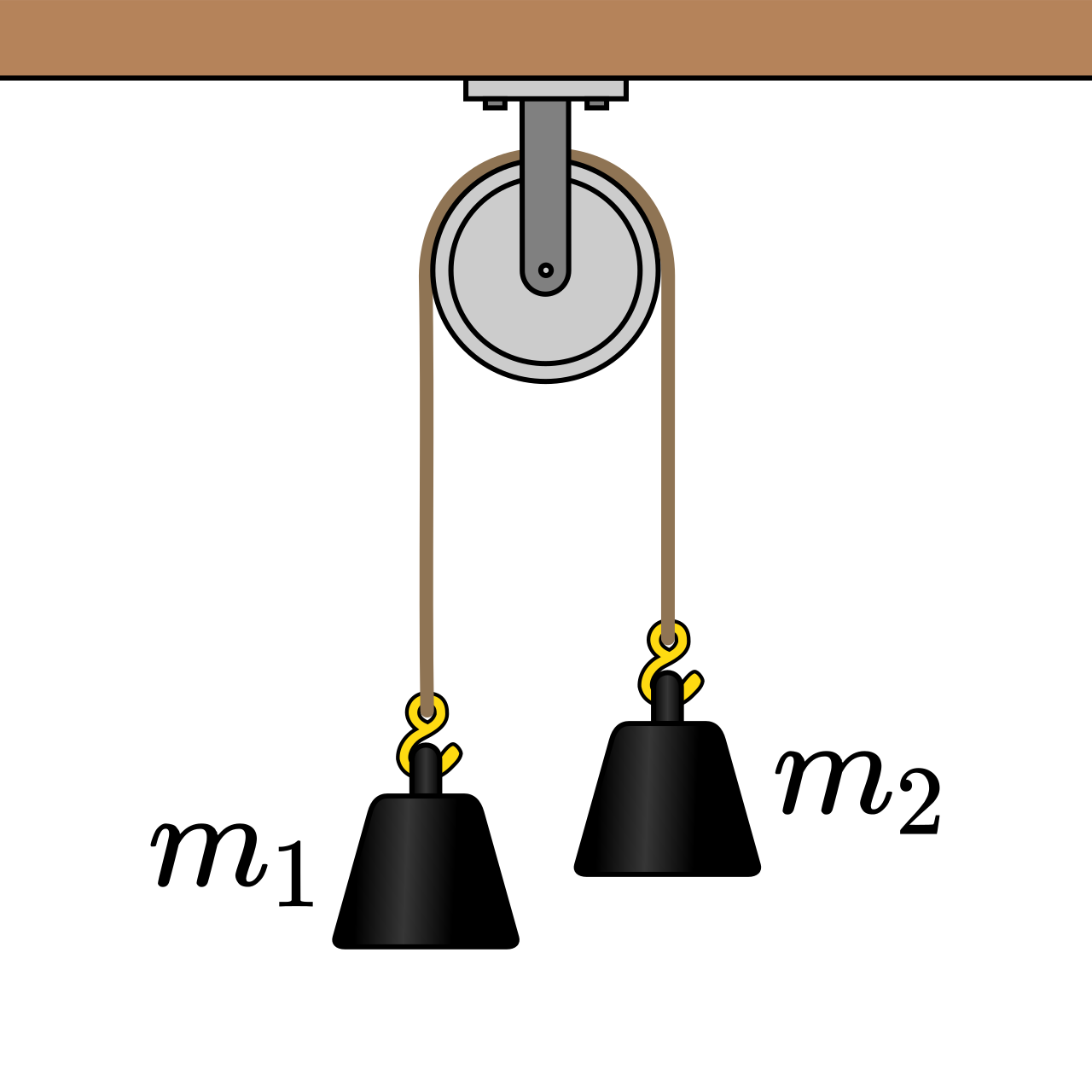
In the Atwood machine shown, the masses are unequal and the pulley is ideal. How does the rope tension compare with the weights?
It equals the weight of the heavier mass
It is greater than the weight of the lighter mass and less than the weight of the heavier mass
It equals the weight of the lighter mass
It equals the sum of both weights
The heavier mass accelerates downward, so ; the lighter accelerates up, so . . Image: MikeRun, CC BY-SA 4.0, via Wikimedia Commons.
