Quiz · Medium
Foundational questions on the parts of the GI tract, what each organ does and where digestion and absorption happen.
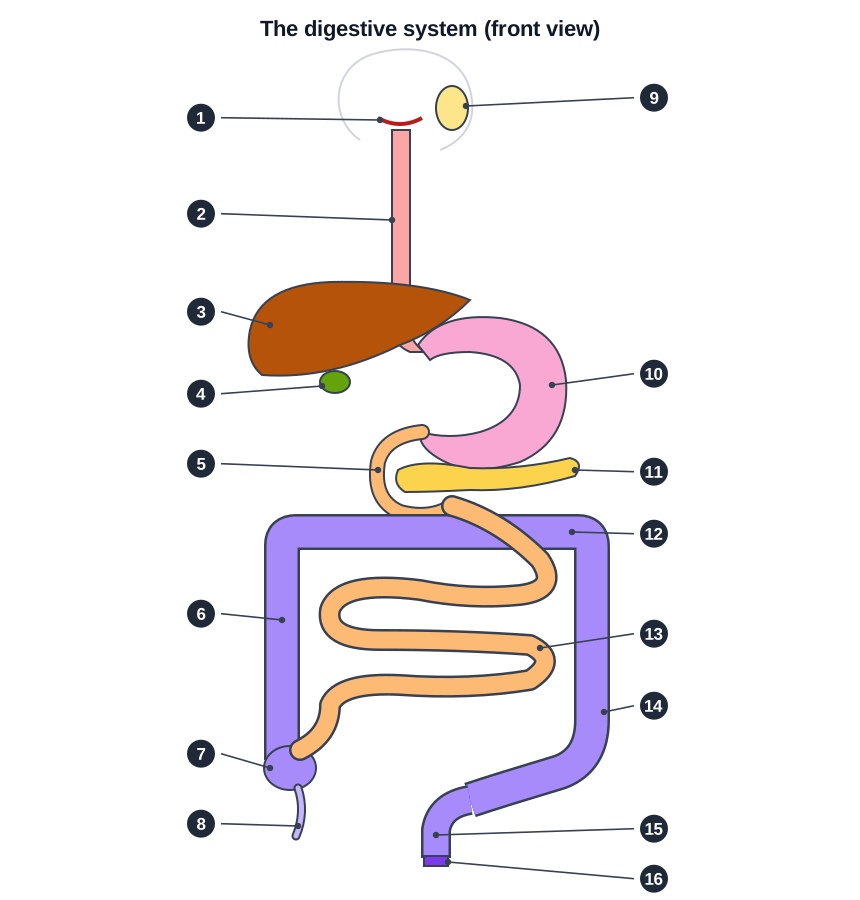
Which structure is labeled 3 in the diagram?
Liver
Stomach
Pancreas
Gallbladder
The liver is the large organ in the upper right abdomen (on the left of a front-view diagram). The gallbladder sits just under it.
Which structure is labeled 11 in the diagram?
Spleen
Transverse colon
Pancreas
Duodenum
The pancreas lies behind the stomach with its head in the C-shaped curve of the duodenum.
Which structure is labeled 7 in the diagram?
Sigmoid colon
Cecum
Rectum
Ileum
The cecum is the pouch at the start of the large intestine, in the right lower abdomen, with the appendix hanging from it.
Where does chemical digestion of carbohydrates begin?
Stomach
Mouth
Duodenum
Jejunum
Salivary amylase starts breaking starch down in the mouth. The stomach does not digest carbohydrate; its acid inactivates amylase.
Which cells of the stomach secrete hydrochloric acid?
Chief cells
G cells
Parietal cells
Goblet cells
Parietal cells pump H+ (proton pump) and also make intrinsic factor. Chief cells make pepsinogen; G cells make gastrin.
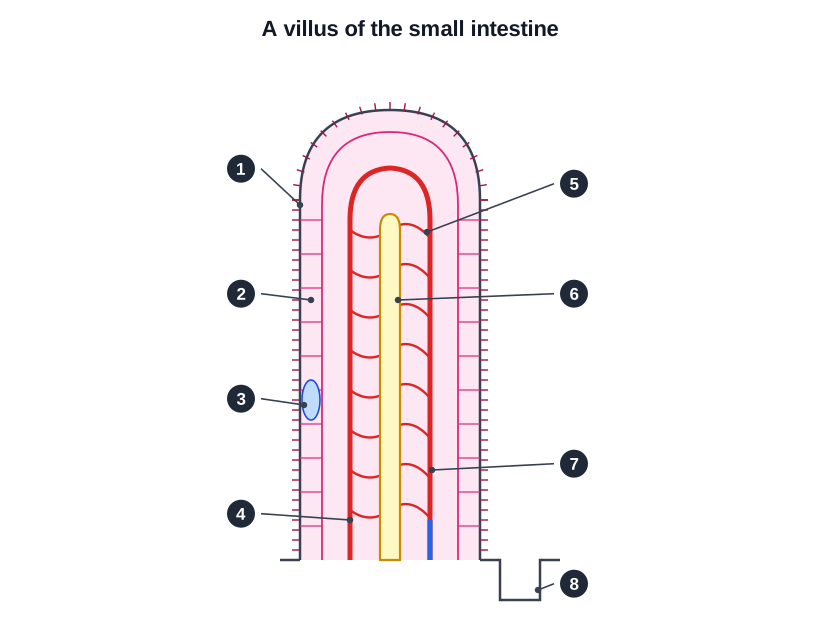
Which structure absorbs dietary fat into the lymphatic system?
Lacteal
Capillary
Hepatic portal vein
Crypt
Fat leaves enterocytes as chylomicrons, which are too large for blood capillaries, so they enter the lacteal.
What does bile do?
Digests proteins
Emulsifies fats
Digests starch
Neutralizes bacteria
Bile salts break fat into small droplets so lipase can work faster. Bile itself contains no digestive enzymes.
Where is bile made?
Gallbladder
Pancreas
Liver
Duodenum
The liver makes bile; the gallbladder only stores and concentrates it. This is a classic trap.
Which organ is NOT part of the alimentary canal?
Esophagus
Pancreas
Stomach
Ileum
The pancreas is an accessory organ: it secretes into the duodenum, but food never passes through it.
Most nutrient absorption takes place in the…
stomach
small intestine
large intestine
esophagus
The small intestine, with its folds, villi and microvilli, has an enormous surface area. The large intestine mainly absorbs water and electrolytes.
Which enzyme is secreted in an inactive form and activated by stomach acid?
Pepsinogen
Trypsinogen
Amylase
Lactase
HCl converts pepsinogen to pepsin. Trypsinogen is also inactive, but it is activated by enteropeptidase in the duodenum, not by acid.
Wave-like muscle contractions that push food along the GI tract are called…
segmentation
peristalsis
emulsification
mastication
Peristalsis propels. Segmentation mixes contents back and forth without moving them much.
Which hormone makes the gallbladder contract?
Secretin
Gastrin
Cholecystokinin (CCK)
Insulin
CCK is released by fat and protein in the duodenum. Secretin mainly stimulates bicarbonate secretion.
True or false: The large intestine produces most of the body's digestive enzymes.
True
False
False. The large intestine secretes mucus, not digestive enzymes. Most enzymes come from the pancreas and the small intestine's brush border.
The stomach wall has an extra muscle layer not found elsewhere in the GI tract. Which one?
Inner oblique
Outer circular
Inner longitudinal
Muscularis mucosae
The inner oblique layer helps the stomach churn food. The rest of the tract has inner circular and outer longitudinal layers.
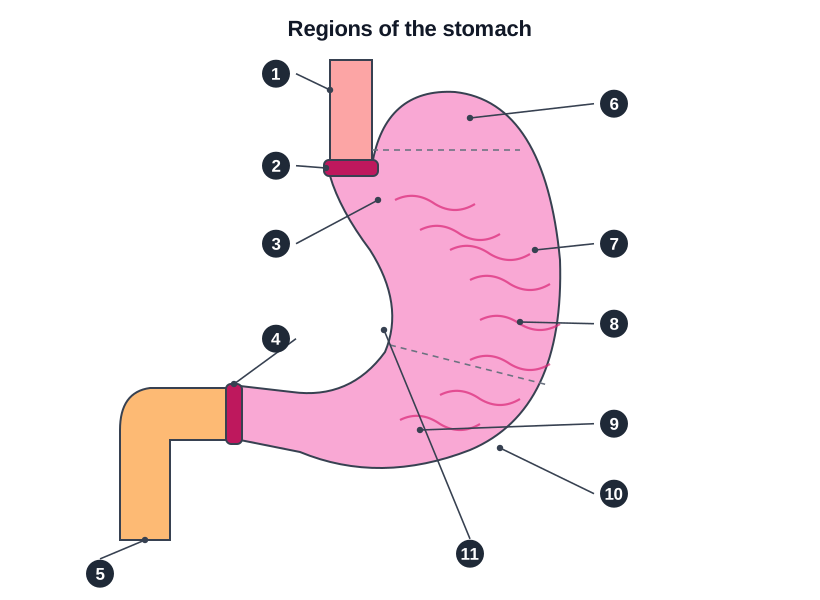
Which structure is labeled 4 in the diagram?
Lower esophageal sphincter
Pyloric sphincter
Ileocecal valve
Cardia
The pyloric sphincter sits between the stomach and the duodenum and controls gastric emptying.
Vitamin B12 absorption requires a protein made in the stomach. What is it?
Pepsin
Gastrin
Intrinsic factor
Mucin
Intrinsic factor from parietal cells binds B12, which is then absorbed in the terminal ileum.
Which vessel carries absorbed nutrients from the intestines to the liver?
Hepatic vein
Hepatic portal vein
Inferior vena cava
Hepatic artery
The hepatic portal vein brings nutrient-rich blood to the liver. The hepatic veins drain the liver into the inferior vena cava.
Which of these is mechanical digestion?
Amylase breaking starch
Bile salts forming micelles
The stomach churning food
Lipase splitting triglycerides
Churning changes the size of food pieces, not their chemistry. Amylase and lipase carry out chemical digestion, and micelles are about carrying fat products to the cells for absorption.
Which bacteria-produced vitamin is absorbed in the colon?
Vitamin C
Vitamin K
Vitamin A
Vitamin D
Colon bacteria make vitamin K (and some B vitamins). Vitamins A and D come from the diet or, for D, the skin.
