Quiz · Medium
Clinical vignettes on Apgar scoring, neonatal GI emergencies, croup and epiglottitis, Kawasaki disease, congenital heart disease and vaccines.
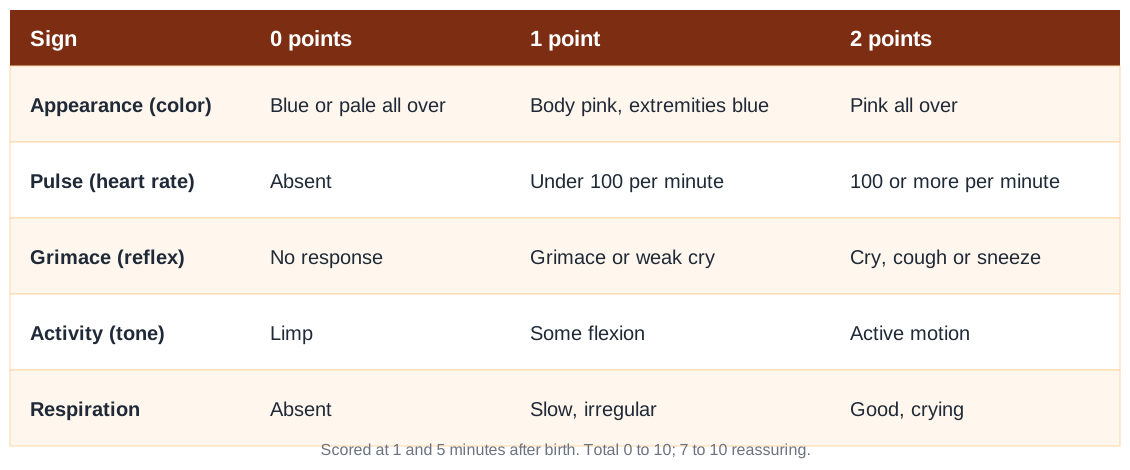
A newborn at 1 minute has a heart rate of 120, a vigorous cry, active motion, and a pink body with blue hands and feet. What is the Apgar score?
9
10
7
8
Appearance 1 (acrocyanosis), pulse 2, grimace 2, activity 2, respiration 2 = 9. Acrocyanosis is common in normal newborns.
Which component of the Apgar score is graded 2 for a heart rate of 100 or more?
Appearance
Pulse
Grimace
Activity
Pulse scores 0 if absent, 1 if under 100, 2 if 100 or more.
A 4-week-old first-born boy has projectile nonbilious vomiting after every feed and a palpable olive-shaped epigastric mass. What lab pattern is expected?
Hyperkalemic acidosis
Hyperchloremic metabolic acidosis
Hypochloremic hypokalemic metabolic alkalosis
Respiratory acidosis
Loss of gastric HCl produces hypochloremic hypokalemic alkalosis. Correct it before pyloromyotomy.
A 10-day-old has bilious vomiting. Which is the most urgent diagnosis to exclude?
Gastroesophageal reflux
Milk allergy
Pyloric stenosis
Malrotation with midgut volvulus
Bilious emesis in a neonate is volvulus until proven otherwise. Pyloric stenosis vomit is nonbilious.
A 2-year-old has a barking cough, stridor and a steeple sign on X-ray. Best treatment?
Dexamethasone
Bronchoscopy
Chest physiotherapy
Antibiotics
Croup is viral. A single dose of corticosteroid reduces airway edema; nebulized epinephrine is added for severe stridor.
A 3-year-old drooling, tripod positioned, with muffled voice and high fever. What is the first priority?
Throat examination with a tongue depressor
Secure the airway
Lateral X-ray in radiology
Start oral amoxicillin
This is epiglottitis. Examining the throat can trigger complete obstruction. Intubate in the OR, then give ceftriaxone.
Which condition presents with fever for 6 days, conjunctival injection, strawberry tongue, cervical lymphadenopathy and swollen hands?
Roseola
Measles
Kawasaki disease
Scarlet fever
These are the Kawasaki criteria. Treat with IVIG and aspirin to prevent coronary aneurysm.
An infant has currant jelly stool, intermittent colicky pain and a sausage-shaped mass. What is the best first test and therapy?
Colonoscopy
Barium swallow
Antibiotics
Ultrasound then air or contrast enema
The target sign on ultrasound confirms intussusception; enema reduction is both diagnostic and therapeutic.
A cyanotic newborn has an 'egg on a string' cardiac silhouette. What immediate treatment keeps him alive?
Prostaglandin E1
Digoxin
Oxygen only
Indomethacin
Transposition of the great arteries depends on shunts (PDA). Prostaglandin E1 keeps the duct open. Indomethacin would close it.
A toddler squats after exertion to relieve cyanotic spells. Which lesion?
VSD
Tetralogy of Fallot
Coarctation
ASD
Squatting raises systemic vascular resistance and reduces the right-to-left shunt in tetralogy of Fallot.
An infant has a continuous machine-like murmur at the left infraclavicular area. Treatment of a symptomatic preterm infant?
Digoxin only
Surgery on day 1
Indomethacin or ibuprofen
Prostaglandin E1
NSAIDs inhibit prostaglandins and close a PDA. Prostaglandin E1 would keep it open.
Which vaccine is a live vaccine?
Hepatitis B
Inactivated polio
DTaP
MMR
MMR is live attenuated. DTaP and hepatitis B are toxoid/recombinant; IPV is inactivated.
At what age should the first MMR dose normally be given?
12 to 15 months
2 years
4 years
6 months
Maternal antibodies interfere with the vaccine before 12 months, though earlier dosing may occur for travel.
Which sign is associated with developmental dysplasia of the hip in newborns?
Trendelenburg gait only
Ortolani clunk
Brudzinski sign
Kernig sign
Ortolani reduces a dislocated hip with an audible clunk. Brudzinski and Kernig signs test for meningitis.
True or false: a 3-year-old with a simple febrile seizure needs routine anticonvulsant prophylaxis.
True
False
False. Simple febrile seizures are benign and do not require anticonvulsants or EEG. Treat the fever source.
A 15-year-old obese boy has knee pain and a limp with an externally rotated leg. Diagnosis?
Septic arthritis
Legg-Calve-Perthes disease
Slipped capital femoral epiphysis
Osgood-Schlatter
SCFE occurs in obese adolescents and needs urgent surgical pinning; the hip pain is often referred to the knee.
A child with Down syndrome has bilious vomiting at birth and a double bubble sign. Diagnosis?
Hirschsprung disease
Intussusception
Pyloric stenosis
Duodenal atresia
Double bubble indicates duodenal atresia, which is strongly associated with trisomy 21.
A 7-year-old has cola-colored urine, hypertension and low C3 two weeks after pharyngitis. What is the diagnosis?
Poststreptococcal glomerulonephritis
IgA nephropathy
Alport syndrome
Minimal change disease
Poststreptococcal GN appears 1 to 3 weeks after infection with low C3. IgA nephropathy follows infection within days and has normal C3.
Which drug should be avoided in a child with varicella?
Acetaminophen
Aspirin
Acyclovir
Oral hydration
Aspirin risks Reye syndrome.
