Quiz · Medium
Foundational questions on flame test colors, group trends, oxides, naming coordination compounds, crystal field basics, unit cells and industrial processes.
What is the oxidation state of cobalt in [Co(NH3)6]Cl3?
+2
+6
0
+3
The three chloride ions are outside the complex, so [Co(NH3)6] is 3+. NH3 is neutral, so cobalt is +3.
Which ion gives this flame color?
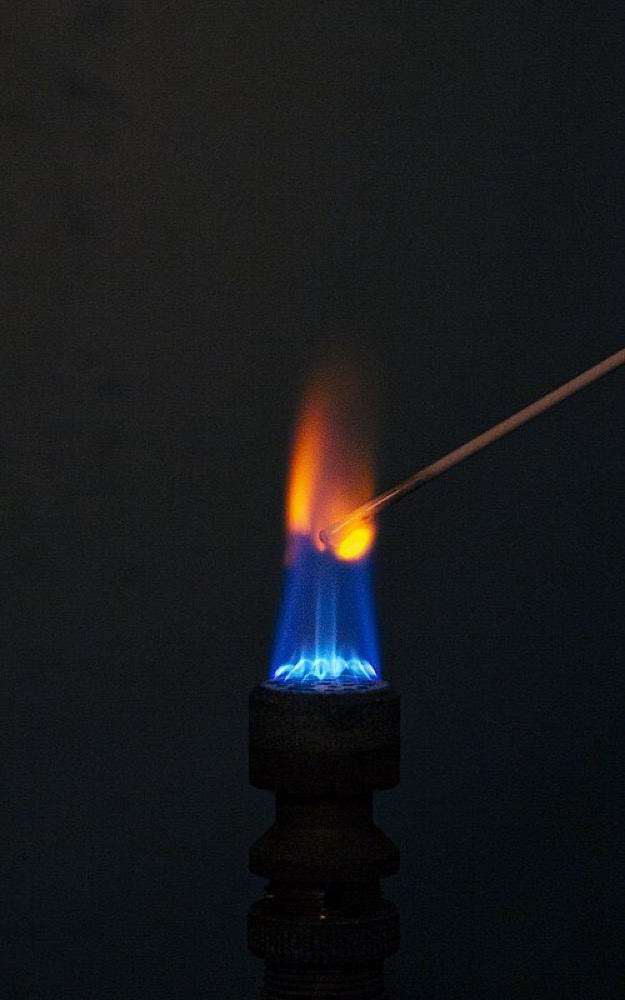
Calcium
Potassium
Sodium
Copper(II)
Calcium gives an orange-red flame. Sodium is a more intense yellow-orange, potassium is lilac and copper is green or blue-green.
Which ion gives this flame color?
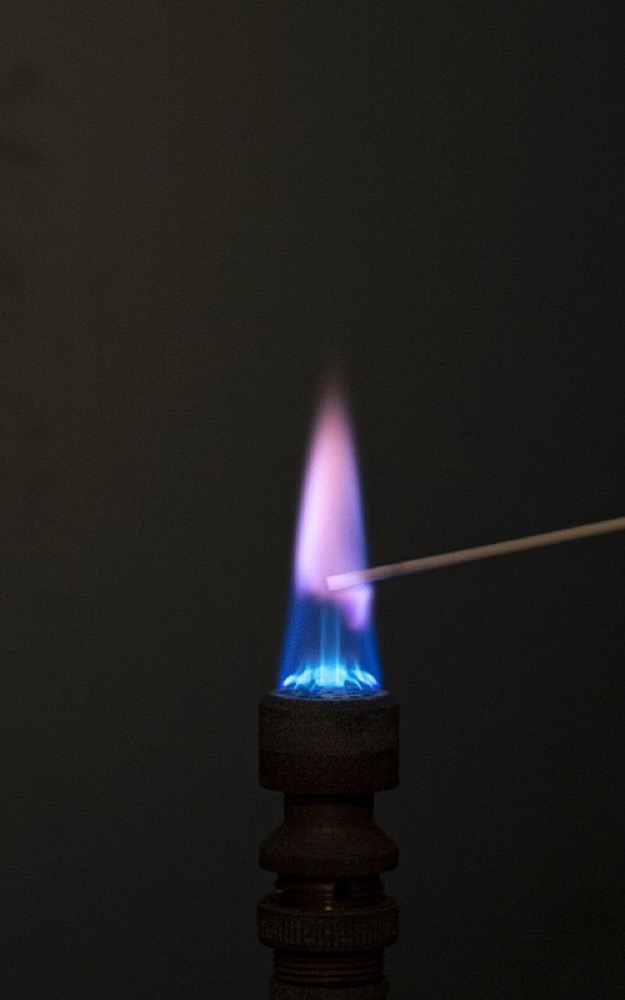
Barium
Potassium
Lithium
Sodium
Potassium gives a pale lilac flame (often seen through cobalt glass to cut out sodium yellow). Lithium is red, barium is green and sodium is yellow.
Which ion gives this flame color?
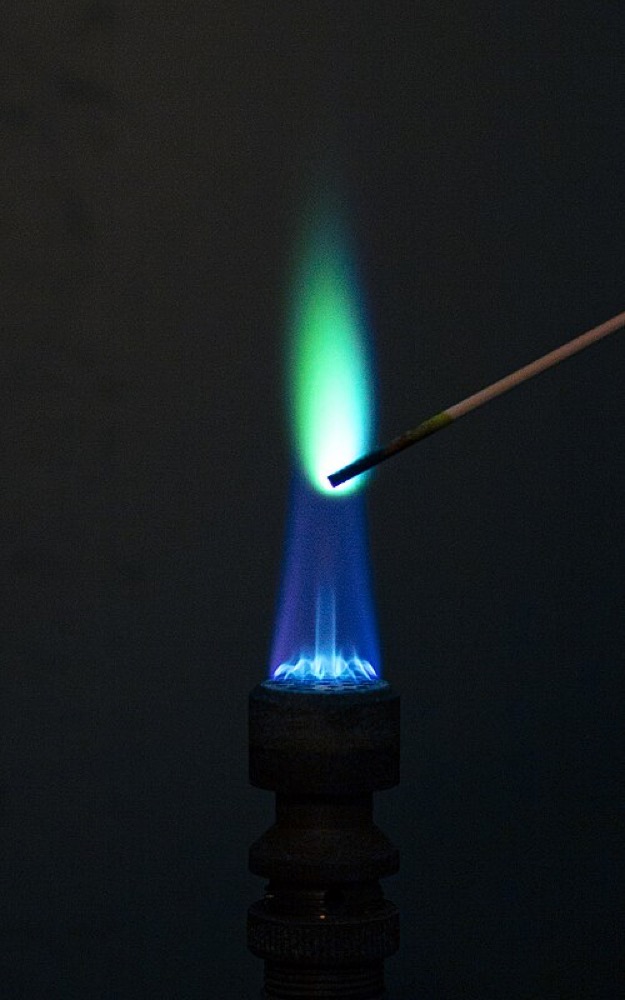
Lithium
Strontium
Copper(II)
Calcium
Copper gives a green or blue-green flame. Strontium and lithium are both red, and calcium is orange-red.
Which trend is correct for group 1 metals going down the group?
First ionization energy decreases
Reactivity with water decreases
Atomic radius decreases
Melting point increases
The outer electron is further from the nucleus and better shielded, so it is easier to remove. Radius increases, melting points decrease and reactivity with water increases.
Which group 2 sulfate is the least soluble in water?
SrSO4
CaSO4
BaSO4
MgSO4
Group 2 sulfate solubility decreases down the group, and BaSO4 is practically insoluble. That is why BaCl2 is used to test for sulfate.
Which halogen is a liquid at room temperature?
Chlorine
Fluorine
Iodine
Bromine
Bromine is a red-brown liquid. Fluorine and chlorine are gases and iodine is a solid.
Which compound is an acidic oxide?
SO3
Al2O3
Na2O
MgO
Oxides of nonmetals such as SO3 give acids with water. Na2O and MgO are basic and Al2O3 is amphoteric.
What is the correct name of K3[Fe(CN)6]?
Potassium hexacyanoferrate(II)
Potassium hexacyanoferrate(III)
Tripotassium iron hexacyanide
Potassium hexacyanoiron(III)
An anionic complex uses the -ate form of the metal (ferrate), and the three K+ balance Fe(III) with six CN- (+3 - 6 = -3).
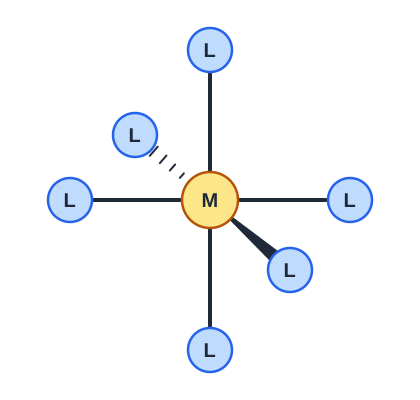
What is the geometry shown here?
Tetrahedral
Trigonal bipyramidal
Square planar
Octahedral
Six ligands around the metal in an octahedral arrangement, coordination number 6.
What does Δo measure?
The ionization energy of the metal
The difference between two ligand sizes
The bond length in an octahedral complex
The energy gap between the t2g and eg sets in an octahedral complex
Δo is the crystal field splitting energy between the lower t2g and upper eg orbitals.
A strong-field ligand typically produces
A large Δo and low-spin complexes
No d orbital splitting
A small Δo and high-spin complexes
Only tetrahedral complexes
Strong-field ligands like CN- and CO give a large splitting, so electrons pair in the lower set (low spin).
Why is [Zn(H2O)6]2+ colorless?
Water absorbs all visible light
Zn2+ is d0
Zn2+ is d10, so no d-d transitions are possible
Zn2+ has too few electrons
With a full d subshell there is no empty d orbital for an electron to move to, so visible light is not absorbed.
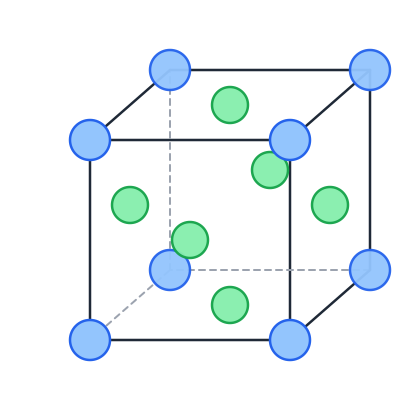
How many atoms belong to one face-centered cubic unit cell?
1
6
2
4
8 corners x 1/8 + 6 face centers x 1/2 = 4.
Which unit cell has the highest packing efficiency among these?
All are identical
Face-centered cubic
Body-centered cubic
Simple cubic
fcc packs 74%, bcc 68% and simple cubic 52%.
In which process is aluminum produced from alumina?
Contact process
Hall-Héroult electrolysis
Blast furnace reduction with CO
Haber process
Aluminum is too reactive to be reduced with carbon, so Al2O3 dissolved in molten cryolite is electrolyzed.
What catalyst is used in the Haber process?
Nickel
Platinum
Iron
Vanadium(V) oxide
Iron (with promoters) catalyzes N2 + 3H2 giving 2NH3. V2O5 is for the Contact process and Pt/Rh for Ostwald.
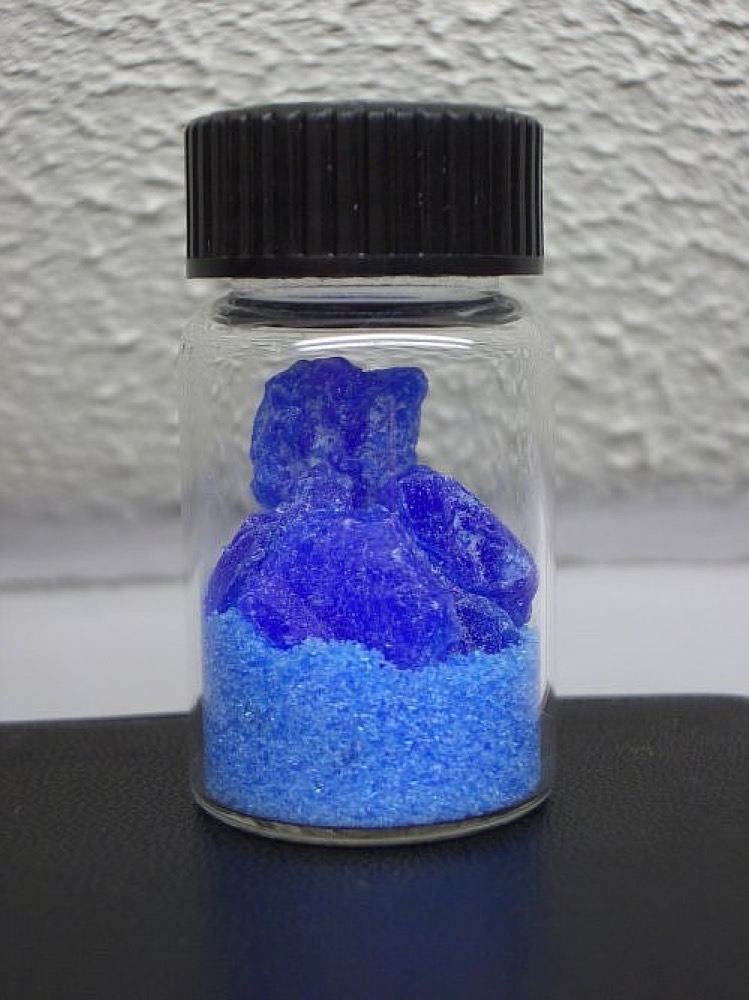
What is the color of anhydrous copper(II) sulfate, and what happens when water is added?
White; it turns blue
Blue; it turns white
Colorless; it stays colorless
Pink; it turns blue
Anhydrous CuSO4 is white and turns blue as the pentahydrate forms, so it is used to test for water.
